 how-to
How to Identify Reliable Peptide Suppliers
Table of Contents
- What Makes Peptide Suppliers Reliable: Core Evaluation Criteria
- Peptide Certificate of Analysis Verification: What to Demand Before You Buy
- How to Read a Peptide CoA: Interpreting HPLC and Mass Spectrometry Data
- Third-Party Peptide Testing Labs: How to Verify Independent Analysis
- Supply Chain Transparency and Shipping Standards for Reliable Peptide Suppliers
- Red Flags That Signal an Unreliable Vendor
- How to Verify Supplier Legitimacy: A Step-by-Step Checklist
- Frequently Asked Questions
Last Updated: August 31, 2026
What Makes Peptide Suppliers Reliable: Core Evaluation Criteria
Identifying reliable peptide suppliers is critical, compromised compounds waste budget, invalidate data, and create safety risks. At Online Peptide Sales, we've built our supply chain around documented purity, verifiable batch identity, and transparent sourcing.
The core question is simple: can this supplier prove what they're selling? Proof means batch-level lab reports, not generic quality statements. Before evaluating pricing or shipping, establish whether vendors meet baseline standards.
Purity Standards and Pharmacopeia Benchmarks
Purity is the percentage of target compound relative to all other substances in a sample. For research-grade peptides, 95% or higher is the minimum for most applications; analytical work often demands 98%+.
The United States Pharmacopeia sets reference standards, and vendors aligning their testing protocols with USP quality standards for pharmaceutical compounds demonstrate commitment to internationally recognized benchmarks. A supplier unable to specify which purity standard they test against is a concern.
Purity claims must be backed by high-performance liquid chromatography data. Any supplier quoting purity without a corresponding HPLC chromatogram is offering an unverifiable assertion.
Legal Status, Regulatory Compliance, and Business Registration
Research peptide suppliers operate in regulated space. In the United States, the FDA oversees compounds intended for human use, but many peptides are sold legally as research chemicals for laboratory use only. Legitimate suppliers make this distinction explicit.
Verify that a vendor has a registered business entity through WHOIS lookup and state business registration databases. Suppliers obscuring corporate structure or operating through anonymous domains present significant risk. The FDA guidance on research chemicals and regulatory compliance provides context on how these compounds are classified.
Peptide Certificate of Analysis Verification: What to Demand Before You Buy
A Certificate of Analysis is a formal document from a testing laboratory confirming a compound's identity, purity, and safety profile for a specific batch. It is analytical evidence, not marketing material.
Every peptide purchase should be preceded by CoA review. If a supplier cannot provide one, stop the evaluation.
A legitimate CoA must include:
- The specific batch or lot number
- Test date and testing laboratory name
- Purity result from HPLC analysis
- Molecular weight confirmation from mass spectrometry
- Contaminant screening results, including endotoxins and heavy metals
- The analytical method used for each test
Batch-Level vs. Spot-Check Testing: Why the Difference Matters
Spot-check testing means a supplier tests one sample from an occasional run and applies results across multiple batches. Batch-level testing means every individual lot is independently analyzed before shipment.
The risk difference is substantial. Batch-level testing enables traceability and accountability; spot checks do not. When a lab receives compromised compound from a spot-check supplier, there is no path to resolution.
Online Peptide Sales provides Janoshik-verified batch reports for identified samples. Janoshik is an established third-party analytical laboratory with reports traceable to specific batches. This is the standard to hold every supplier to.
How to Read a Peptide CoA: Interpreting HPLC and Mass Spectrometry Data
Reading a peptide CoA accurately separates researchers who can independently verify quality from those accepting supplier claims on faith. The two primary analytical methods are high-performance liquid chromatography and mass spectrometry.

Reading HPLC Chromatograms for Purity Levels
An HPLC chromatogram displays peaks corresponding to compounds detected in a sample. The target peptide should produce a single dominant peak. Purity percentage is calculated as the area of that peak divided by total area of all peaks.
What to look for:
- Single dominant peak: Clean chromatogram with one large peak and minimal secondary peaks indicates high purity
- Peak area percentage: Should match the purity claim; if 98% purity is stated, the primary peak should represent 98% of total area
- Retention time: Should be consistent with reference data for that peptide
- Baseline noise: Excessive noise suggests contamination or calibration issues
Multiple significant peaks indicate impurities, synthesis byproducts, or degradation products that could interfere with results.
Using Mass Spectrometry to Confirm Molecular Identity
Mass spectrometry confirms you received the compound you ordered. HPLC indicates purity; mass spectrometry indicates identity.
Check the observed molecular weight versus theoretical molecular weight. These should match within acceptable instrument tolerance, typically 0.1 to 0.5 Daltons. Mismatched values indicate misidentification or structural modification such as oxidation or deamidation, neither acceptable for legitimate research.
Checking for Contaminants, Endotoxins, and Heavy Metals
Contaminant screening is often skipped but critical. Endotoxins, lipopolysaccharides from bacterial cell walls, are particularly concerning for cell-based assays, as trace contamination can trigger inflammatory responses corrupting results.
Heavy metals including lead, arsenic, and cadmium can be introduced during synthesis. Acceptable thresholds are defined by pharmacopeia standards. Legitimate CoAs show endotoxin levels in EU/mg and heavy metal concentrations in parts per million, with values below established limits.
Third-Party Peptide Testing Labs: How to Verify Independent Analysis
Third-party testing means the analytical laboratory has no financial relationship with the supplier. This independence makes the data meaningful.
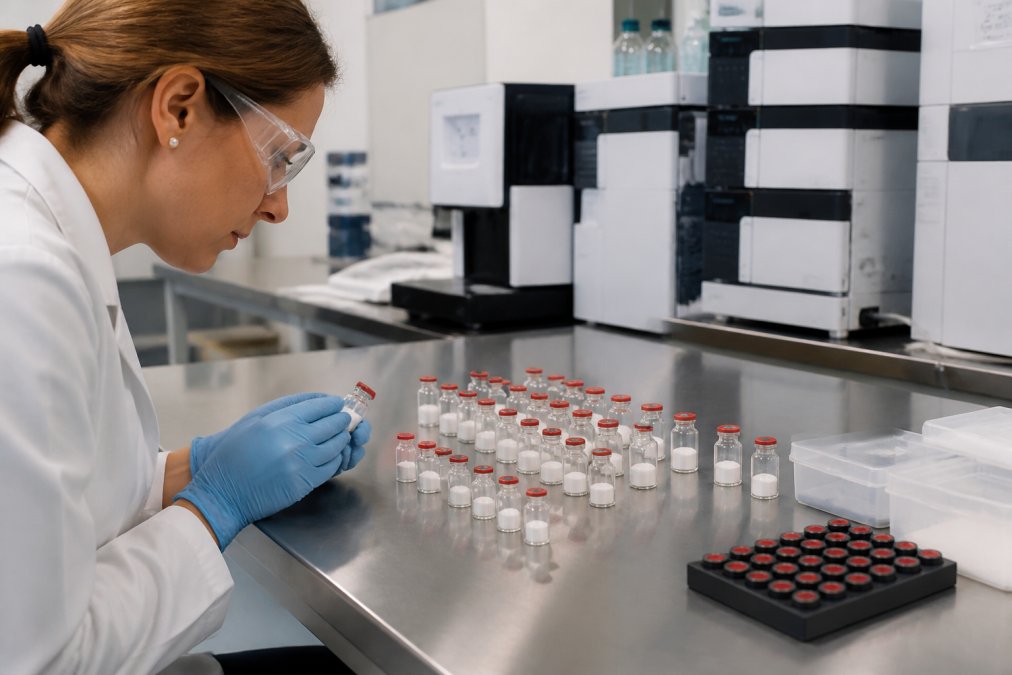
The most common failure is in-house testing presented as independent verification. A supplier running their own lab has a direct conflict of interest. Data may be accurate, but there is no external check.
To verify independent laboratory CoAs:
- Search the testing lab's name independently to confirm separate business entity status
- Check whether lab contact information on the CoA matches their public website
- Look for accreditation reference, such as ISO/IEC 17025, the international standard for testing laboratory competence recognized by NIST's laboratory accreditation resources
- Ask whether you can contact the lab directly to verify the report
Janoshik, the third-party lab used for Online Peptide Sales batch reports, operates as an independent analytical service with reports including the lab's own identification data for straightforward verification.
Supply Chain Transparency and Shipping Standards for Reliable Peptide Suppliers
Supply chain transparency goes beyond website claims. A vendor can publish quality assertions without verifiable connection to manufacturing source. The question is whether documentation traces back to an identifiable factory, actual synthesis run, and specific batch.
Factory-direct sourcing reduces intermediaries between manufacture and delivery, limiting opportunities for product substitution, mislabeling, or improper storage. Online Peptide Sales sources directly from manufacturers, ensuring batch reports correspond to actual production runs.
Cold Chain Shipping, Lyophilized Powder Stability, and Storage Conditions
Lyophilized powder is standard for research peptides because it is significantly more stable than reconstituted solution. Freeze-drying removes water, dramatically extending shelf life and reducing degradation risk during transit.
Proper storage requires:
- Temperatures between -20°C and -80°C for long-term storage
- Protection from humidity and repeated freeze-thaw cycles
- Amber or light-blocking packaging to prevent photodegradation
Cold chain shipping maintains refrigerated or frozen conditions throughout transit. Not every lyophilized peptide requires cold chain shipping, many are stable at ambient temperature for short periods, but suppliers should specify appropriate conditions for each compound.
Tamper-evident seals are evidence that product arrived in the condition it left the facility.
Stability and Degradation Protocols: What to Ask Before Ordering
Stability data tells you how compounds behave over time under defined conditions, directly affecting reproducibility of experimental results.
Ask prospective suppliers:
- What is the documented shelf life in lyophilized form?
- Has stability testing been conducted at intended storage temperature?
- What degradation products form if stored improperly, and are these detected in the CoA?
- What is the recommended reconstitution protocol, and how does it affect stability?
A supplier unable to answer with reference to actual data is not equipped to support serious research procurement.
Red Flags That Signal an Unreliable Vendor
The peptide supplier market includes vendors prioritizing search visibility over analytical rigor. Recognizing warning signs quickly protects research integrity.
| Red Flag | What It Signals |
|---|---|
| No batch-specific CoA available | Spot-check testing at best; no testing at worst |
| CoA issued by the supplier itself | Conflict of interest; no independent verification |
| Purity claimed without HPLC data | Unverifiable assertion |
| No business registration traceable | Anonymous operation; no accountability |
| No response to pre-purchase technical questions | Poor support; likely to disappear post-sale |
| Prices dramatically below market without explanation | Compromised quality or undisclosed sourcing |
| No stability or storage specifications provided | Supply chain gaps affecting product integrity |
| WHOIS shows domain registered recently with privacy protection | Potential fly-by-night operation |
How to Verify Supplier Legitimacy: A Step-by-Step Checklist
Reliable peptide suppliers can be verified systematically. Run every new vendor through this process before placing a first order.
Step 1: Confirm business registration [Time: 15 minutes] Search the supplier's business name in the relevant state's Secretary of State database. Confirm the entity is active and registration date is consistent with claimed operating history.
Step 2: Run a WHOIS lookup on their domain [Time: 5 minutes] Check domain registration date and registrant information. A domain registered six months ago for a company claiming years of experience is a contradiction worth investigating.
Step 3: Request batch-specific CoA documentation before ordering [Time: varies] Ask for the CoA for the specific batch you intend to purchase. Generic documents not tied to lot numbers are not acceptable.
Step 4: Verify the testing laboratory independently [Time: 10 minutes] Search the lab named on the CoA. Confirm it exists as an independent entity and check for ISO/IEC 17025 accreditation.
Step 5: Interpret the HPLC and mass spectrometry data yourself [Time: 20 minutes] Apply the reading criteria from the CoA section above. Do not accept purity numbers without reviewing underlying chromatograms.
Step 6: Assess contaminant screening results [Time: 10 minutes] Confirm endotoxin and heavy metal results are present and fall within acceptable limits.
Step 7: Evaluate shipping and storage specifications [Time: 10 minutes] Confirm the supplier specifies storage conditions, provides tamper-evident packaging, and describes cold chain or ambient shipping protocol.
Step 8: Test customer support responsiveness [Time: 1-2 days] Send a technical pre-purchase question. Response quality, specificity, speed, and accuracy predict post-purchase support. A supplier unable to answer technical questions before sale will not answer after.
Supplier Verification Summary
| Verification Step | Time Required | Pass Criteria |
|---|---|---|
| Business registration check | 15 min | Active entity, consistent history |
| WHOIS domain lookup | 5 min | Domain age matches operating history |
| Batch-specific CoA request | Varies | Lot-numbered document provided |
| Independent lab verification | 10 min | Lab exists separately; accreditation confirmed |
| HPLC chromatogram review | 20 min | Single dominant peak; area matches purity claim |
| Contaminant screening review | 10 min | Endotoxins and heavy metals within limits |
| Shipping/storage confirmation | 10 min | Conditions specified per compound |
| Support responsiveness test | 1-2 days | Specific, accurate technical response |
The verification process takes roughly two to three hours for a new vendor, negligible compared to the cost of failed experiments or compromised studies caused by unverified compounds.
For researchers wanting additional context, the NIH guidelines on research reagent quality and sourcing provide information on why supply chain verification matters in federally funded research.
Frequently Asked Questions
What is a Certificate of Analysis (CoA) in peptide research?
A Certificate of Analysis is a document issued by a testing laboratory that confirms a peptide batch meets specified quality and purity standards. A legitimate CoA reports purity levels from high-performance liquid chromatography (HPLC), molecular weight confirmation from mass spectrometry, and results for contaminants such as endotoxins and heavy metals. For research-grade compounds, the CoA should reference the specific batch number so you can match the document to the exact product you receive.
Why is third-party testing critical for peptide purity?
Third-party peptide testing labs have no financial stake in the outcome, which removes the conflict of interest that exists when a supplier tests its own products. An independent lab applies standardized analytical methods, typically HPLC and mass spectrometry, and issues results the supplier cannot alter. This is the only way to confirm that purity levels and molecular identity claims are accurate. Batch-level third-party testing, rather than periodic spot-checks, gives procurement teams the strongest assurance of consistent quality assurance across every order.
How do I know if a peptide vendor is legitimate?
Start with verifiable business registration records and a WHOIS lookup on the supplier's domain to confirm how long it has been active. Request batch-specific CoAs from an identifiable third-party lab and cross-check the report directly with that lab's public database or contact. Confirm the supplier provides secure, tamper-evident packaging and clear customs documentation for international shipments. Vendors with transparent supply chain information, traceable factory-direct sourcing, and a documented replacement or refund policy for shipment issues are significantly more credible than those offering only generic quality assurance claims.
What shipping and storage standards should reliable peptide suppliers meet?
Lyophilized peptide powder is stable at room temperature for transit when properly sealed, but long-term storage requires controlled conditions, typically -20°C or lower, to prevent degradation. A reliable supplier provides clear reconstitution instructions, shelf life data, and information on stability under different storage conditions. Packaging should be tamper-evident and designed to protect samples during express international shipping. Ask whether the supplier provides cold chain options for temperature-sensitive formulations and whether customs documentation is included to avoid border delays.
Sourcing research-grade peptides without a rigorous verification process is a risk most labs cannot afford. Online Peptide Sales addresses the core supply chain concerns directly: Janoshik-verified batch reports for identified samples, factory-direct sourcing from manufacturers, tamper-evident packaging, and express international shipping. View batch lab reports to assess documentation quality before committing to an order.