 how-to
How to Read COA Documents: A Step-by-Step Guide
Table of Contents
- What is a Certificate of Analysis?
- Why a COA Matters for Research Compounds
- How to Read COA Documents: The Essential Sections
- How to Verify Peptide Purity Using COA Data
- Understanding HPLC and MS Results in Peptides
- How to Spot Fake COA Documents
- Red Flags That Signal an Unreliable COA
- Frequently Asked Questions
Last Updated: September 22, 2026
What is a Certificate of Analysis?
A Certificate of Analysis (COA) is an official document that reports the results of laboratory testing on a research compound sample. It shows what's actually in the product, how pure it is, and whether it contains any contaminants. Think of it as a lab's official report card for a batch of peptides.
Every COA includes the sample identification, test results, and the lab's stamp of approval. When you're buying research compounds, the COA is your proof that the product matches what the seller claims. Without it, you're buying blind.
Why a COA Matters for Research Compounds
Your research depends on knowing exactly what you're working with. A COA gives you that certainty.
When you run an experiment, every variable matters. If your peptide sample contains impurities or falls short on potency, your entire study gets compromised. You waste time, money, and resources on results that don't reflect the compound's true properties. A proper COA prevents that disaster.
The COA also protects you legally. If something goes wrong, you have documented proof of what you received. This matters especially for regulated research. Many institutional review boards and lab safety protocols require batch verification before work begins.
At Online Peptide Sales, we provide Janoshik-verified batch reports for identified samples. This third-party verification adds a layer of credibility that internal lab reports alone cannot match.
How to Read COA Documents: The Essential Sections
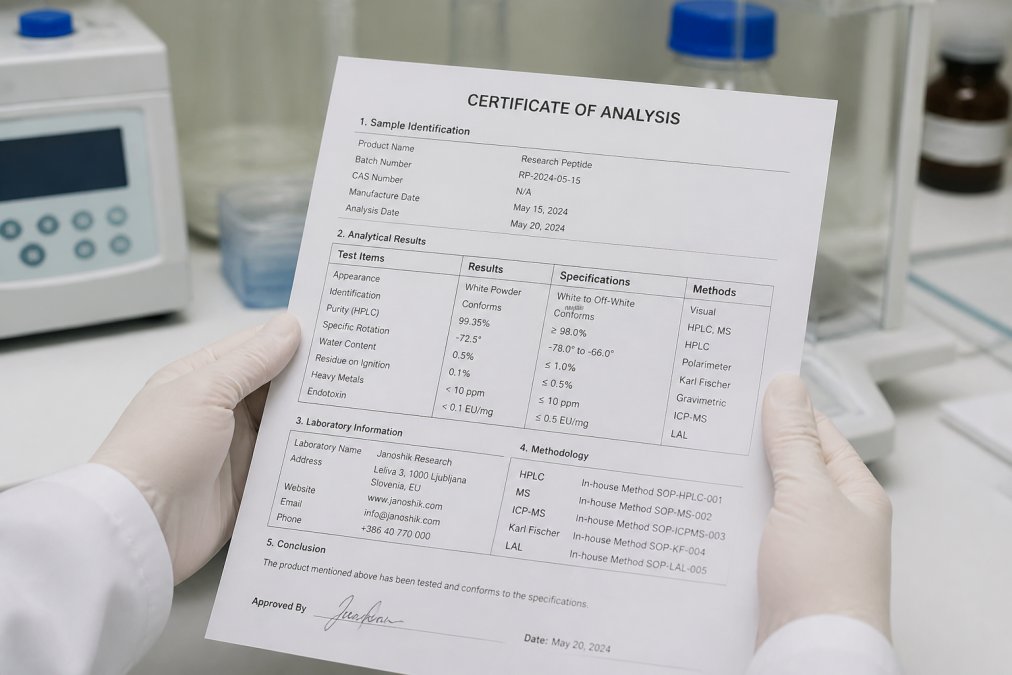
A COA typically contains five key areas. Learning to read each one takes minutes, but it saves you from costly mistakes.
Sample Identification and Batch Information
The first section identifies which product you're looking at. It includes:
- Product name, the peptide or compound being tested
- Batch number (Lot number), the specific production run
- Manufacturing date, when the batch was made
- Expiration date, when the product degrades or loses stability
Always match the batch number on your COA to the batch number on your vial.
Analytical Parameters and Specification Limits
This section shows what the lab actually measured and what the acceptable range is. It is the heart of the COA.
- Potency/Purity, the percentage of active compound (e.g., 98.5% purity)
- Moisture content, water in the sample (matters for stability and shelf life)
- Heavy metals, contaminant screening for lead, cadmium, mercury, and arsenic
- Microbial analysis, bacterial or fungal contamination counts
- Residual solvents, leftover chemicals from manufacturing (acetone, ethanol, etc.)
- Identity confirmation, often via HPLC or mass spectrometry to confirm the compound is what it claims to be
Always check whether results meet or exceed specifications.
Testing Laboratory and Accreditation
Not all labs are equal. The lab's credentials matter more than the results themselves.
Look for these markers of credibility:
- ISO 17025 certification, the international standard for testing laboratories; proves the lab follows standardized quality procedures
- Lab name, full address, and phone number, reputable labs publish complete contact information
- Accreditation body, which organization verified the lab (e.g., A2LA, ILAC member)
- Test methods used, the specific procedure (HPLC, mass spectrometry, ICP-MS, etc.) and reference standards
- Analyst signature or initials, indicates individual accountability
Test Methodology and Reference Standards
The method section explains how the lab performed each test. This matters because different methods can produce different results.
HPLC (High-Performance Liquid Chromatography) is the standard for purity testing. The report should specify:
- The column type and dimensions
- The solvent system (mobile phase)
- The detection wavelength
- The reference standard used for comparison
Mass spectrometry (MS) identifies what impurities actually are by measuring molecular weight. Look for:
- The ionization method (ESI, MALDI, etc.)
- The mass range scanned
- Whether a reference standard was run alongside the sample
How to Verify Peptide Purity Using COA Data
Purity is the single most important number on a COA for research compounds.
Understanding HPLC and MS Results in Peptides
Two main testing methods appear on peptide COAs: HPLC and mass spectrometry (MS).
When reading HPLC results:
- Look for a single dominant peak (your peptide)
- Small peaks should be labeled as known impurities or residue
- The chromatogram (graph) should be clean, not cluttered with mystery peaks
- The retention time should match previous batches of the same peptide
How to Spot Fake COA Documents
Fake COAs exist. Suppliers sometimes fabricate reports to sell low-quality, misidentified, or counterfeit compounds. However, not all suspicious COAs are outright forgeries, some are real but indicate poor quality or risky sourcing. Learning to distinguish between the two protects your research.
Tier 1: Signs of Document Forgery
These indicators suggest the COA itself is fabricated or tampered with:
- No lab name, address, or contact information, legitimate labs identify themselves fully and welcome verification calls
- No accreditation listed or vague claims ("certified" without naming the certifying body), real labs proudly display ISO 17025 or equivalent credentials
- Blurry, pixelated, or obviously edited document, suggests digital tampering or photocopying of a photocopy
- Generic template appearance, looks like it was created in Microsoft Word with a standard table, not generated by lab software
- No batch number, manufacturing date, or expiration date, makes it impossible to verify or trace
- Analyst signature missing or illegible, removes individual accountability
- Lab logo or watermark that appears low-resolution or inconsistent across multiple COAs from the same lab
- Results with impossible precision (e.g., "99.999% purity" for a peptide), real labs report 1-2 decimal places
- No test methodology section, real reports explain exactly how testing was done, what equipment was used, and what reference standards were compared
Tier 2: Signs of Poor Quality or Risky Sourcing
These COAs are real but indicate quality-control problems or inconsistent sourcing:
- Specification limits significantly wider than industry standard, suggests the lab set easy targets to ensure passing results (e.g., a purity spec of 90-105% when 95-102% is typical)
- No heavy metals or microbial testing listed, incomplete analysis hides potential problems
- Batch numbers that don't follow a logical sequence across multiple purchases from the same supplier (e.g., random alphanumeric strings instead of sequential numbers), suggests fabricated documentation or sourcing from multiple unvetted suppliers
- Expiration dates far in the future (e.g., 5+ years from manufacturing), unrealistic for peptides and signals guessing rather than stability data
- Results with no decimal precision ("98%" instead of "98.3%"), looks rounded and suspicious; real labs report measured values
- Different lab names on successive batches from the same supplier, indicates inconsistent sourcing or switching labs to avoid accountability
- No contact method for the testing lab (no phone, email, or website), makes follow-up verification impossible
- Specification limits that match the actual results exactly (e.g., spec is 98-102% and result is exactly 100%), statistically unlikely and suggests the lab worked backward from a desired result
- Missing reference standard information, the COA doesn't state what the lab compared the sample against, making results unverifiable
- Moisture content listed as "<0.5%" with no actual number, vague reporting hides potential instability
Verification Checklist
Before accepting a COA, verify these items:
- Batch number on COA matches batch number on the physical vial
- Lab name and address are listed and verifiable via independent web search
- ISO 17025 accreditation or equivalent is stated and the accrediting body is named
- [ ]
- [ ]
- Purity/potency result includes at least one decimal place
- Heavy metals and microbial testing are included
- Test methodology section explains the procedure, equipment, and reference standards
- Analyst signature or initials are present
- Lab contact information (phone or email) is provided
- Results fall within specification limits
If any item is missing, contact the supplier or lab before proceeding. A legitimate supplier welcomes verification and can provide missing details within 24 hours.
Red Flags That Signal an Unreliable COA
Beyond obvious fakes, some COAs are real but indicate poor quality or risky sourcing.
Red flag indicators:
- Specification limits wider than industry standard, suggests the lab set easy targets to ensure passing results
- No heavy metals or microbial testing, incomplete analysis hides potential problems
- Batch numbers that don't follow a logical sequence, suggests fabricated documentation
- Expiration dates far in the future, unrealistic for peptides, signals guessing
- Results with no decimal precision, "98%" instead of "98.3%" looks rounded and suspicious
- Different lab names on successive batches, inconsistent sourcing raises questions
- No contact method for the testing lab, makes follow-up verification impossible
Frequently Asked Questions
What are the most critical sections to check when reading a COA for peptides?
Focus on four areas: sample identification (batch and lot numbers), analytical parameters (purity percentage and potency results), specification limits (acceptable ranges), and third-party lab accreditation. Verify that batch numbers match your order, purity results meet your protocol requirements, and the testing laboratory is recognized for peptide analysis. Missing or mismatched information in any of these areas warrants contacting your supplier before using the compound.
How do I know if a COA is from legitimate third-party testing?
Verify the testing laboratory's name and credentials on the document. Look for ISO certification, accreditation from recognized bodies, and contact information you can independently confirm. Legitimate labs display their credentials prominently and allow verification of their testing methods. Cross-reference the lab name with industry directories. Janoshik-verified reports, for example, come from an established third-party testing provider. Be skeptical of COAs listing only a generic lab name or providing no way to verify the lab's legitimacy.
What does it mean if the analytical results fall outside the specification limits on a COA?
Specification limits define the acceptable range for purity, potency, and contaminant levels. Results outside these limits indicate the batch does not meet quality standards for your intended use. This could mean the compound is degraded, contaminated with heavy metals or pesticide residue, or fails microbial analysis. Do not use the batch. Contact your supplier immediately for a replacement or refund. Results consistently outside limits from the same supplier signal a supply chain problem.
Can I use a COA from the manufacturer instead of a third-party tested report?
Manufacturer COAs are less reliable for research purposes. Third-party testing provides independent verification of potency, purity, and contaminant screening. For rigorous research protocols, third-party COAs reduce bias and strengthen the credibility of your results. Many institutional review boards and funding agencies require third-party verification. When sourcing research compounds, always request third-party tested batches, particularly for studies requiring compliance documentation.