 ultimate-guide
Research Peptide Shipping Customs Guide: 2026 Steps
Table of Contents
- What You'll Need Before Your Peptides Ship
- FDA Import Requirements for Research Chemicals
- Step-by-Step Customs Clearance for Peptide Shipping Customs
- Carrier-Specific Protocols and Cold-Chain Shipping
- Risks of Buying Grey Market Peptides
- Peptide Customs Seizure Process and Post-Seizure Protocol
- Frequently Asked Questions
Last Updated: September 10, 2026
What You'll Need Before Your Peptides Ship
Research peptide shipping customs guide compliance starts long before a parcel leaves the warehouse. Most seizures trace back to paperwork gaps, not the compounds themselves. Online Peptide Sales ships 10-vial research kits internationally, which provides insight into common documentation challenges. Before anything moves, you need three things locked: a supplier who provides batch-level verification, a complete import documentation set, and a realistic understanding of how border control evaluates research chemicals.
What separates a clean clearance from a two-week hold comes down to preparation. Below, we'll walk through the exact documentation, labeling, and carrier protocols that keep peptide shipping customs clearance predictable.
Documentation Checklist for Import
The documents below form the minimum set for a research compound shipment. Missing any one of them is the most common reason parcels stall at inspection.
- Commercial invoice with harmonized system codes and declared value
- Certificate of analysis (CoA) tied to the specific batch number
- Safety data sheet for each compound
- Packing list matching vial count to the manifest
- Research-use-only labeling on the outer and inner packaging
- Importer identity and institutional affiliation, where applicable
A common mistake is treating the CoA as optional. It is the single document border control uses to confirm what the shipment actually contains.
Choosing a Compliant Supplier
Supplier quality decides your customs experience before your parcel ever reaches a port. A supplier who provides batch-specific third-party reports, tamper-evident packaging, and accurate commercial invoices removes most clearance friction. Online Peptide Sales provides Janoshik-verified batch reports for identified samples, offering a verifiable document trail.
Ask any supplier three questions: Is verification batch-specific or spot-checked? Will they correct a commercial invoice error after shipment? What happens if a parcel is held? The answers separate a supply chain partner from a reseller.
FDA Import Requirements for Research Chemicals
The FDA treats research chemicals as a distinct category from approved drugs, and that distinction drives every labeling and documentation decision. Compounds intended for laboratory research, not human use, fall under different import scrutiny than finished pharmaceuticals. This is the core of FDA import requirements for research chemicals: the shipment must clearly and consistently declare its research-only purpose.
Research-Use-Only Status and Labeling
Research-use-only status is a labeling and documentation designation, not a legal shield. It signals that the compound is not intended for human consumption, and it must appear consistently across the CoA, invoice, and physical packaging. Inconsistent labeling invites inspection.
A frequent error is a shipment labeled RUO on the vial but described as a "supplement" on the customs form. That contradiction is a seizure trigger. Everything must align.
FDA guidance on imports of research chemicals
Harmonized System Codes and Declaration of Value
Harmonized system codes classify the shipment for duty and screening. Research peptides typically fall under codes for organic compounds or laboratory reagents, and the correct code depends on the specific substance. Under-declaring value to reduce import duties is a serious mistake: it creates a documentation mismatch that border control flags immediately.
Declare the true transaction value. Accurate declaration of value is a compliance requirement, not a negotiable line item.
Step-by-Step Customs Clearance for Peptide Shipping Customs
Customs clearance for research peptides follows a predictable sequence once documentation is correct. The steps below reflect how a compliant shipment moves from arrival to release.
Step 1: Verify Import Documentation
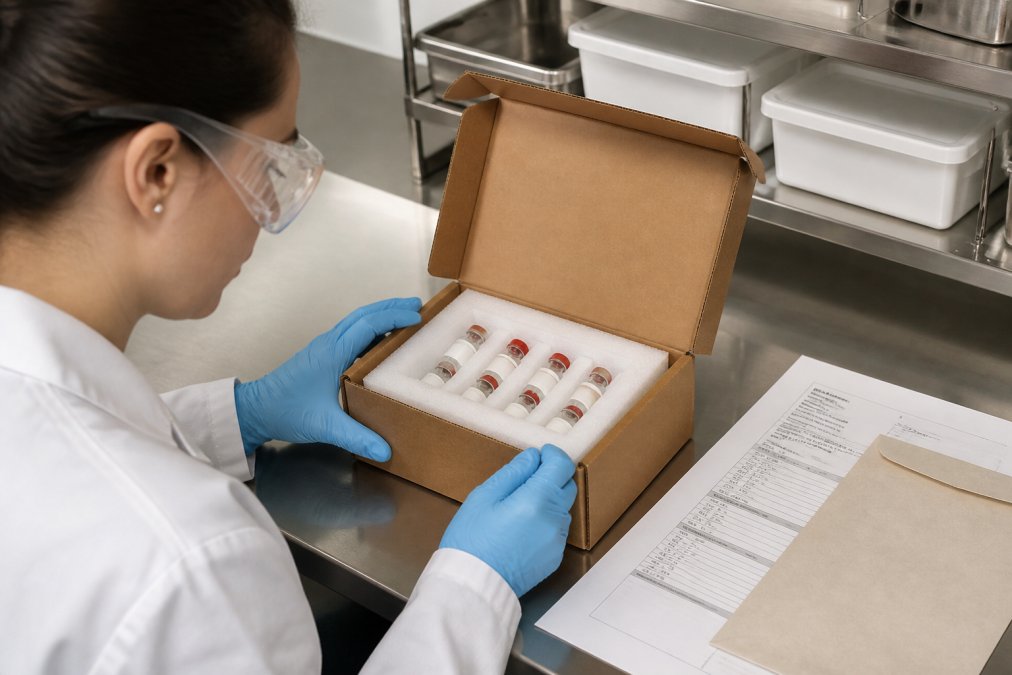
Confirm every document matches before the parcel arrives. The invoice, CoA, packing list, and manifest must agree on compound name, batch number, quantity, and declared value. One mismatch triggers a hold.
Expected result: a documentation set with zero discrepancies.
Step 2: Prepare the Shipping Manifest and Certificate of Analysis
The shipping manifest lists contents for border control, and the CoA proves identity and purity. Attach the batch-specific CoA to the manifest so an inspector can match vial to report without requesting more information. Shipments that arrive with the CoA already attached clear faster.
Step 3: Respond to Border Control Holds
If a parcel is held, respond with the requested document within the stated window. Border control holds usually request the CoA, invoice, or an end-use statement. A supplier who can produce corrected paperwork quickly is valuable for efficient customs clearance.
Carrier-Specific Protocols and Cold-Chain Shipping
Couriers layer their own restricted-item and handling policies on top of customs rules, and those policies differ enough that the carrier you pick can decide whether a parcel ever reaches a border officer. A carrier rejection at origin looks identical to a customs seizure on your tracking page, so confirm eligibility before you book.
How the Major Carriers Differ
- FedEx: Treats many research chemicals and biological materials as restricted or requiring advance approval. Shipments to residential addresses may be refused or held for account review. FedEx generally wants the commercial invoice and a clear description of contents uploaded electronically before pickup.
- UPS: Applies a restricted-commodity list and often requires a business or institutional address for anything flagged as a chemical or biological substance. UPS customs brokerage will contact the importer directly when documentation is incomplete, which can add a day or more to clearance.
- DHL: The most explicit of the three about requiring advance documentation for biological and chemical shipments. DHL frequently requires a proforma or commercial invoice plus a safety data sheet before the parcel is accepted, and will reject undeclared research chemicals at the counter.
- USPS: Cheapest option, but the weakest tracking and the least predictable handoff to customs. For temperature-sensitive or high-value research kits, the cost savings rarely justify the loss of visibility.
A common pattern is that the same shipment clears cleanly with one carrier and stalls with another purely because of how each one files the advance manifest. If a supplier has a preferred carrier, ask why, it usually reflects which one accepts their documentation format without friction.
Cold-Chain Mechanics for Peptide Stability
Many research peptides degrade outside a narrow temperature band, so transit time and packaging matter as much as paperwork.
- Gel packs vs. dry ice: Gel packs hold a stable refrigerated range for roughly 24-48 hours depending on ambient temperature and box insulation (the CDC). Dry ice holds frozen range longer but is itself a regulated material for air transport and must be declared.
- Insulated liners: Vacuum-insulated panels extend the hold time significantly over standard foam. For multi-day international transit, the liner choice is the single biggest variable in whether the compound arrives intact.
- Labeling: Mark temperature-controlled parcels clearly so they are not left on a hot tarmac or in a sorting facility. An unlabeled cold-chain box is treated like any other parcel.
- Seasonal timing: Summer and winter transits stress the cold chain hardest. Where possible, avoid shipping temperature-sensitive kits into extreme-weather windows.
Pre-Booking Checklist
Before you hand a parcel to any carrier, confirm four things: the compound is not on that carrier's restricted list, the destination address type is accepted, the cold-chain packaging is rated for the expected transit time, and the advance manifest and invoice are uploaded. Skipping any one of these is the most common reason a compliant shipment never reaches customs at all.
| Carrier Consideration | What to Confirm | Impact If Ignored |
|---|---|---|
| Restricted item list | Research chemical eligibility | Parcel refused at origin |
| Address type | Business vs. residential | Delivery failure |
| Cold-chain handling | Insulation rating and labeling | Degraded compound |
| Documentation upload | Advance manifest submission | Customs delay |
| Seasonal timing | Extreme-weather windows | Cold-chain failure |
Risks of Buying Grey Market Peptides
Grey market peptides carry risks that go beyond legal exposure. The compounds may lack batch verification, arrive with no CoA, or be mislabeled. When a shipment has no verifiable documentation, it is far more likely to be seized, and there is no recourse once it is gone.
The bigger risk is scientific. An unverified compound can invalidate an entire study. If you cannot trace a batch to a third-party analytical report, you cannot defend your results. The risks of buying grey market peptides ultimately land on your data, not just your budget.
Peptide Customs Seizure Process and Post-Seizure Protocol
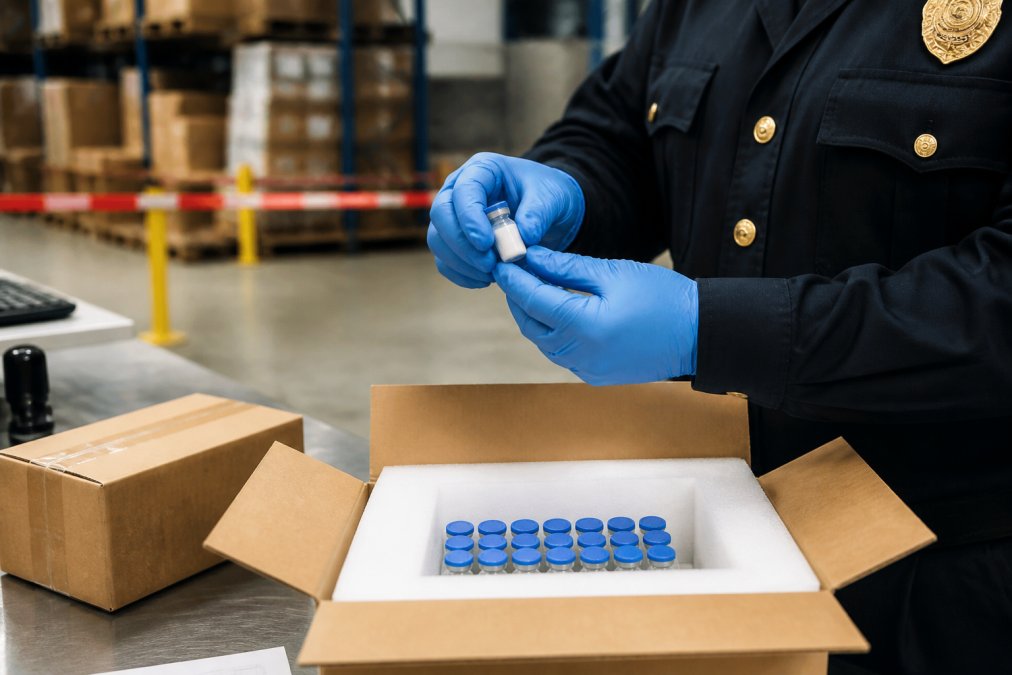
The peptide customs seizure process almost never starts with confiscation. It starts with a detention notice. Border control detains the shipment, issues a notice stating the reason, and gives the importer a defined window to respond with documentation. If the response is adequate, the parcel is released. If it is missing or inadequate, the shipment is seized and eventually destroyed. The difference between the two outcomes is usually how fast and how completely you respond.
Detention vs. Seizure: Know Which One You Have
- Detention: The shipment is held pending information. You can still resolve it. The notice will cite a specific reason, missing CoA, value discrepancy, unclear end use, or a labeling mismatch.
- Seizure: The shipment has been formally taken. At this point the product is generally not recoverable, and the focus shifts to documentation for any appeal and to preventing a repeat.
Most holds researchers encounter are detentions, not seizures. Treating a detention like a seizure, or ignoring it, is what converts one into the other.
Step-by-Step Response Protocol
- Read the notice and identify the cited reason. The notice tells you exactly what is missing or inconsistent. Respond to that specific point, not to everything at once.
- Contact your supplier immediately. Request the full documentation set: batch-specific CoA, corrected commercial invoice, safety data sheet, and packing list. A supplier who can produce corrected paperwork within a day is valuable for efficient customs clearance.
- Assemble a complete response. Match compound name, batch number, quantity, and declared value across every document. One mismatch re-triggers the hold.
- Submit within the stated window. Response windows are short. Late responses are treated as no response.
- Include an end-use statement if requested. A clear statement that the material is for laboratory research, not human use, resolves many end-use questions.
- Track the response. Follow up through the carrier's brokerage or the relevant agency contact listed on the notice.
What to Do If the Shipment Is Seized
Once a shipment is formally seized, recovery is rare. The practical moves are: document everything for your records, request the formal seizure notice in writing, and review what triggered it so the next shipment does not repeat the error. If your supplier offers a delivery guarantee with replacement or refund, this is the point where that guarantee matters. If they do not, the loss is yours.
Preventing the Next Hold
After any detention or seizure, audit the documentation set against the checklist at the top of this guide. The recurring causes are almost always the same: a CoA that does not match the batch, a declared value that does not match the invoice, or RUO labeling that contradicts the customs description. Fix the root cause, not just the individual parcel.
CBP guidance on detained and seized shipments
Frequently Asked Questions
Can peptides go through customs?
Yes, research peptides can go through customs if they are properly declared as research-use-only materials and accompanied by correct documentation, including a certificate of analysis and harmonized system codes. Shipments must comply with FDA import requirements for research chemicals. Packages that lack proper labeling or contain controlled substances face higher seizure risk. Working with a supplier that provides Janoshik-verified batch reports and secure export packaging reduces the chance of delays at border control.
Will customs confiscate peptides?
Customs may confiscate peptides if they are mislabeled, lack required import documentation, or are deemed unapproved for personal importation. The peptide customs seizure process typically begins with a hold notice, followed by a formal seizure letter. Once seized, you can file a petition for release or abandon the shipment. To avoid confiscation, ensure your supplier includes a certificate of analysis, accurate declaration of value, and research-use-only labeling on every vial.
How are peptides supposed to be shipped?
Research peptides should be shipped in tamper-evident, secure export packaging with cold-chain shipping when required for peptide stability. International freight should include a shipping manifest, certificate of analysis, and proper harmonized system codes. Express couriers with established courier protocols handle most shipments, but you should confirm carrier-specific restrictions. Temperature-sensitive logistics, such as insulated liners or gel packs, help maintain peptide integrity during transit time.
What are the legal requirements for importing research chemicals?
Importing research chemicals legally requires compliance with FDA import requirements, including accurate customs declaration, research-use-only labeling, and a certificate of analysis for each batch. You must also ensure the compounds are not on controlled substances lists. Personal importation is generally not permitted for unapproved research chemicals. Commercial importation requires a registered entity and may need a customs brokerage to handle regulatory compliance and import duties.