 ultimate-guide
Understanding Janoshik Peptide Batch Reports: A Guide
Table of Contents
- What a Janoshik Peptide Batch Report Actually Tells You
- How to Verify Peptide Purity on a Certificate of Analysis
- HPLC vs LC-MS Peptide Testing: What Each Method Confirms
- How to Check Janoshik Report Authenticity and Spot Tampering
- What the Report Does Not Test For: Sterility and Endotoxins
- Batch Tested vs Vial Tested: The Difference That Matters
- Conclusion: Make Batch Reports Part of Your Verification Protocol
- Frequently Asked Questions
Last Updated: September 9, 2026
Janoshik peptide batch reports are third-party Certificates of Analysis (COAs) documenting the purity and identity of a specific peptide batch through HPLC and LC-MS testing. For researchers, it is the primary evidence that a compound meets its labeled specification. This guide from Online Peptide Sales explains how to read these reports critically, verify their authenticity, and understand what they do and do not confirm.
Most buyers check that a purity percentage looks high and move on, but a report is only useful if you can trace it to the batch in your hand, confirm the analytical methods are appropriate, and rule out tampering. Below, we break down each section of a typical report and highlight the gaps that even legitimate reports leave open.
What a Janoshik Peptide Batch Report Actually Tells You
A Janoshik peptide batch report documents the identity and purity of a specific peptide batch using validated analytical chemistry methods.
The report centers on two analytical techniques: HPLC (high-performance liquid chromatography) and LC-MS (liquid chromatography-mass spectrometry). HPLC separates the sample and quantifies the main peptide peak, while LC-MS confirms the molecular weight. Together, they address the two questions researchers care about: "Is it pure?" and "Is it the right molecule?"
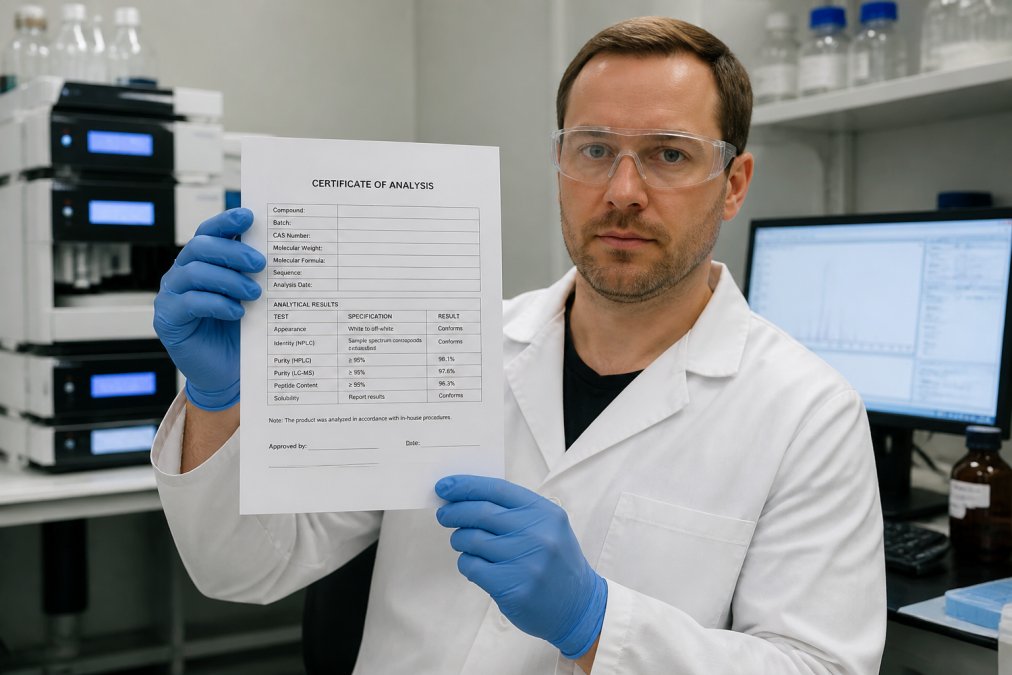
A common mistake is treating the report as a general quality guarantee. It is not; it is a snapshot of one identified sample from one batch, tested at one point in time.
How to Verify Peptide Purity on a Certificate of Analysis
Verifying peptide purity on a Certificate of Analysis starts with locating the purity percentage and confirming it matches the expected specification for your compound, typically above 98% for research-grade peptides. The purity figure is reported as an area percentage from the HPLC chromatogram (PubMed).
To verify peptide purity properly, check three things: confirm the batch number on the COA matches the batch number on your vial labels; review the HPLC conditions to ensure the method is appropriate; and examine the chromatogram for a clean single peak rather than shoulders or multiple peaks that indicate impurities.
The purity percentage alone tells you little about sample integrity. A high percentage from a poorly resolved chromatogram is less reliable than a slightly lower percentage from a clean, well-separated run, so the chromatogram image matters as much as the number.
Reading the Chromatogram Like a Chemist
Most guides stop at “check for a single peak,” but that is where the real analysis begins. A chromatogram is a plot of detector response over time, and the x-axis (retention time) is where the story unfolds. For a peptide like semaglutide, the main peak should appear at a consistent retention time, typically between 8 and 12 minutes on a C18 column with a standard acetonitrile/water gradient, but the exact time depends on the method parameters listed in the report header (peer-reviewed research).
What you are looking for is peak symmetry and baseline resolution. A clean sample shows a single, sharp, symmetrical peak that returns to baseline before and after elution. Impurities reveal themselves in three visual patterns:
- Shoulders: A bump on the leading or trailing edge of the main peak indicates a closely related impurity that did not fully separate, often from oxidized or deamidated variants.
- Ridge splitting: A visible notch or dip at the apex of the main peak suggests two compounds co-eluting at nearly identical retention times, inflating the reported purity percentage if the integration software merged both signals.
- Baseline drift or extra peaks: Small peaks before the main peak (truncated sequences) or after it (aggregation products) indicate the sample contains more than just the target compound. A purity of 98% with three impurity peaks is chemically different from one with a single impurity peak.
Why Integration Parameters Matter
The purity percentage is not measured directly; it is calculated by integration software that draws a baseline under the peaks and sums the areas. The way the software sets that baseline can change the result by several percentage points. A report that lists the integration method gives you more confidence than one that omits it. A rising baseline under the main peak may exclude part of the peak area, lowering purity, or include a broad impurity hump, inflating it.
The 98% Threshold Is Not Universal
Another layer of verification is knowing what purity level is actually meaningful for your peptide. While 98% is a common benchmark, longer peptides (over 30 amino acids) or those with disulfide bonds often show lower achievable purity due to oxidation or misfolding. A report claiming 99.5% purity for a complex peptide like a 40-mer should prompt more scrutiny, not less. Cross-check the purity against the expected range for your specific peptide sequence.
HPLC vs LC-MS Peptide Testing: What Each Method Confirms
HPLC and LC-MS peptide testing answer different questions. HPLC provides quantitative analysis, measuring how much of the target peptide is present relative to impurities. LC-MS provides qualitative analysis, confirming the molecular weight and therefore the identity of the compound.
HPLC separates compounds by their chemical properties and quantifies them as they elute from the column. LC-MS adds a mass spectrometer, which ionizes the separated compounds and measures their mass-to-charge ratio, giving you the molecular weight.
A report that includes only HPLC data confirms purity but not identity; a compound could co-elute with the target peptide and inflate the purity figure. LC-MS closes that gap by confirming the molecular weight matches the expected peptide sequence. The most trustworthy reports include both methods.
| Testing Method | What It Confirms | Primary Question Answered |
|---|---|---|
| HPLC | Purity percentage via peak integration | How much of the target peptide is present? |
| LC-MS | Molecular weight and compound identification | Is it the correct peptide molecule? |
| HPLC + LC-MS | Purity and identity together | Is it pure and is it the right compound? |
How to Check Janoshik Report Authenticity and Spot Tampering
Checking Janoshik peptide batch reports for authenticity requires examining two elements: the unique report key and the physical integrity of the document itself. Every legitimate report carries a unique verification key that can be checked against the testing laboratory's database.
Start with the unique key. A genuine report includes a distinct identifier, often presented as a scannable QR code, that links to the original record held by the testing facility. Cross-reference this key on the Janoshik verification portal to confirm the report exists in their system.
Visual identification of report tampering is a skill most buyers lack. Look for inconsistent fonts, misaligned text, or numbers that appear pasted over other text. Check that the batch number, test date, and purity values are consistent across the document. A common fraud technique is editing the batch number or purity percentage on a genuine report.
What the Report Does Not Test For: Sterility and Endotoxins
A Janoshik peptide batch report does not test for sterility, endotoxins, or microbial contamination. These are separate analytical assays requiring different methods, including growth-based testing and the Limulus Amebocyte Lysate (LAL) assay.
High purity does not mean the peptide is safe for use in cell culture or animal studies. Endotoxins, which are lipopolysaccharides from bacterial cell walls, can trigger immune responses and invalidate experimental results even at trace levels (the NIH). Sterility testing confirms the absence of viable microorganisms.
If your research protocol requires sterile material or specific endotoxin limits, you must request additional testing or source from a supplier that provides it. The absence of these assays on a batch report is not a red flag by itself, but assuming they were performed is a dangerous error.
Batch Tested vs Vial Tested: The Difference That Matters
The difference between "batch tested" and "vial tested" is one of the most misunderstood concepts in peptide verification. Batch tested means one sample was drawn from the production batch and analyzed. Vial tested means the specific vial in your hand was opened and analyzed, which is rare because it destroys the product.
A batch test provides reasonable assurance that the production run was consistent, assuming the manufacturer follows good manufacturing practices and the sample was representative. However, it does not guarantee that every vial in the batch is identical. Variations in lyophilization, fill volume, or contamination can occur after the tested sample was taken.
This is where sample chain of custody becomes critical. A legitimate batch report is only meaningful if you can trace the document to the actual batch you received. Verify the lot number on the report matches the lot number on your vials.
The Chain of Custody Gap: What Happens Before the Lab
Most verification guides stop at matching the batch number, but that is only the last link in a chain that begins at the manufacturing facility. The sample that reaches Janoshik’s laboratory is a small aliquot that someone physically transferred from a production vessel or a filled vial into a shipping container. That transfer is the single most vulnerable point in the entire process.
Consider the realistic scenarios where the chain breaks:
- The manufacturer cherry-picks the sample. A producer who knows their batch has inconsistent fill volumes or variable purity can select the cleanest vial to send for testing, reflecting the best-case sample, not the average batch quality.
- The supplier tests once and sells many batches. A company may run a single Janoshik test on one production run, then use that same report to back subsequent batches that were never tested. The batch number on the report will not match your vials.
- The sample degrades in transit. Peptides are sensitive to heat and moisture. If the sample is shipped without proper cold-chain packaging or desiccant, the results may reflect a degraded peptide, not the material you receive later.
What You Can Actually Verify
You cannot observe the manufacturer’s sampling process, but you can ask questions that expose weak custody practices. A legitimate supplier should be able to answer all of the following without hesitation:
- Who selected the sample for testing? Was it the manufacturer, an independent broker, or the supplier themselves? Ideally, the party who benefits from the sale should not be the only one handling the sample.
- How many vials were opened to obtain the sample? If the report is for a 10-vial kit, was one vial sacrificed for testing, or was the sample pooled from multiple vials? Pooling is more representative but is rarely disclosed.
- What is the date gap between the test and the ship date? A report from six months ago may not reflect the current condition of the batch.
- Does the report’s batch number match the kit’s batch number exactly? Batch numbers can be reused, misprinted, or deliberately mismatched. Compare the characters one by one, including any suffixes or prefixes.
The Vial-Level Reality
Even with a perfect chain of custody, batch testing leaves a residual risk at the vial level. Lyophilization can produce subtle variations in cake appearance and moisture content across a single batch. A peptide that is stable in one vial may degrade faster in another if the vacuum seal was imperfect or the rubber stopper allowed moisture ingress. This is why researchers who work with sensitive peptides often run their own in-house purity check via analytical HPLC before starting a long-term study.
Conclusion: Make Batch Reports Part of Your Verification Protocol
A Janoshik peptide batch report is a powerful tool, but only when read critically and integrated into a broader verification protocol. The report confirms purity and identity for a tested sample. It does not confirm sterility, endotoxin levels, or the condition of every individual vial.
At Online Peptide Sales, every identified batch is backed by Janoshik-verified reports, giving you access to documented third-party validation of purity and identity. We source directly from manufacturers in China and ship in tamper-evident 10-vial kits. View our batch lab reports to see the documentation for yourself.
Verify the report, match the batch number, understand the methods, and know the gaps. That process takes minutes and protects months of research.
Frequently Asked Questions
Is Janoshik testing reliable for peptide verification?
Janoshik is a widely used third-party analytical lab in the peptide research community. Its reports provide HPLC and LC-MS data that identify the compound and quantify purity. Reliability depends on the sample submitted and the lab's protocols. A report confirms the analysis of the sample received, not necessarily every vial in your possession. Cross-check the report's unique key with the batch number on your product and confirm the document's authenticity with the lab to ensure the results apply to your specific batch.
How do I read a purity percentage on a Janoshik report?
The purity percentage on a Janoshik report represents the area under the main peak in the HPLC chromatogram, relative to the total area of all detected peaks. A higher percentage, typically above 98%, indicates a cleaner sample with fewer impurities. Look at the chromatogram itself to see if there are multiple peaks. A single dominant peak with a clean baseline supports the stated purity. This value confirms chemical purity, not sterility or absence of endotoxins.
What is the difference between HPLC and LC-MS testing in peptide reports?
HPLC (High-Performance Liquid Chromatography) separates the sample components and provides a quantitative purity measurement based on peak integration. LC-MS (Liquid Chromatography-Mass Spectrometry) adds a mass spectrometry step, which identifies the molecular weight of each separated component. This provides qualitative identity confirmation, ensuring the compound is what the label claims. A Janoshik report typically uses HPLC for purity percentage and LC-MS to verify the compound's identity, giving you both quantitative and qualitative analysis.
How can I check the authenticity of a Janoshik report?
Authentic Janoshik reports have a unique verification key printed on the document. Go to the official Janoshik website and use their report verification tool to enter this key. The tool will confirm if the report is on file. Check that the batch number on the report matches the batch number on your product vial. Inspect the PDF for visual signs of tampering, such as mismatched fonts, altered dates, or white-out marks. A legitimate report should also include the lab's contact details.
What does a Janoshik batch report not test for?
A standard Janoshik batch report focuses on chemical analysis: identity via LC-MS and purity via HPLC. It does not test for sterility, meaning it does not confirm the absence of bacteria, or for endotoxins, which are pyrogens that can cause fever. The report also does not assess the concentration of the peptide in solution or the accuracy of the fill volume in each vial. These are separate quality control concerns that a Certificate of Analysis from the manufacturer often covers.
What is the difference between 'batch tested' and 'vial tested'?
A 'batch tested' designation means a single, representative sample was taken from a larger production batch and sent for analysis. The results are assumed to apply to the whole batch, but they do not guarantee that every individual vial is identical. 'Vial tested' would mean every single vial was analyzed, which is rare and costly. When reviewing a batch report, understand that you are relying on sample integrity and the manufacturer's quality control to ensure the tested sample represents the vials you received.
Get started with Online Peptide Sales and add documented third-party validation to your sourcing protocol.