 how-to
How to Validate Peptide Supplier Quality Standards
Table of Contents
- Why Supplier Quality Validation Matters for Research Peptides
- Step 1: Request and Review Third-Party Verification Reports
- Step 2: Interpreting Peptide Mass Spectrometry Reports
- Step 3: How to Verify Peptide Purity Standards
- Step 4: Identify Common Peptide Synthesis Impurities
- Step 5: Verify Supplier Documentation and Chain of Custody
- Step 6: Assess Shipping, Storage, and Handling Standards
- Step 7: Establish Ongoing Quality Monitoring
- Frequently Asked Questions
Last Updated: September 30, 2026
Why Supplier Quality Validation Matters for Research Peptides
To validate peptide supplier quality, you must establish essential standards for any research program that depends on reliable, pure compounds. Low-quality peptides introduce experimental variables that compromise results, waste resources, and delay timelines. The difference between a verified supplier and an unvetted one often determines whether a study produces reproducible findings or fails at the analytical stage.
Research-grade peptides require rigorous verification because synthesis introduces impurities at multiple stages. Truncated sequences, oxidation, acetylation, and post-translational modifications can all affect peptide behavior in assays. A supplier's willingness to provide third-party verification reports, especially Janoshik batch reports, signals transparency and manufacturing control.
Online Peptide Sales addresses this challenge by offering Janoshik-verified batch reports for identified samples. This verification layer removes guesswork from supplier evaluation and gives researchers confidence in compound identity and purity before they begin experiments.
Step 1: Request and Review Third-Party Verification Reports
The first validation step is requesting independent verification documentation from your supplier. Legitimate suppliers provide third-party reports without hesitation. These reports come from accredited laboratories that test samples using standardized analytical methods.
What verification reports tell you:
- Compound identity confirmation
- Purity percentage and impurity profile
- Batch-to-batch consistency
- Manufacturing origin and traceability
A supplier unwilling to share verification data is a red flag.
Understanding Janoshik Batch Reports
Janoshik reports are third-party analytical documents that confirm peptide identity and purity. These reports use mass spectrometry and chromatography to verify that the compound matches its specification sheet and meets acceptable purity thresholds.
Janoshik testing provides:
- Exact molecular weight confirmation via mass spectrometry
- High-performance liquid chromatography (HPLC) purity data
- Detailed impurity identification
- Batch-specific traceability information
What to Look For in Verification Documentation
When reviewing verification reports, focus on these key elements:
- Batch identification number, matches your order
- Molecular weight confirmation, exact match to specification
- Purity percentage, typically 95%+ for research-grade peptides
- Impurity breakdown, identifies what else is present
- Test date, recent testing (within 6 months is standard)
- Laboratory accreditation, third-party lab credentials
- Signature or seal, proof of official verification
Reports should be on laboratory letterhead with contact information for verification. If a report looks generic or lacks specific batch identifiers, request clarification or a replacement.
Step 2: Interpreting Peptide Mass Spectrometry Reports
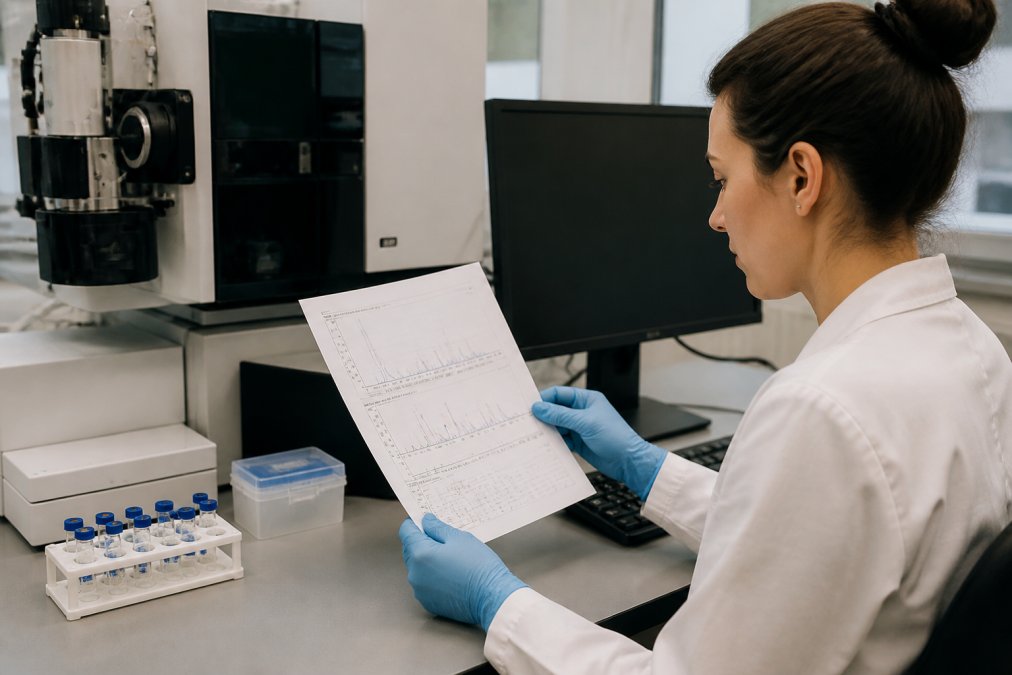
Mass spectrometry reports reveal the exact molecular composition of your peptide sample. Understanding how to read these reports transforms raw data into actionable quality assessment.
Reading M/Z Ratios and Fragmentation Patterns
The m/z ratio is the mass of an ion divided by its charge state. For a peptide with a known molecular weight, you can predict what m/z values should appear in the spectrum. If the observed m/z matches the expected value, the compound identity is confirmed.
Expected patterns in peptide spectra:
- Precursor ion (intact peptide) at highest m/z
- B-ions (fragment ions from N-terminus cleavage)
- Y-ions (fragment ions from C-terminus cleavage)
- Charge state variants (same peptide with different charge)
Identifying Expected vs. Unexpected Peaks
A clean spectrum shows strong intensity at expected m/z values and minimal background noise. Unexpected peaks indicate impurities or degradation products.
What to look for:
- Strong precursor ion peak (should dominate the spectrum)
- Consistent fragmentation pattern matching literature or previous batches
- Low baseline noise between peaks
- Absence of peaks at unexpected m/z values
Step 3: How to Verify Peptide Purity Standards
Purity directly impacts experimental reliability. A peptide that appears pure under one analytical method may show impurities under another. Understanding purity measurement standards ensures you're comparing apples to apples across suppliers.
HPLC Analysis and Purity Thresholds
High-performance liquid chromatography (HPLC) separates peptide components by charge and hydrophobicity. The chromatogram shows distinct peaks for each chemical species present. The area under each peak correlates to the amount of that substance.
Typical HPLC parameters for peptides:
- Reverse-phase separation (C18 column)
- Gradient elution over 20-40 minutes
- UV detection at 214 or 280 nanometers
- Flow rate 0.5-1.0 milliliters per minute
Acceptable Purity Ranges for Research Applications
Purity requirements vary by application. Most research applications accept peptides in the 90-98% range. Stricter applications (clinical research, regulatory studies) may require 99%+ purity.
Typical purity standards:
- General research: 90-95% acceptable
- Structural studies: 95-98% preferred
- Bioassays: 95%+ recommended
- Clinical or regulatory work: 98-99%+ required
Step 4: Identify Common Peptide Synthesis Impurities
Understanding what impurities typically appear during synthesis helps you recognize normal byproducts versus contamination. Solid-phase peptide synthesis (SPPS) generates predictable impurities at each stage.
Truncated Sequences and Incomplete Synthesis
Truncated sequences are shorter peptides missing one or more amino acids. They form when the coupling step fails to attach the next amino acid. A 20-amino-acid peptide might have truncated versions of 19, 18, or 17 amino acids present.
Why truncation occurs:
- Incomplete coupling reactions
- Hindered amino acids (bulky side chains)
- Insufficient reaction time or temperature
- Low-quality coupling reagents
Oxidation, Acetylation, and Post-Translational Modifications
Oxidation occurs when amino acids with reactive side chains (methionine, tryptophan, tyrosine) react with oxygen. This adds 16 mass units to the affected amino acid. Oxidized peptides appear as separate peaks in HPLC and distinct m/z values in mass spectrometry.
How to identify modifications in reports:
- Mass shift of 16 (oxidation)
- Mass shift of 42 (acetylation)
- Unexpected peaks in chromatogram
- Detailed impurity list in verification documentation
Step 5: Verify Supplier Documentation and Chain of Custody
Documentation creates accountability. A supplier with rigorous record-keeping demonstrates manufacturing control and quality commitment. Chain of custody documentation proves the compound you receive is the same batch that was tested and verified.
Essential documentation includes:
- Certificate of Analysis (CoA) for your specific batch
- Manufacturing date and batch number
- Storage conditions and shelf life
- Handling instructions
- Verification test results with dates
Certificate of Analysis Requirements
A Certificate of Analysis (CoA) is the official document confirming that a specific batch meets specification. It should include:
- Batch/lot number matching your order
- Compound name and molecular formula
- Molecular weight with tolerance range
- Purity percentage and test method
- Impurity breakdown
- Test date and expiration date
- Laboratory name and accreditation
- Authorized signature
Traceability and Manufacturing Origin
Traceability means you can follow the compound from synthesis through delivery. This requires documented manufacturing origin, synthesis date, and quality checkpoints.
Ask suppliers:
- Where is the peptide synthesized?
- What synthesis method is used?
- Who performs quality testing?
- How long is the documented shelf life?
- What storage conditions are required?
Step 6: Assess Shipping, Storage, and Handling Standards
Quality degradation doesn't stop at the laboratory door. Improper shipping and storage destroy compound integrity. Verification of supplier handling standards is as critical as analytical verification.
Temperature Control and Packaging Security
Peptides should ship in temperature-controlled conditions (Recommendations for the generation, quantification, storage and handling of peptides used...). Ambient temperature shipping works for short distances and cool seasons but risks degradation in summer or long-distance transit.
Proper peptide shipping includes:
- Insulated packaging with ice packs or gel packs
- Temperature-monitoring labels
- Tracking information for transit time visibility
- Arrival within 2-3 days of shipment
Tamper-Evident Sealing and Transit Integrity
Tamper-evident packaging proves the compound hasn't been opened or contaminated during transit. Look for:
- Sealed vials with safety seals
- Tamper-evident tape on outer packaging
- Unique batch identifiers on seals
- Tracking numbers for verification
Step 7: Establish Ongoing Quality Monitoring
A single verification at purchase isn't enough. Ongoing quality monitoring detects batch-to-batch variation and storage degradation over time. This is especially important if you order from the same supplier repeatedly.
Batch-to-Batch Consistency Checks
When you receive a new batch from the same supplier, compare its verification report to previous batches. Look for:
- Similar purity percentages (within 2-3%)
- Consistent impurity profiles
- Stable molecular weight confirmation
- Consistent batch numbers and synthesis dates
Building a Supplier Performance Record
Maintain a spreadsheet tracking:
- Order dates and batch numbers
- Purity percentages from verification reports
- Impurity types and percentages
- Arrival dates and condition
- Any issues encountered during use
Over 6-12 months, this record reveals patterns. A supplier showing consistent quality and responsive communication deserves continued business. A supplier with declining quality or poor communication should be replaced.
Frequently Asked Questions
What is the standard purity level for research-grade peptides?
Research-grade peptides typically meet purity standards of 85-95% or higher, depending on the application and synthesis method. High-performance liquid chromatography (HPLC) analysis confirms purity by measuring the percentage of the desired peptide sequence relative to total impurities. Suppliers like Online Peptide Sales provide Janoshik-verified batch reports that document exact purity levels for each batch, allowing you to confirm the peptide meets your specific research requirements before use.
How do you read a Janoshik analytical report for peptides?
Janoshik reports present mass spectrometry data showing the peptide's molecular weight, fragmentation pattern, and purity assessment. Key sections include the precursor ion m/z ratio, the list of detected fragment ions (b-ions and y-ions), and the calculated purity percentage. Cross-reference the reported molecular weight against your expected peptide mass, and verify that the fragmentation pattern matches known amino acid sequences. The report confirms whether the peptide was synthesized correctly and contains acceptable levels of impurities for your research application.
Why is third-party verification important for peptide suppliers?
Third-party verification by independent laboratories like Janoshik removes bias and ensures objective quality assessment. A supplier's own testing cannot guarantee accuracy or detect deliberate mislabeling. Independent verification confirms that the peptide matches the stated sequence, purity, and identity through tandem mass spectrometry (MS/MS) and other analytical methods. This protects your research integrity, ensures reproducibility, and provides documentation acceptable to institutional review boards and funding agencies.
What documentation should a reputable peptide supplier provide with each order?
Reputable suppliers include a Certificate of Analysis (CoA) detailing purity, molecular weight, and synthesis date; third-party analytical reports (such as Janoshik verification for identified samples); batch tracking numbers for traceability; storage and handling instructions; and shipping documentation confirming secure transit and tamper-evident packaging. Online Peptide Sales provides Janoshik-verified batch reports for identified samples, secure export packaging, and clear documentation of manufacturing origin, allowing you to validate quality standards and maintain compliance with research protocols.