 ultimate-guide
Peptide Storage Guidelines for Labs: 2026 Best Practices
Table of Contents
- Why Peptide Storage Guidelines for Labs Determine Research Reproducibility
- Lyophilized Peptide Storage Temperature: -20°C vs -80°C Explained
- Peptide Reconstitution Best Practices for Laboratory Use
- Peptide Vial Kit Size Requirements and Aliquot Strategy
- Protecting Peptides from Light, Moisture, and Oxidation
- Troubleshooting Degraded Samples and Shipping Guidelines
- Conclusion: Building a Reliable Peptide Storage Protocol
- Frequently Asked Questions
Last Updated: October 1, 2026
Why Peptide Storage Guidelines for Labs Determine Research Reproducibility
Peptide storage guidelines for labs are the documented procedures that keep a research compound chemically intact from the moment it arrives until the final assay, covering temperature, light exposure, moisture control, and handling technique. Get them wrong and the amino acid sequence itself may be fine while the results are not. This guide from Online Peptide Sales covers the temperature thresholds, reconstitution practices, and aliquot strategy that protect sample integrity across a study's full timeline.
Lyophilized Peptide Storage Temperature: -20°C vs -80°C Explained
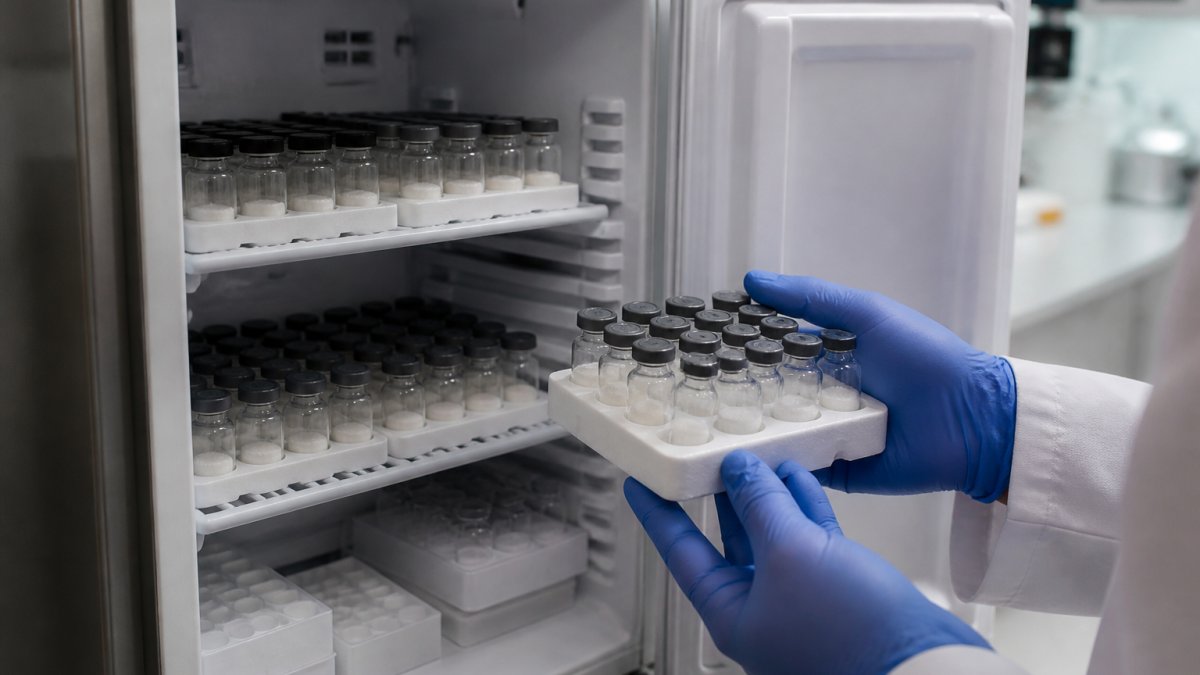
Lyophilized peptide storage temperature should be -20°C for most short-term work and -80°C for long-term archival material. The freeze-dried powder is far more stable than the reconstituted solution, but that stability still has a ceiling. Hydrolysis and oxidation continue slowly at any temperature above cryogenic storage.
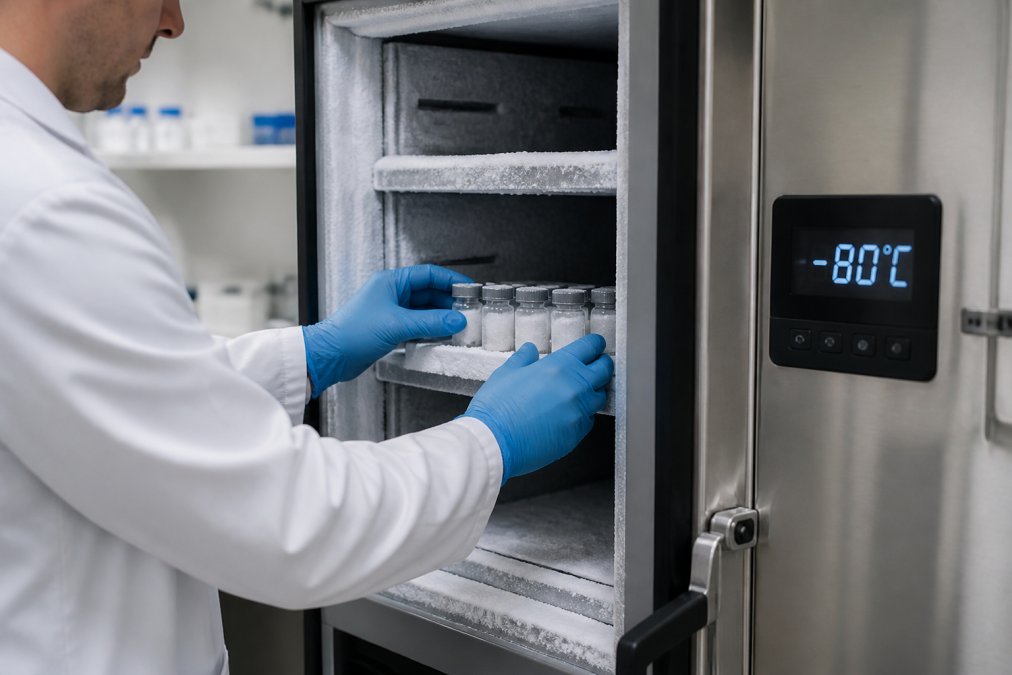
Short-Term vs Long-Term Temperature Ranges
Use -20°C for vials you will open within a few months. Move anything intended for longer storage, or anything particularly sensitive to hydrolysis, to -80°C. A frost-free freezer is a poor choice for either: the automatic defrost cycle raises the internal temperature periodically, which counts as a slow thermal cycle repeated for as long as the vial sits there. Manual-defrost freezers hold a steadier temperature.
Room Temperature Equilibration Before Opening
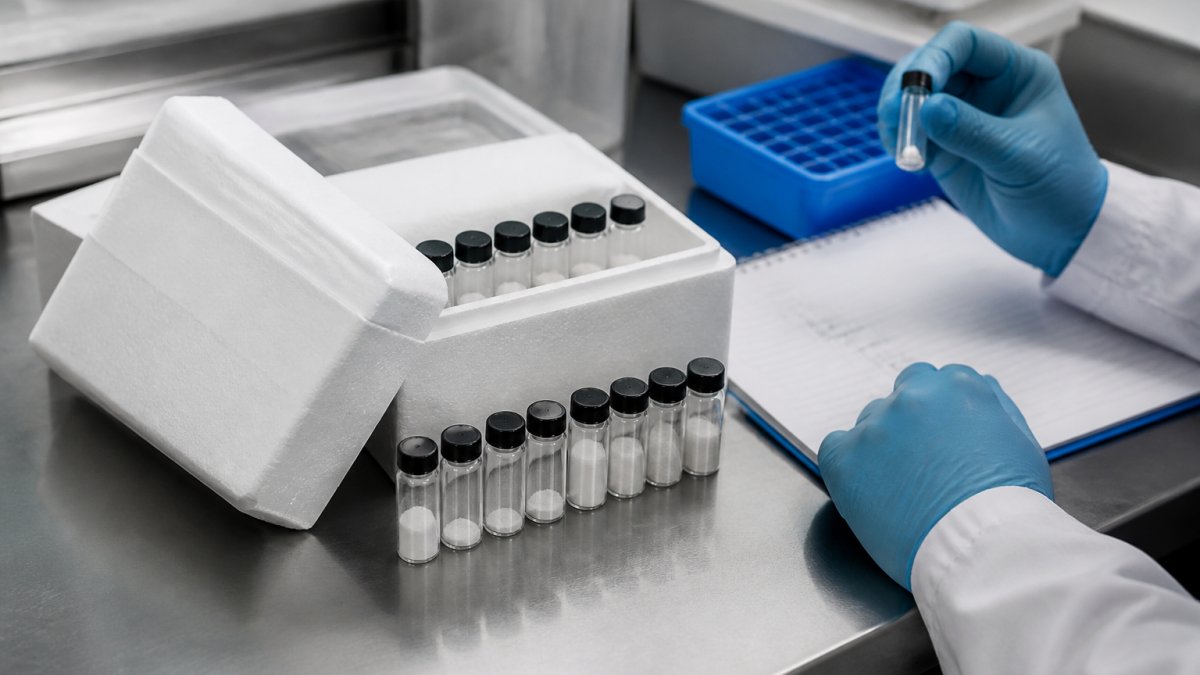
Never open a cold vial. Condensation forms on the cold powder and on the vial interior the instant warm room air enters, and that moisture starts hydrolysis before the peptide is even weighed. Let the sealed vial equilibrate to room temperature first, still capped, still sealed. The wait is measured in tens of minutes, not seconds.
Peptide Reconstitution Best Practices for Laboratory Use
Peptide reconstitution best practices start with a buffer matched to the peptide's pH sensitivity, not with whatever diluent is closest to hand. Reconstitution is where most irreversible damage happens. Once the powder is in solution, every subsequent handling step matters more.
Buffer Selection, pH Sensitivity, and Solubility
Most research peptides dissolve cleanly in sterile water or a buffered saline solution. Peptides with acidic or basic residues can aggregate near their isoelectric point, so a buffer that holds pH away from that point improves solubility. Add the diluent gently down the vial wall rather than directly onto the powder. Swirl; do not shake. Vortexing and ultrasonication can shear larger structures and introduce foam that denatures the peptide at the air-liquid interface.
Sterile Technique and Contamination Prevention
Microbial contamination is invisible until it isn't. Work in a laminar flow hood, wipe septa with alcohol before every puncture, use a fresh needle each time, and never re-enter a vial with a syringe that has touched anything else. A contaminated vial may look clear while bacterial proteases quietly cleave the peptide. If a solution turns cloudy, shows particles, or develops an odor, discard it.
Peptide Vial Kit Size Requirements and Aliquot Strategy
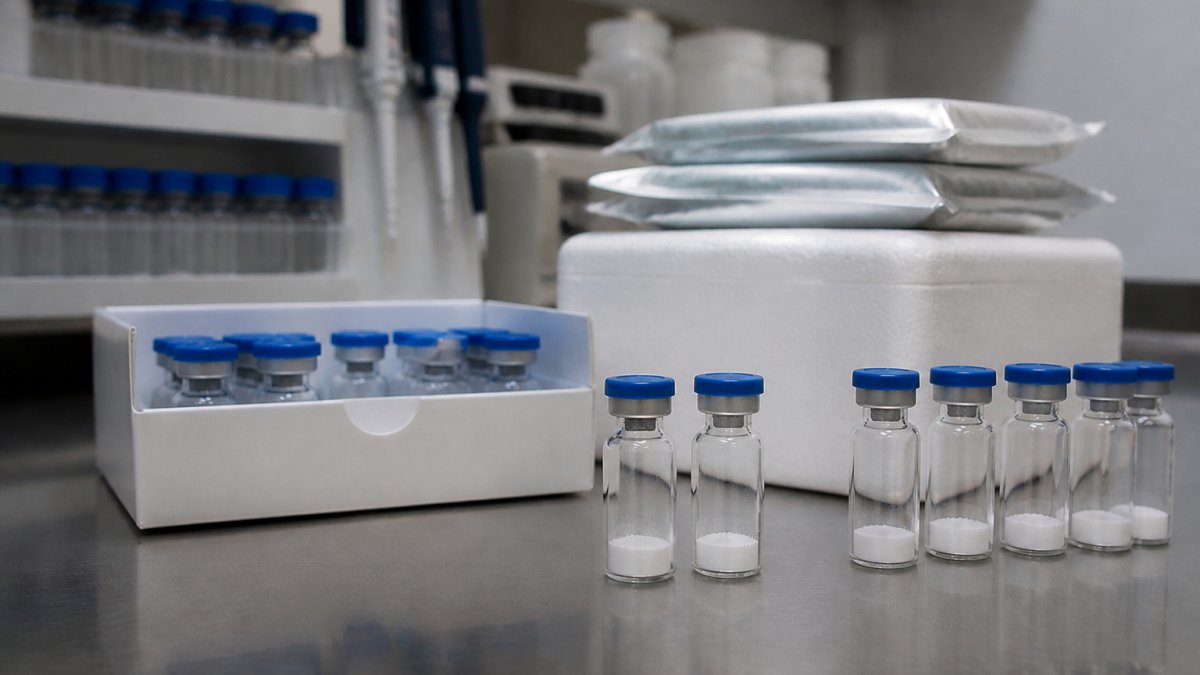
Peptide vial kit size requirements depend on study phase, not on convenience. A pilot study and a confirmatory study have different batch needs, and matching kit size to phase reduces both waste and the number of times a vial is opened. Standard 10-vial research kits suit most early-phase work; larger or repeated studies benefit from planning consumption per arm before ordering.
Matching Kit Size to Study Phase
Estimate total peptide mass needed, add a margin for failed runs, then divide by vial size to get vial count. Ordering one large vial instead of several smaller ones looks efficient until the first freeze-thaw cycle ruins the whole lot. Smaller vials mean fewer open-and-close events per unit of material.
A practical planning sequence:
- Calculate mass per experimental arm (concentration × volume × number of runs).
- Multiply by the number of arms, then add 15-20% for failed runs and instrument repeats.
- Divide total mass by the peptide mass per vial to get the minimum vial count.
- Round up, then split that count across the study timeline so no single vial is opened more than once.
Freeze-Thaw Cycle Impact and How to Avoid It
Every freeze-thaw cycle degrades a fraction of the peptide, and the damage compounds: each cycle adds aggregation and hydrolysis products that shift assay readings. The mechanism is physical, not just chemical. Ice crystal formation concentrates solutes in the remaining liquid channels, pushing local pH and ionic strength outside the range the peptide tolerates. On thaw, those concentrated pockets can drive aggregation before the solution ever reaches uniform temperature.
| Study Phase | Typical Kit Size | Storage Temperature | Aliquot Approach |
|---|---|---|---|
| Pilot / feasibility | Small, few vials | -20°C | Single-use aliquots |
| Confirmatory | Standard 10-vial | -20°C or -80°C | Single-use aliquots |
| Long-term archival | Standard 10-vial | -80°C | Sealed, unopened |
| Sensitive compounds | Small, few vials | -80°C | Single-use, minimal handling |
Protecting Peptides from Light, Moisture, and Oxidation
Light and moisture destroy peptides quietly. Ultraviolet light oxidizes susceptible residues, particularly methionine and tryptophan, while ambient humidity drives hydrolysis in both powder and solution. Amber glass vials or foil wrapping block the light; a desiccant in the storage container handles moisture.
Troubleshooting Degraded Samples and Shipping Guidelines
Degraded samples usually announce themselves through inconsistent assay results rather than visible changes. When results drift, check the storage log first. A clouded solution, visible precipitate, or a peptide that no longer dissolves at its usual concentration points to aggregation or hydrolysis.
Diagnosing a Suspect Sample
Work through the failure in order, from least to most destructive:
- Visual inspection. Hold the vial against a light source. Cloudiness, floating particles, or a color shift from the reference batch are early indicators. A clear solution is not proof of integrity, but a cloudy one is proof of a problem.
- Solubility check. A peptide that dissolved cleanly at reconstitution but will not fully dissolve after storage has likely aggregated. Aggregates often will not return to solution with additional swirling.
- Fresh-aliquot comparison. Thaw a never-opened aliquot and run it alongside the suspect sample under identical conditions. If the fresh aliquot behaves differently, the stored material is the problem. If both behave the same way, the issue is upstream, buffer, instrument, or assay.
- pH check. A drifted pH in a stored solution points to buffer degradation or contamination rather than peptide degradation, and the two require different corrective actions.
- Mass confirmation. When the assay result is ambiguous, mass spectrometry on the suspect sample against the batch's reference data settles the question.
Shipping and Cold-Chain Integrity
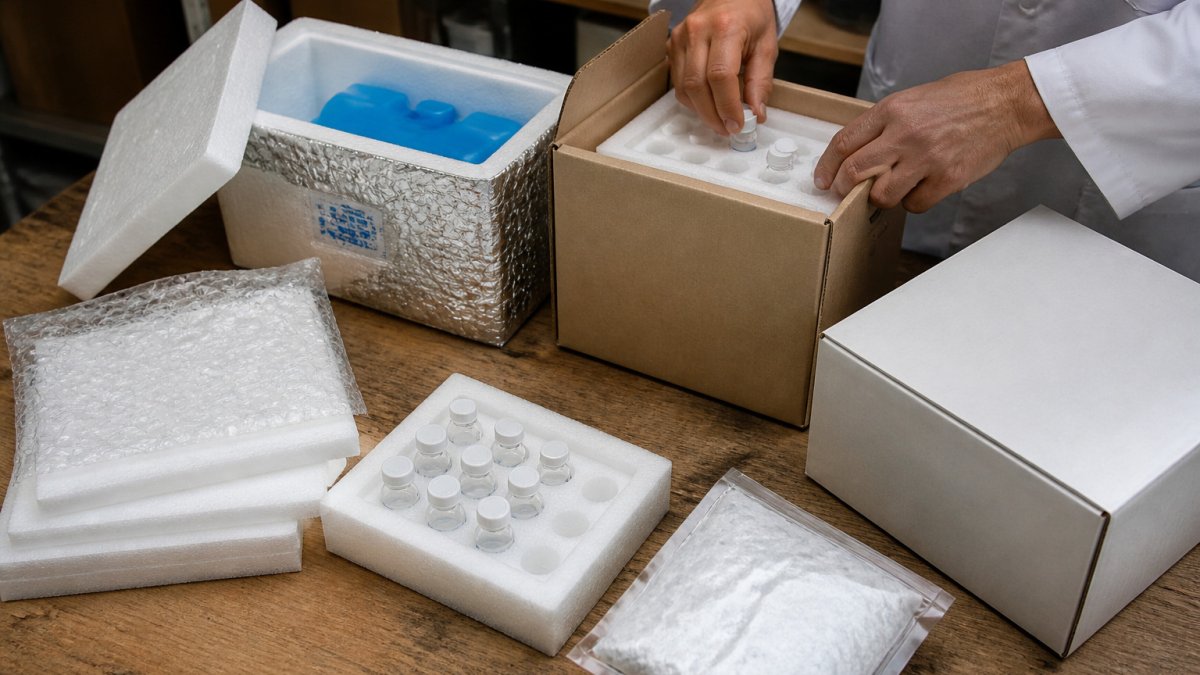
Shipping and transport deserve the same rigor as freezer storage. Peptides move through temperature swings that a lab freezer never sees, and the cold chain is only as strong as its weakest segment, pack-out, carrier handling, and final delivery.
Key controls:
- Insulated packaging sized to transit time. Gel packs suit short domestic transits; dry ice is required when the material must stay at -20°C or below for more than a day. Under-sized coolant is the most common cause of arrival-temperature failure.
- A temperature indicator in the box. A single-use indicator strip or data logger turns an assumption into a record. Without one, a warm arrival is indistinguishable from a warm transit.
- Tamper-evident sealing. Any breach should be visible on arrival, before the package is opened.
- Minimized time in transit. Express shipping reduces the single largest variable in transport-related degradation.
- Immediate transfer to storage. A package that sits on a loading dock for two hours has effectively added a thermal cycle to every vial inside it.
Conclusion: Building a Reliable Peptide Storage Protocol
A working storage protocol answers four questions for every vial: how cold, how dark, how dry, and how many times it has been opened. Temperature choice follows study timeline, buffer choice follows pH sensitivity, and aliquot strategy follows freeze-thaw tolerance. Write each decision into the protocol before the first vial arrives, and the reproducibility problem largely disappears. Online Peptide Sales supplies research compounds in 10-vial kits with Janoshik-verified batch reports for identified samples, giving labs a documented starting point for that protocol.
Frequently Asked Questions
How long can BPC 157 stay unrefrigerated?
Lyophilized BPC 157 is stable at room temperature for short transit periods, typically a few days to a week, if kept away from light and moisture. Once reconstituted, it should be refrigerated at 2-8°C and used within a few weeks. For long-term storage, keep the lyophilized powder at -20°C or lower. Always check the Janoshik-verified batch report for specific stability data on your lot.
What are the optimal temperature ranges for long-term peptide storage?
For lyophilized peptides, -20°C is suitable for most routine research use, while -80°C is recommended for peptides prone to degradation or for storage beyond six months. Reconstituted peptides should be kept at 2-8°C and used within days to weeks depending on the peptide. Avoid repeated freeze-thaw cycles by aliquoting before freezing. These ranges align with standard laboratory peptide storage guidelines.
How does lyophilization affect peptide storage requirements?
Lyophilization removes water from the peptide, greatly slowing hydrolysis and oxidation. This allows lyophilized peptides to be stored at -20°C or -80°C for months or years. Once reconstituted, the peptide becomes vulnerable to microbial contamination and degradation, so refrigeration and sterile technique become critical. Online Peptide Sales ships lyophilized peptides in 10-vial kits with desiccant to maintain stability during transit.
What are the signs of peptide degradation in a laboratory setting?
Visible signs include cloudiness, particulates, color change, or gel formation in reconstituted solutions. Lyophilized powders may show shrinkage, discoloration, or a sticky texture. Analytical signs include shifts in HPLC retention time or mass spectrometry results. If you suspect degradation, do not use the sample for critical experiments. Proper storage at recommended temperatures and protection from light and moisture help prevent these issues.
How should peptides be reconstituted and stored after opening?
Use sterile technique: wipe the vial septum with 70% ethanol, use a sterile syringe and needle, and add the appropriate buffer or solvent slowly down the vial wall to avoid foaming. Swirl gently; do not vortex or shake vigorously. After reconstitution, store at 2-8°C, protected from light. For longer storage, aliquot into polypropylene tubes and freeze at -20°C or -80°C. Avoid repeated freeze-thaw cycles.
Why is moisture control critical for peptide stability?
Moisture promotes hydrolysis, oxidation, and microbial growth, all of which degrade peptides. Lyophilized peptides are hygroscopic and can absorb moisture from the air, so vials should be sealed with desiccant and allowed to equilibrate to room temperature before opening to prevent condensation. Online Peptide Sales uses tamper-evident packaging and desiccant to protect peptides during shipping and storage.