 ultimate-guide
How Long Do Reconstituted Peptides Stay Stable?
Last Updated: October 26, 2026
Quick Summary
Peptide stability after reconstitution varies with temperature, light, pH, and handling, so no single shelf life applies to every compound. Refrigerated solutions are commonly cited as usable for 24 to 72 hours at 4°C, while broader estimates put the window at 4 to 8 weeks at 2°C to 8°C depending on sequence composition.
- Lyophilized peptides stored at -20°C or -80°C remain stable for up to 24 months when kept sealed.
- Reconstituted shelf life with bacteriostatic water under refrigeration is roughly 28 days as an industry benchmark.
- Let frozen vials reach room temperature before opening to prevent condensation from starting degradation early.
- Swab the septum with 70% isopropyl alcohol and use a fresh needle for every draw.
- Record reconstitution date, diluent, storage temperature, and access count for every vial.
Table of Contents
- What Peptide Stability After Reconstitution Actually Means
- Reconstituted Peptide Shelf Life: What the Data Shows
- Peptide Storage Guidelines for Refrigerated and Frozen Vials
- Factors Affecting Peptide Degradation in Solution
- Peptide Vial Contamination Prevention During Repeated Access
- How to Spot Degradation Before It Ruins a Study
- Sourcing Vials With Documentation You Can Actually Verify
- Frequently Asked Questions
What Peptide Stability After Reconstitution Actually Means
Peptide stability after reconstitution is the measure of how long a dissolved peptide retains its structural integrity and biological activity once water is added to the lyophilized powder. It is not a single fixed number. It is a variable that changes with temperature, light exposure, pH, and how often the vial is opened.
That distinction matters because most storage questions assume a universal answer. There isn't one. A short sequence with no oxidation-prone residues can hold for weeks under refrigeration. A longer peptide with methionine or tryptophan in its chain may degrade noticeably faster under identical conditions. Research published through the National Center for Biotechnology Information on peptide degradation pathways identifies oxidation of methionine and tryptophan residues as primary degradation routes, which is why formulation and handling strategy have to match the specific compound.
At Online Peptide Sales, the practical takeaway is straightforward: treat stability as a protocol question, not a label question. The sections below break down what the published data actually shows, where the estimates diverge, and how to build a storage routine that protects a study from avoidable loss.
Reconstituted Peptide Shelf Life: What the Data Shows
Published shelf-life figures for reconstituted peptides cluster into two camps, and the gap between them is wider than most researchers expect. Refrigerated solutions are commonly cited as usable for 24 to 72 hours at 4°C under standard guidelines, while broader estimates put the window at 4 to 8 weeks at 2°C to 8°C depending on sequence composition. A separate industry benchmark places reconstituted shelf life at roughly 28 days when bacteriostatic water is used under refrigeration.
The divergence is not sloppiness. It reflects different assumptions about the peptide, the diluent, and the acceptable threshold for degradation. A lab running a short assay can tolerate minor loss. A lab running a quantitative study cannot.
For a deeper breakdown of the underlying figures, the guide to shelf life of reconstituted peptides walks through the same evidence in more detail.
Two operational points follow from the data. First, degradation rate, not concentration, is the primary variable in stability assays, per ACS Publications' protocol comparison for peptide stability testing. Second, any shelf-life figure quoted without the storage conditions attached is close to meaningless.
Published shelf-life estimates for reconstituted peptides vary widely depending on the assumptions behind them.
| Storage condition | Cited shelf life | Note |
|---|---|---|
| Refrigerated at 4°C, standard guidelines | 24 to 72 hours | Commonly cited figure |
| Refrigerated at 2°C to 8°C | 4 to 8 weeks | Depends on sequence composition |
| Bacteriostatic water, refrigerated | Roughly 28 days | Industry benchmark |
| Lyophilized at -20°C or -80°C | Up to 24 months | Dry powder, kept sealed |
Peptide Storage Guidelines for Refrigerated and Frozen Vials
Storage decisions split cleanly by product state. Lyophilized peptides held at -20°C or -80°C remain stable for up to 24 months, while reconstituted solutions need refrigeration and a much shorter planning horizon.
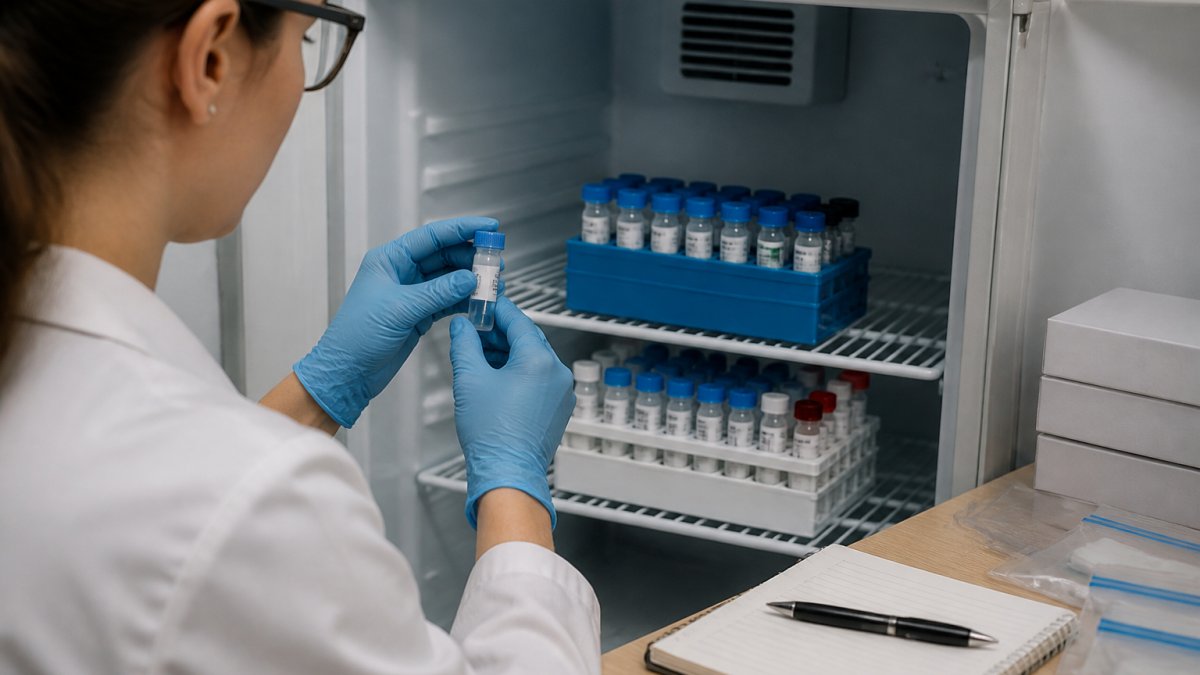
A workable routine looks like this:
- Dry powder: store at -20°C or -80°C, keep sealed, and allow vials to reach room temperature before opening to prevent condensation.
- Reconstituted solution: refrigerate at 2°C to 8°C, label with the reconstitution date, and plan use within the documented window for that sequence.
- Aliquoting: split a reconstituted vial into single-use portions to avoid repeated freeze-thaw cycles.
- Freezing solutions: only where the protocol allows it, and never refreeze a thawed aliquot.
What most guides miss is the condensation problem. Opening a frozen vial before it equilibrates pulls moisture onto the powder, and that moisture starts the clock early.
Factors Affecting Peptide Degradation in Solution
Degradation in solution is driven by a small set of controllable variables. Get them wrong and no amount of careful handling rescues the sample.
Temperature, Light, and Oxygen
Heat accelerates hydrolysis and oxidation simultaneously. Light drives photo-oxidation of susceptible residues, which is why amber vials and dark storage are standard rather than decorative. Oxygen dissolved in the diluent feeds oxidation directly, and headspace in a partially used vial gives it somewhere to keep working.
The review of light exposure as a peptide storage risk covers the photodegradation side in detail, and the analysis of why peptides degrade at room temperature explains the thermal pathway.
Diluent Choice and pH
Bacteriostatic water is the common choice for multi-use vials because the benzyl alcohol content limits microbial growth. Sterile water works for single-use preparation. Neither is universally correct.
pH sits behind both. Each peptide has a pH range where it is most stable, and pushing outside that range accelerates deamidation or aggregation. A diluent that suits one compound can shorten the life of another.
Peptide Vial Contamination Prevention During Repeated Access
Repeated access is the most underrated stability risk in routine lab work. Every needle entry introduces a contamination path and a small oxygen exchange. Both compound over a study.
The controls are unglamorous but effective:
- Swab the septum with 70% isopropyl alcohol and let it dry before every entry.
- Use a fresh needle and syringe for each draw.
- Keep the vial upright and avoid touching the septum with gloved fingers.
- Store reconstituted vials refrigerated between draws, not on the bench.
- Inspect for cloudiness, particulates, or color shift before each use.
The visual guide to spotting contamination in vials shows what those failure signs look like in practice. Watch out: a cloudy solution that clears on warming is still a contaminated solution, and running it through an assay wastes both the sample and the run.
How to Spot Degradation Before It Ruins a Study
Visible change is a late signal. By the time a solution turns cloudy or throws a precipitate, measurable activity loss has usually already occurred.
Earlier indicators sit in the data, not the vial. A sudden drop in assay response from a batch that performed well previously points to degradation. Unexplained aggregation on a chromatogram does the same. So does a shift in retention time.
The practical discipline is documentation. Record reconstitution date, diluent, storage temperature, and access count for every vial. When results drift, that log tells you whether the cause is the sample or the protocol.
Sourcing Vials With Documentation You Can Actually Verify
Stability work starts before reconstitution, with the batch documentation that tells you what is in the vial. Regulatory bodies including the FDA and ICH have established formal guidelines for stability testing of therapeutic peptides, documented through PMC's review of peptide quality control frameworks, and third-party analytical reports have become the practical way researchers confirm purity at the point of sourcing.
Online Peptide Sales supplies research compounds in 10-vial kits with Janoshik-verified batch reports for identified samples, factory-direct sourcing, and tamper-evident export packaging. A step-by-step guide to reading COA documents covers how to check a report rather than simply file it.
The summary that matters: stability is a chain, and the weakest link sets the outcome. Match the storage protocol to the specific sequence, control access and temperature without shortcuts, and start with documentation that proves what the vial contains.
Frequently Asked Questions
How does temperature affect peptide stability after reconstitution?
Temperature is the single biggest driver of degradation once a peptide is in solution. Reconstituted vials held at 4°C typically stay usable for 24 to 72 hours in short-term work, while refrigerated storage between 2°C and 8°C supports a 4 to 8 week window depending on sequence. Freeze-dried peptide kept at -20°C or -80°C can hold for up to 24 months. Every warm cycle accelerates hydrolysis and oxidation, so keep vials cold and avoid repeated warming.
What is the recommended storage duration for reconstituted peptides?
Most reconstituted peptide shelf life estimates land at 28 days when the compound is dissolved in bacteriostatic water and held under refrigeration. Some sequences tolerate 4 to 8 weeks at 2°C to 8°C, and short-term work often uses a 24 to 72 hour window at 4°C. Treat 28 days as a working benchmark, not a guarantee, and confirm against the specific sequence and your own stability assay.
How does repeated vial access impact peptide degradation?
Each puncture introduces air, moisture, and potential microbial contamination. Peptide vial contamination prevention starts with wiping the septum with 70% isopropyl alcohol, using a fresh needle every time, and minimizing the number of draws per vial. Repeated access also adds oxygen, which drives oxidation of methionine and tryptophan residues. If a study needs many aliquots, split the reconstituted volume into smaller single-use vials rather than drawing from one repeatedly.
How can researchers identify signs of peptide degradation?
Request Janoshik-verified batch reports from Online Peptide Sales.