 how-to
Is Light Exposure a Risk for Peptide Storage? A Review
Table of Contents
- How Light Exposure Affects Peptide Stability
- Peptide Light Sensitivity: Why Some Sequences Are More Vulnerable
- Lyophilized Peptide Storage: Protecting Powder from Light and Moisture
- Reconstituted Peptide Stability: Light Protection After Mixing
- Peptide Stability After Repeated Vial Access
- What to Do After Accidental Light Exposure
- Validated Testing and Stability Indicators
- Conclusion
- Frequently Asked Questions
Last Updated: October 19, 2026
How Light Exposure Affects Peptide Stability
Is light exposure a risk for peptide storage? Yes. Light is one of the most underrated threats to peptide integrity, and it works quietly.
This guide from Online Peptide Sales covers how light degrades peptides, which sequences are most vulnerable, and how to build a storage routine that limits exposure.
Light damage is not a cosmetic issue. It is a chemical one, and it starts at the molecular level.
Photooxidation and Light-Sensitive Amino Acid Residues
Photooxidation is the light-driven reaction where oxygen combines with susceptible sites on a molecule, altering its structure. In peptides, this most often hits a small set of amino acid residues. Tryptophan, tyrosine, phenylalanine, and cysteine are the usual suspects.
The result is a peptide that still weighs roughly the same but no longer behaves the same. Oxidation can change binding affinity, folding, and stability in solution. For research use, that means results you cannot reproduce.
Visible Light vs. UV Light: Which Poses More Risk?
UV light carries more energy per photon, so it drives photooxidation faster. But visible light is not harmless, and it is far more common in a lab setting. Fluorescent room lighting, desk lamps, and even indirect sunlight through a window all deliver visible light over long periods.
A common mistake is guarding against UV and ignoring ambient light. In practice, hours of ordinary room light can matter more than a few seconds of direct sun, simply because the exposure is constant.
Peptide Light Sensitivity: Why Some Sequences Are More Vulnerable
Not all peptides respond to light the same way. Sensitivity depends on which residues sit where in the sequence and how exposed they are. A peptide rich in tryptophan will generally show more light-driven change than one built from residues with low reactivity.
This is where generic storage advice falls short. "Keep it dark" is a good start, but the real question is how dark, for how long, and for which compound.
Tryptophan, Tyrosine, Phenylalanine, and Cysteine
Each of these residues reacts differently:
- Tryptophan: Highly light-sensitive; oxidizes readily under UV and visible light.
- Tyrosine: Susceptible to photoionization, especially in the presence of oxygen.
- Phenylalanine: Less reactive alone but can participate in energy transfer.
- Cysteine: Prone to oxidation and disulfide shuffling, which light can accelerate.
Sequences containing several of these residues deserve the tightest light protection.
Evidence Quality and Peptide-Specific Variation
Much of what is known about peptide light sensitivity comes from solution studies and model compounds. That is useful, but it does not translate perfectly to every peptide or every storage format.
What most guides miss is that light risk is compound-specific. Treat published generalities as a starting point, not a guarantee. When in doubt, protect more than you think you need to.
Lyophilized Peptide Storage: Protecting Powder from Light and Moisture
Lyophilized peptide storage is more forgiving than solution storage, but it is not immune to light.
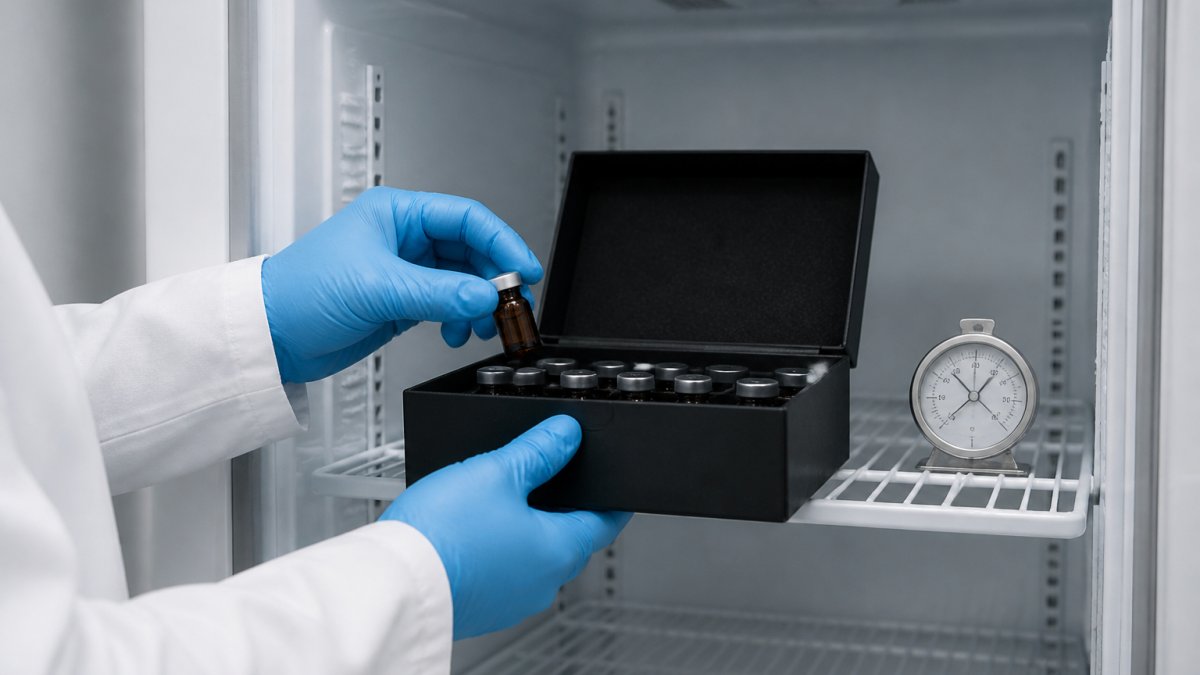
The standard defense is packaging. Amber vials filter much of the harmful wavelength range, and opaque secondary packaging adds another layer. Store kits in a dark box or cabinet, not on an open shelf.
Amber Vials, Protective Packaging, and Humidity Control
Amber glass blocks a meaningful share of UV and short-wavelength visible light. It is not a full shield, so treat it as one part of a layered approach.
Moisture control matters just as much. Humidity drives hydrolysis and can speed light-related reactions. Keep the storage environment dry and stable.
- Keep vials in their original amber glass whenever possible.
- Store the outer box closed and away from windows.
- Add a desiccant where humidity is a concern.
- Avoid opening vials under bright bench lighting.
Reconstituted Peptide Stability: Light Protection After Mixing
Once a peptide is in solution, light risk rises sharply. Dissolved oxygen, water, and light together create the conditions for photooxidation, and the clock starts the moment the powder dissolves.
Reconstituted peptide stability depends on three things: temperature, light, and time. Refrigeration helps, but it does not replace light protection. Wrap the vial in foil or keep it in an opaque container inside the fridge.
Peptide Stability After Repeated Vial Access
Every time a vial is opened or pierced, the contents meet air and light.
Reduce the number of access events. Draw what you need in one pass where possible. Work quickly, and keep the vial capped between draws.
A common mistake is laying the vial on its side under a task lamp while preparing the next step. That single habit can undo weeks of careful storage.
What to Do After Accidental Light Exposure
Accidental exposure happens: a vial left on the bench, a box set near a window, a delivery that sat in a sunlit entryway. The useful question is not whether exposure occurred but whether it mattered. A short, structured assessment beats either panic or denial.
Step 1: Characterize the Exposure
Before touching the vial, write down what you know. Four variables drive risk:
- Light source and intensity. Direct sunlight is far more energetic than overhead fluorescent lighting. A windowsill is not the same as a closed cabinet.
- Duration. Minutes under a task lamp and hours under ambient room light are different problems. Estimate conservatively.
- Wavelength. UV sources (germicidal lamps, direct sun through glass) carry more energy per photon than warm white LEDs.
- Peptide form. Lyophilized powder degrades more slowly than reconstituted solution, where dissolved oxygen and water amplify photooxidation.
Step 2: Check Product Documentation
Match the vial to its batch documentation. Online Peptide Sales supplies Janoshik-verified batch reports for identified samples, so you can confirm identity and purity as received. That baseline matters: if the report shows high purity at release, any post-exposure change is easier to attribute to the exposure event rather than to the starting material.
Step 3: Inspect, Then Decide
Visible changes, yellowing, discoloration, clumping, or a hazy solution, are meaningful but not exhaustive. Absence of visible change does not prove the peptide is intact; oxidation can proceed without obvious color shift.
A practical decision process:
- Short exposure, dry powder, amber vial, no visible change. Return to dark storage, annotate the record, and proceed with normal handling. Risk is low but not zero.
- Long exposure, reconstituted solution, or known light-sensitive sequence. Flag the batch. Consider analytical testing before use in a controlled study.
- Visible change or repeated exposure events. Treat the vial as compromised for research purposes and replace it.
Step 4: Document and Learn
Record the approximate duration, light source, form (powder or solution), and any visible changes. Over time, these notes reveal which handling steps in your workflow create the most exposure, usually vial opening, aliquoting, and transport between storage and bench.
Validated Testing and Stability Indicators
Visual inspection catches gross changes. It does not catch oxidation of a single tryptophan residue, deamidation, or subtle aggregation. Validated analytical testing fills that gap, and it is also how you separate light damage from the other storage risks that produce similar symptoms.
What Analytical Methods Actually Measure
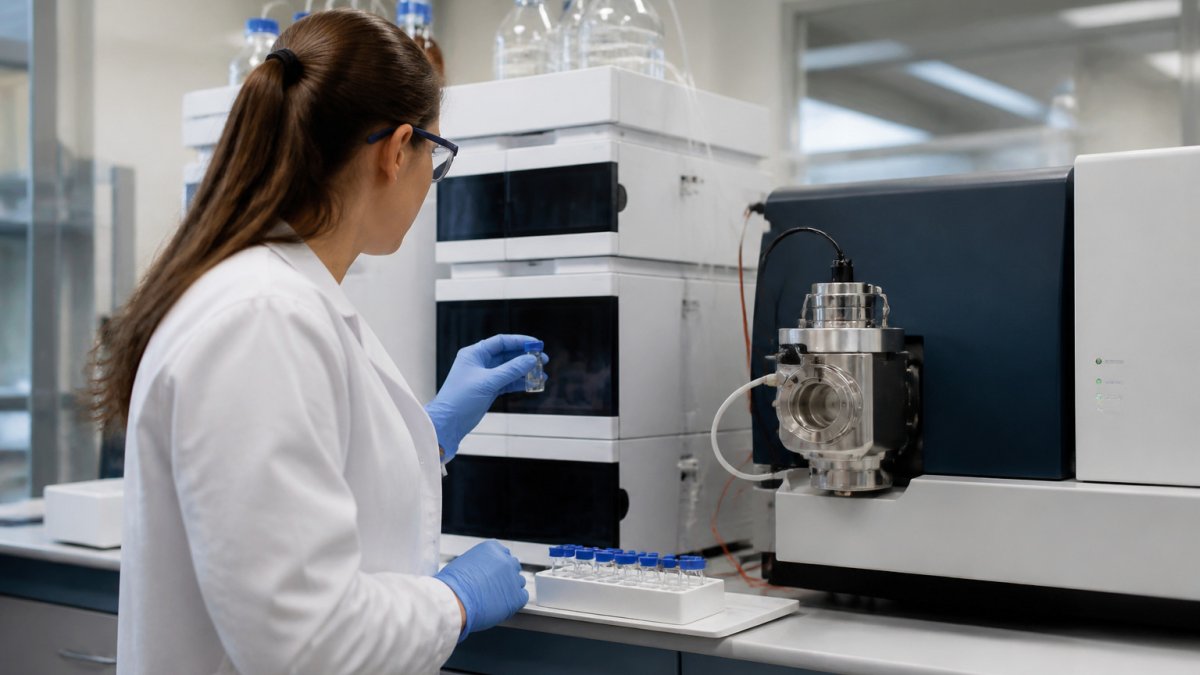
- Reverse-phase HPLC separates peptide species by hydrophobicity. Oxidized variants typically elute earlier or later than the parent peak, so a purity profile can reveal degradation products that are invisible to the eye.
- Mass spectrometry confirms molecular weight. A shift of roughly 16 Da is consistent with oxidation; multiple shifts suggest more extensive modification.
- Peptide mapping digests the peptide and identifies which residues changed, useful when you need to know whether a light-sensitive site was affected.
- Karl Fischer titration measures residual water in lyophilized powder, which affects both hydrolysis and light-related reactivity.
These methods do not replace good storage. They verify whether storage worked.
Separating Light Damage from Other Storage Risks
Troubleshooting goes wrong when every problem is blamed on light. Use the pattern of evidence to narrow the cause:
- Photodegradation tends to track with exposure events and often shows oxidation of tryptophan, tyrosine, or cysteine residues. Discoloration may appear, but not always.
- Heat damage correlates with temperature excursions and often shows aggregation or deamidation rather than clean oxidation.
- Moisture damage in powder shows clumping, stickiness, or hydrolysis products; it usually follows humidity exposure rather than light exposure.
- Freeze-thaw damage produces aggregation and precipitation after repeated cycling, independent of lighting.
When symptoms overlap, the batch record and handling log are your best evidence. A vial that was left in sunlight and also thawed repeatedly has two candidate causes; analytical data helps assign weight.
Using Batch Documentation
Online Peptide Sales supplies Janoshik-verified batch reports for identified samples. Match the report to the specific batch before use, and compare release purity against any post-storage testing. A drop in purity after a known exposure event is stronger evidence than a visual impression.
Keep the batch report with the vial. A purity profile at release is only useful if you can retrieve it when a storage question arises.
Testing does not make a peptide stable. It tells you whether your storage practice held up, and when it did not, it points to the likely cause.
Conclusion
Light exposure is a real and often overlooked risk in peptide storage, and its effects range from subtle oxidation to measurable changes in a compound's behavior.
Good storage habits plus verified batch documentation give researchers the best chance of reproducible results. Online Peptide Sales supports that work with Janoshik-verified reports and secure, tamper-evident packaging built for transit and storage.
Frequently Asked Questions
Can light exposure degrade peptides?
Yes. Light exposure, especially UV and visible light, can trigger photooxidation in susceptible amino acid residues like tryptophan, tyrosine, phenylalanine, and cysteine. This can lead to oxidation, structural changes, and reduced peptide stability. The risk depends on the peptide sequence, its form (lyophilized or reconstituted), and the intensity and duration of exposure. Amber vials and protective packaging reduce but do not eliminate risk, so storage in the dark remains the safest practice for research peptides.
Are lyophilized peptides sensitive to light?
Lyophilized peptides are generally more stable than reconstituted solutions, but they are still sensitive to light. Peptide powder can undergo photooxidation on the surface, and moisture absorption during handling can worsen light-induced degradation. Proper lyophilized peptide storage includes keeping vials in amber glass or opaque containers, avoiding direct sunlight, and controlling humidity. Even brief exposure to strong UV light can affect sensitive residues, so minimize handling under bright light.
How should reconstituted peptides be protected from light?
After reconstitution, peptide solutions are more vulnerable to light, heat, and microbial growth. Store reconstituted vials in amber vials or wrap them in foil, keep them refrigerated, and avoid repeated exposure to ambient light. Use a dark cabinet or a refrigerator with a closed door. For peptide stability after repeated vial access, minimize the time the vial is open and never leave it on a benchtop under direct sunlight. If the solution changes color or becomes cloudy, discard it.
What destroys peptides besides light?
Peptides can be degraded by heat, moisture, extreme pH, repeated freeze-thaw cycles, and enzymatic or microbial contamination. Hydrolysis and oxidation are common chemical pathways. Handling practices matter: repeated vial access introduces air and moisture, and improper storage temperature accelerates degradation. To preserve compound quality, use amber vials, control humidity, refrigerate reconstituted solutions, and avoid repeated warming to room temperature. Always follow the storage conditions provided with your research kit.
How long can peptides remain outside refrigerated storage?
There is no single answer because stability varies by peptide, form, and storage conditions. Lyophilized peptides are generally more tolerant of short periods at room temperature than reconstituted solutions, but light and humidity still pose risks. Reconstituted peptides should be refrigerated and protected from light. For any specific peptide, consult the batch documentation and stability data. If you must transport vials, use insulated packaging with cold packs and keep them in the dark to limit light exposure.