 how-to
Common Impurities in Research Peptides: A 2026 Guide
Table of Contents
- What Are Common Impurities in Research Peptides
- How Impurities Form During Peptide Synthesis
- Peptide Degradation Products and Post-Synthesis Changes
- Peptide Purity Testing and Identity Testing Methods
- Reading a Research Peptide Purity Report
- Storage and Handling Effects on Peptide Quality
- Frequently Asked Questions
Last Updated: October 18, 2026
What Are Common Impurities in Research Peptides
Common impurities in research peptides are unwanted molecular variants that appear alongside the target peptide sequence. These impurities arise during synthesis, storage, or handling and can affect experimental reproducibility and data quality. Understanding their origins helps researchers interpret batch reports and make informed purchasing decisions.
Impurities fall into two main categories: peptide-related impurities (variants of the intended sequence) and process-related impurities (byproducts from the synthesis method itself).
Peptide-Related Impurities
Peptide-related impurities are molecular variants that contain the same amino acids but in altered sequences or configurations.
Deletion sequences occur when one or more amino acids are missing from the chain.
Truncated peptides are incomplete chains that stop prematurely during synthesis. If the cleavage step occurs early or incompletely, shorter fragments remain in the final batch.
Extended sequences happen when extra amino acids attach to the chain. This typically results from incomplete deprotection of the growing peptide, allowing an extra coupling cycle to occur.
Amino acid insertion produces sequences with one or more extra residues inserted into the middle of the chain, usually from duplicate coupling reactions at a single position.
These variants appear as distinct peaks in high-performance liquid chromatography (HPLC) reports and are identified by mass spectrometry.
Process-Related and Product-Related Impurities
Process-related impurities come from the synthesis chemistry itself, while product-related impurities form after the peptide is made.
Incomplete coupling products contain protecting groups still attached to the peptide backbone or side chains.
Incomplete deprotection products result when the chemical removal of protecting groups fails to go to completion. Residual protecting groups add mass and change the peptide's behavior in experiments.
Residual solvents used in synthesis (like dimethylformamide or acetonitrile) can remain trapped in the peptide powder if drying is incomplete. These solvents are organic compounds that contaminate the sample.
Aggregates form when peptide molecules clump together, especially if the peptide is hydrophobic or prone to self-association. Aggregates appear as high-molecular-weight species in mass spectrometry.
How Impurities Form During Peptide Synthesis
Peptide synthesis follows a step-by-step process called solid-phase peptide synthesis (SPPS). Impurities arise at multiple stages when reactions don't proceed to completion or when side reactions occur.
Incomplete Coupling and Deprotection
In solid-phase peptide synthesis, amino acids attach one at a time to a growing chain anchored to a resin bead. Each cycle involves three steps: deprotection (removing the protective group from the previous amino acid), coupling (attaching the next amino acid), and washing.
Incomplete coupling happens when the coupling reaction doesn't reach 100% efficiency. A small percentage of chains fail to attach the new amino acid. On longer peptides, these failures accumulate.
Incomplete deprotection leaves protective groups on the peptide. These groups block reactive sites on the amino acid side chains during synthesis to prevent unwanted reactions.
The longer the peptide, the more opportunities for incomplete reactions to accumulate. This is why longer peptides typically have lower reported purity than shorter ones.
Deletion Sequences and Truncated Peptides
Deletion sequences arise directly from incomplete coupling. Each time a coupling step fails, the resulting peptide is one amino acid shorter. The final batch contains a mixture of full-length peptide and many deletion variants.
Truncated peptides form when the cleavage step (which removes the finished peptide from the resin) occurs prematurely. If cleavage happens during synthesis rather than at the end, short fragments are released and remain in the batch.
Truncation also results from peptide chain breakage if the backbone is damaged during synthesis. Peptides with acid-labile sequences or those synthesized under harsh conditions are more prone to this.
Chemical Modifications and Degradation
Epimerization occurs when the stereochemistry at the alpha carbon of an amino acid inverts. The amino acid remains attached but flips to its mirror-image form (D-form instead of L-form). This changes the peptide's three-dimensional structure and biological activity. Epimerization is more common at certain amino acids (especially histidine and cysteine) and under high temperatures or extended reaction times.
Oxidation happens when oxygen reacts with sensitive amino acids, particularly methionine and tryptophan. The side chain becomes modified, adding oxygen atoms and changing the peptide's mass and properties. Oxidation can occur during synthesis or storage.
Diketopiperazine formation occurs in very short peptides (usually dipeptides or tripeptides). The two terminal amino acids cyclize into a six-membered ring, removing the peptide from the batch. This is especially common during synthesis of short sequences.
Peptide Degradation Products and Post-Synthesis Changes
After synthesis, peptides continue to change. Storage conditions, handling, and time all affect the final batch composition.
Oxidation and Epimerization
Oxidation accelerates in the presence of oxygen, light, and heat. A peptide stored at room temperature in a non-inert atmosphere will gradually oxidize. Methionine and tryptophan residues are most vulnerable. Each oxidation event adds 16 mass units (one oxygen atom) and creates a new impurity peak in HPLC.
Epimerization also continues after synthesis if the peptide is stored at elevated temperatures or in alkaline conditions. The longer a peptide sits, the more of the L-form amino acids may convert to D-form. This post-synthesis epimerization is slower than synthesis-related epimerization but still significant over months or years.
Deamidation and Aspartic Acid Modifications
Deamidation is the hydrolytic removal of the amide group from asparagine or glutamine residues. Deamidation is accelerated by heat, neutral or alkaline pH, and the presence of nucleophiles (pubmed.ncbi.nlm.nih.gov).
Aspartic acid modifications include deamidation and β-elimination, where the side chain is cleaved off entirely. Aspartic acid is particularly susceptible to these changes, especially when followed by a small amino acid like serine or threonine. Succinimide formation is an intermediate step in aspartic acid degradation.
Pyroglutamate formation occurs at the N-terminus when glutamic acid or glutamine is the first amino acid. The side chain cyclizes into a pyroglutamic acid residue, removing one water molecule and changing the mass by -18. This is essentially irreversible under physiological conditions.
Peptide Purity Testing and Identity Testing Methods
Batch verification relies on two complementary analytical techniques. Together, they confirm both the purity (percentage of target peptide) and the identity (correct sequence).
High-Performance Liquid Chromatography
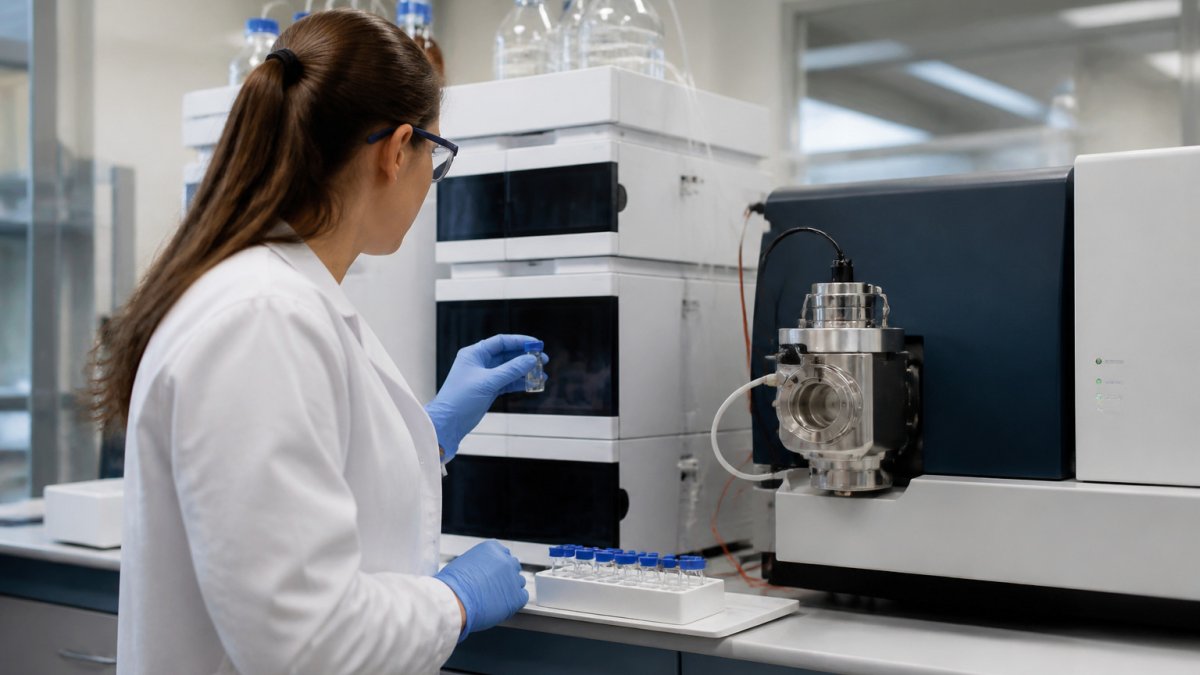
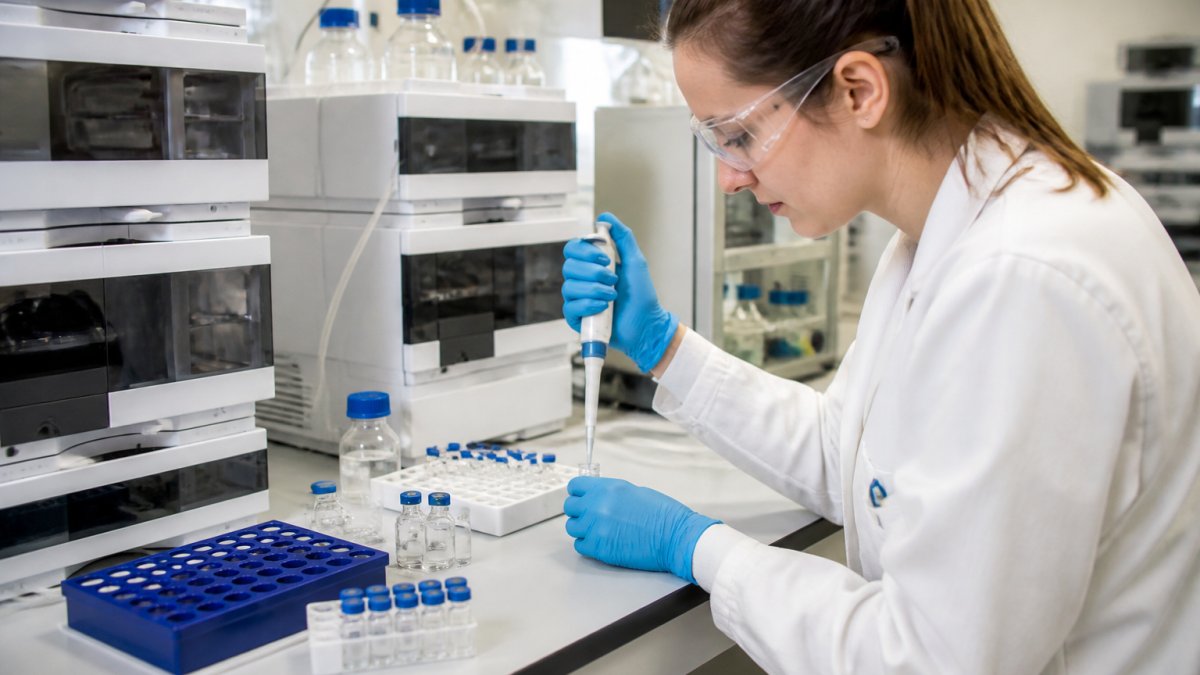
High-performance liquid chromatography (HPLC) separates peptides by size, charge, or hydrophobicity. The peptide mixture flows through a column packed with stationary phase material.
A detector measures the amount of peptide at each retention time, producing a chromatogram. Each peak represents a different molecular species. The area under each peak is proportional to the amount of that species present.
Purity calculation sums the area of the target peptide peak and divides by the total area of all peaks. A result of 95% means the target peptide accounts for 95% of the total material.
HPLC cannot determine the sequence of an unknown peak. It only shows that different compounds are present. This is why HPLC purity percentages are often accompanied by mass spectrometry data.
Mass Spectrometry for Sequence Confirmation
Mass spectrometry measures the mass-to-charge ratio (m/z) of peptides. Each peptide has a specific mass based on its amino acid composition and sequence.
Intact mass spectrometry measures the full peptide without breaking it apart. The observed mass confirms the molecular weight. If the measured mass matches the theoretical mass for the intended sequence, the identity is confirmed.
Peptide sequencing via tandem mass spectrometry (MS/MS) breaks the peptide into fragments and measures the mass differences between fragments. These differences reveal the sequence of amino acids.
When a batch report shows both HPLC purity and MS data, the MS data confirms that the major peak in the HPLC chromatogram is indeed the intended peptide, not an impurity with a similar retention time.
Reading a Research Peptide Purity Report
A typical batch verification report includes purity percentage, impurity profile, and identity confirmation. Learning to interpret these reports ensures the purchased peptide matches the experimental requirements.
Understanding Purity Percentages
Purity percentage represents the fraction of the batch that is the target peptide. A 95% pure batch contains 95 grams of target peptide per 100 grams of material. The remaining 5% is impurities.
Higher purity is not always necessary. A 90% pure peptide may be sufficient for many experiments. However, if the impurities are known to interfere with the assay or if the experiment requires high precision, higher purity becomes critical.
Purity varies by peptide length and synthesis method. Longer peptides typically have lower purity due to accumulation of deletion sequences. Custom peptides synthesized for specific applications may have different purity targets than standard research peptides.
The purity percentage alone does not identify which impurities are present. Two batches at 95% purity might contain completely different impurity profiles.
Interpreting Impurity Profiles and Batch Verification
An impurity profile lists the detected impurities, their retention times (or m/z values), and their approximate percentage of the total batch.
Major impurities (those above 2-3% of the batch) are usually identified. Common identifications include deletion sequences (listed by the missing amino acid), truncation products, or known degradation products.
Minor impurities (below 2%) are often reported as "unknown" or lumped into an "other impurities" category.
When reviewing a batch report, check whether the impurity profile matches expectations for that peptide. A report showing 3% methionine oxidation on a methionine-rich peptide is unsurprising.
Janoshik reports provide third-party verification of purity and identity. Online Peptide Sales offers Janoshik-verified batch reports for identified samples, giving an independent confirmation of the analytical data.
Storage and Handling Effects on Peptide Quality
Once synthesized and verified, peptides continue to degrade if storage conditions are poor.
Peptides stored at room temperature in standard plastic vials degrade faster than those stored frozen in inert gas.
Optimal storage uses a freezer (below -20°C), a desiccant packet inside the vial, and nitrogen or argon flushing to displace oxygen.
Reconstitution (dissolving the peptide powder in solvent) introduces new degradation risks. Once dissolved, the peptide is exposed to water, oxygen, and elevated pH.
Shipping at ambient temperature for a few days typically causes minimal degradation.
When a peptide arrives and purity has dropped from the reported batch value, storage or shipping conditions during transit are the likely cause.
Common impurities in research peptides arise from multiple sources: synthesis chemistry, post-synthesis degradation, and storage conditions.
High-performance liquid chromatography and mass spectrometry provide complementary data: HPLC quantifies purity, while mass spectrometry confirms identity. Online Peptide Sales provides access to verified research compounds with Janoshik-verified batch reports for identified samples, allowing researchers to make informed decisions about peptide quality before use.
Frequently Asked Questions
What are the most common impurities in research peptides?
Common impurities in research peptides include deletion sequences (missing amino acids), truncated sequences (incomplete chains), extended sequences (extra amino acids inserted), incomplete coupling products, incomplete deprotection residues, and chemical modifications like oxidation and deamidation. Peptide-related impurities are structural variants of the target sequence, while process-related impurities result from synthesis reactions and product-related impurities form during storage or handling. Understanding which impurities are present helps researchers assess whether a batch meets their experimental requirements.
How do I interpret a research peptide purity report?
A research peptide purity report typically lists the percentage of the target peptide and identifies major impurities by retention time or mass. The purity percentage shows the proportion of the desired sequence; a 95% purity report means 95% of the sample is the target peptide and 5% consists of other compounds. The report should detail what those impurities are, deletion peptides, truncated forms, oxidized variants, or residual solvents. Janoshik-verified batch reports provide third-party analytical data confirming identity and purity, allowing you to assess whether the batch is suitable for your research protocol.
Can purity percentage alone tell me everything about a peptide sample?
No. A purity percentage indicates the proportion of the target peptide but does not identify every impurity present or their potential effects on your research. Two batches with identical 95% purity can contain different impurities, one may have primarily truncated sequences while another has oxidized variants. This is why detailed impurity profiling through HPLC or mass spectrometry is essential. A comprehensive purity report should specify which impurities make up the remaining percentage, not just a single number. This allows you to determine whether the impurity profile is acceptable for your specific experimental design.
How do peptides degrade during storage and what can I do about it?
Peptides degrade through oxidation, hydrolysis, and chemical modification when exposed to heat, moisture, light, or air. Oxidation affects methionine and cysteine residues; deamidation alters asparagine and glutamine; and moisture can trigger hydrolysis of peptide bonds. Storage at -20°C or lower in a dry environment with inert atmosphere packaging significantly slows degradation. Proper handling, avoiding freeze-thaw cycles, keeping vials sealed, and storing away from light, preserves peptide integrity. Janoshik-verified batch reports confirm the initial purity at the time of testing, but storage conditions and handling after receipt directly affect whether that quality is maintained through your research timeline.