 ultimate-guide
Research Peptide Quality Assurance Standards: 2026 Guide
Table of Contents
- What Research Peptide Quality Assurance Standards Actually Require
- HPLC, Mass Spectrometry, and Purity Thresholds in Peptide Testing
- Peptide Identity Testing: Confirming the Sequence, Not Just the Peak
- What Belongs in a Peptide Certificate of Analysis
- How to Read a Peptide Lab Report: A Section-by-Section Walkthrough
- Batch Testing, Contaminant Panels, and Batch Consistency
- Peptide Storage Guidelines and Stability Controls After Delivery
- Conclusion: Building a Repeatable Verification Workflow
- Frequently Asked Questions
Last Updated: October 7, 2026
What Research Peptide Quality Assurance Standards Actually Require
Research peptide quality assurance standards are the documented practices, analytical tests, and record-keeping requirements that let a laboratory confirm a peptide's identity, purity, and freedom from contaminants before it enters a study.
The core of any peptide quality framework rests on three pillars: analytical testing, identity confirmation, and batch documentation. A certificate of analysis without a supporting chromatogram is a claim.
This guide walks through what each standard covers, how to read the underlying analytical data, and how to build a repeatable verification workflow that holds up under institutional review.
FDA guidance on analytical procedures and methods validation
HPLC, Mass Spectrometry, and Purity Thresholds in Peptide Testing
Purity is measured by separating a sample into its component peaks and calculating how much of the total signal belongs to the target compound.
Mass spectrometry answers a different question: does the molecule present actually match the expected mass? Used together, HPLC and mass spectrometry give orthogonal confirmation.
A purity threshold is the minimum acceptable percentage of target peptide in a sample, typically expressed as a single figure such as 99%.
| Method | What It Confirms | Typical Output |
|---|---|---|
| HPLC | Relative purity and impurity profile | Chromatogram with peak areas |
| Mass spectrometry | Molecular identity and mass | Mass spectrum with expected mass |
| Amino acid analysis | Composition and ratio | Residue quantities |
| Karl Fischer titration | Residual water content | Moisture percentage |
What a 99% Purity Result Does and Does Not Tell You
A 99% purity figure tells you that 99% of the detected signal belongs to the target peak under the conditions of that specific run. It does not tell you what the remaining 1% is, whether the method was validated, or whether the sample was handled correctly before analysis.
Peptide Identity Testing: Confirming the Sequence, Not Just the Peak
Peptide identity testing confirms that the molecule in the vial matches the sequence the label claims.
Sequence confirmation typically relies on mass spectrometry to verify the expected molecular weight, and in more rigorous workflows, on tandem mass spectrometry or amino acid analysis to confirm the residue composition.
For researchers evaluating a supplier, the practical question is whether identity testing is performed per batch or only on a reference lot.
What Belongs in a Peptide Certificate of Analysis
A peptide certificate of analysis (CoA) is the formal record that ties a specific lot number to its analytical results.
Incomplete certificates are common. Missing method names, absent lot numbers, and results reported without supporting raw data all limit what a reviewer can conclude. For institutional procurement, the CoA is often the document that determines whether a compound can be used at all.
How to Read a Peptide Lab Report: A Section-by-Section Walkthrough
Reading a peptide lab report means working from the top down and checking that each section connects to the next. The goal is not to admire the purity number, it is to decide whether the document in front of you is sufficient evidence to accept a batch.
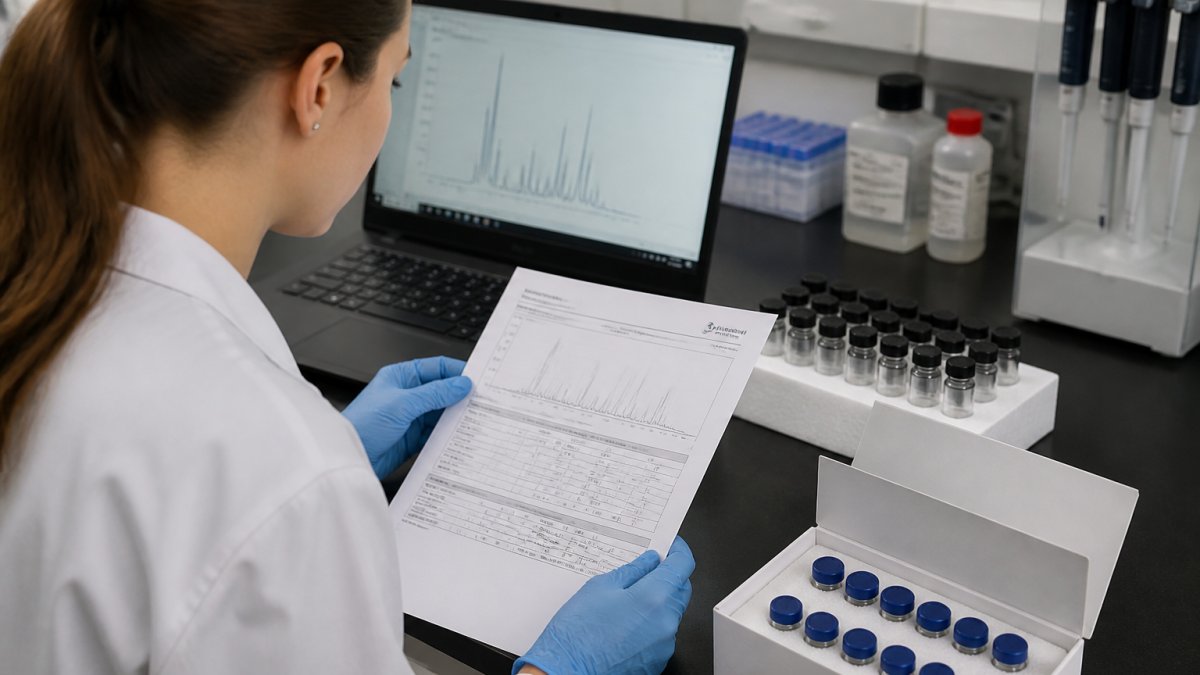
Work through the report in this order, and stop at the first item that does not check out:
- Header and identifiers. Confirm the compound name, sequence, lot number, and testing date. The lot number on the report must match the lot number on the vial label exactly, not a catalog number, not a product code. A report for a different lot tells you nothing about the material in your hands.
- Testing laboratory. Identify who performed the analysis. A report issued by the same entity that sold the material is a self-declaration, not independent verification. Look for a laboratory name, an address, and a report or job number you could reference if you needed to follow up.
- Method description. Note the column type and dimensions, mobile phase, gradient, flow rate, detection wavelength, and injection volume. A report that states only "HPLC" without these parameters cannot be reproduced or challenged. If the method is not named, treat the purity figure as unverified.
- Purity result and chromatogram. Read the percentage alongside the chromatogram, never in isolation. Check the baseline (is it flat or drifting?), the peak shape (tailing or fronting can hide co-eluting impurities), and the integration (are small peaks being ignored or manually excluded?). A single sharp peak on a clean baseline supports the number; a noisy trace with a reported 99% does not.
- Identity result. Confirm the observed mass matches the expected mass for the stated sequence, and check the mass accuracy, how close the observed value sits to the theoretical value. A match within a tight tolerance is meaningful; a loose match may not distinguish the target from a closely related sequence.
- Contaminant panel. Check which contaminants were screened for and what limit applied to each. A panel that lists tests without limits, or limits without units, is incomplete.
- Raw data attachments. Look for the actual chromatogram and mass spectrum, not just a summary table. Summaries can be transcribed incorrectly or selectively; raw traces can be inspected.
Red flags that should pause acceptance
- A purity figure reported to two decimal places with no chromatogram attached.
- A method section that omits the column or detection wavelength.
- A lot number that appears on the report but not on the label, or vice versa.
The United States Pharmacopeia general chapters on analytical quality provide useful context for what a defensible analytical record should contain, including expectations around method description, system suitability, and documentation of raw data.
Batch Testing, Contaminant Panels, and Batch Consistency
Batch testing is the practice of analyzing each production lot rather than assuming consistency from a single reference sample. Batch consistency is the evidence that results hold steady across lots over time.
Contaminant panels screen for the impurities most likely to appear in a given synthesis route: residual solvents, heavy metals, microbial contamination, and degradation products. The panel should state which contaminants were tested and the limit applied to each.
Consistency is where most supply chains fail quietly. Two vials from the same catalog number can come from different synthesis runs with different impurity profiles. Per-lot testing is the only way to catch that.
Peptide Storage Guidelines and Stability Controls After Delivery
Peptide storage guidelines exist because a verified compound can degrade after it arrives. A certificate of analysis describes the material at the moment of testing; it says nothing about what happens during transit, on a loading dock, or in a freezer that cycles open and closed. Stability controls are the practices and records that preserve the quality the CoA documented.
What degrades a peptide
- Temperature excursions. Lyophilized peptides generally tolerate short-term ambient transit, but repeated or prolonged exposure to warm conditions can accelerate degradation, oxidation, and aggregation. A single hot afternoon in a delivery vehicle is a different event from a controlled cold-chain shipment.
- Moisture. Lyophilized powder is hygroscopic. Every time a vial is opened to ambient air, it takes on water. Moisture promotes hydrolysis and can turn a stable powder into a degraded solution over time.
- Light. Many peptides contain residues sensitive to photodegradation. Amber vials, opaque packaging, and storage in the dark reduce this risk.
Storage practice by state
| State | Typical Storage | Key Controls |
|---|---|---|
| Lyophilized, sealed | Low temperature, protected from light and moisture | Desiccant, amber or opaque vial, minimal opening |
| Lyophilized, opened | Same, with desiccant and prompt resealing | Log opening date; avoid repeated exposure |
| Reconstituted, short-term | Refrigerated | Use within the near term; label with reconstitution date |
| Reconstituted, long-term | Frozen, aliquoted | Avoid repeated freeze-thaw; record each cycle |
Stability data and what it does and does not tell you
Stability data describes how a specific peptide behaves under defined conditions over a defined period. It is not a universal guarantee. A stability study run in one buffer at one concentration may not predict behavior in a different formulation. When stability data is available, check the conditions tested, the duration, the analytical method used to detect degradation, and whether the study was run on the same lot you hold.
Shipping and receipt controls
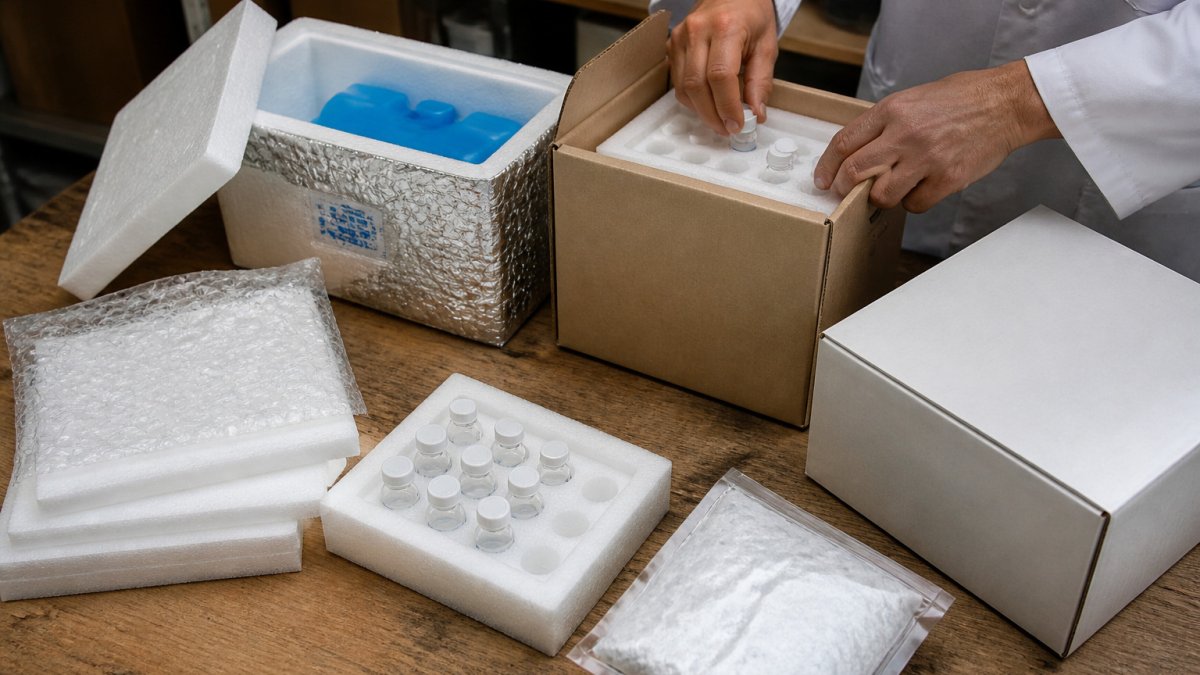
Quality assurance does not stop at the loading dock. On receipt, inspect packaging for tamper evidence, check for temperature indicators if included, and note the condition of the vials. Record the receipt date, the packaging condition, and the storage location. If a shipment arrives warm or damaged, document it before storing the material, a contemporaneous note is far more useful than a reconstruction weeks later.
Building a handling log
For regulated research environments, a simple log covering receipt date, storage conditions, opening dates, reconstitution dates, and freeze-thaw cycles supports the chain of custody that reviewers expect. The log does not need to be elaborate; it needs to be contemporaneous and complete. A reviewer who can trace a vial from delivery through use has a defensible record. A reviewer who cannot has an assumption.
Conclusion: Building a Repeatable Verification Workflow
The value of that sequence is repeatability. A one-time check tells you about one vial. A documented workflow tells you whether a supply chain can be trusted across an entire study.
Online Peptide Sales supplies research compounds in 10-vial kits with Janoshik-verified batch reports for identified samples, tamper-evident export packaging, and express international shipping, which gives researchers the documentation trail a verification workflow depends on.
Frequently Asked Questions
How is research peptide purity tested?
Purity is measured mainly by HPLC (high-performance liquid chromatography), which separates the target peptide from related impurities and reports each as a percentage of total peak area. Mass spectrometry then confirms the molecular weight matches the expected sequence. Because HPLC relies on UV detection, it cannot see every possible impurity, so a 99% purity figure reflects what the method detects, not a complete chemical profile. Reputable suppliers run both methods on each batch and publish the results.
What should a peptide certificate of analysis include?
A complete peptide certificate of analysis should list the peptide name and sequence, lot number, test date, and testing laboratory. It should show HPLC purity percentage with the method used, mass spectrometry results with expected versus observed mass, and any contaminant screening results. Look for a chromatogram image, not just a number, plus the analyst's signature or report ID. Without a lot number tying the report to your specific vials, the document proves very little about what you received.
Can a purity report confirm that a peptide is safe for human use?
No. Research peptide quality assurance standards address identity, purity, and consistency for laboratory work only. A certificate of analysis does not evaluate sterility, endotoxins, or safety for human consumption, and research-grade materials are not manufactured under pharmaceutical good manufacturing practice. A 99% purity result means the detected peak area is 99% of the total; it says nothing about whether the compound is appropriate for any human use. These products are labeled research use only.
How do you check whether a peptide test report matches a specific batch?
Match three things: the lot number on the vial label, the lot number printed on the report, and the test date relative to when the batch was produced. Then confirm the peptide name and sequence on the report match your order. If a supplier offers Janoshik-verified batch reports for identified samples, ask for the report tied to your lot rather than a generic sample. A report without a lot number cannot be linked to what you received, so treat it as marketing rather than documentation.
What contaminants can peptide testing detect?
Analytical testing can flag deletion sequences, truncated fragments, oxidation products, and residual solvents or counterions left from synthesis and purification. Mass spectrometry catches mass variants, while HPLC reveals related impurities that elute near the main peak. Heavy metals, microbial contamination, and endotoxins require separate assays that most routine peptide reports do not include. If your protocol demands those panels, request them explicitly and confirm the testing laboratory can perform them before ordering.
How should research peptides be stored to preserve quality?
Lyophilized peptides are generally most stable stored dry at -20°C, protected from light and moisture. Once reconstituted, most should be kept at 2-8°C for short-term use and frozen for longer storage, with aliquoting to avoid repeated freeze-thaw cycles. Peptide storage guidelines vary by sequence: some peptides with cysteine or methionine residues oxidize faster and need stricter handling. Record reconstitution dates, use appropriate buffers, and avoid leaving vials at room temperature longer than necessary.