 how-to
How to Spot Fake Peptides: 2026 Lab Verification Guide
Table of Contents
- Why Fake Peptides Are a Growing Problem in Research
- Understanding Peptide COA Reports: What Real Documentation Looks Like
- How to Verify Peptide Purity Through Independent Testing
- Identifying Underdosed Peptides: Signs Your Vial Isn't What It Claims
- Visual Red Flags: Counterfeit Packaging and Labeling
- Payment and Vendor Red Flags That Signal Fake Peptides
- Conclusion: Building a Verification Workflow Before You Order
- Frequently Asked Questions
Last Updated: October 4, 2026
Why Fake Peptides Are a Growing Problem in Research
Learning how to spot fake peptides starts with what is inside the vial. Counterfeit research compounds are harder to detect because packaging, labels, and paperwork now look convincing at a glance.
A peptide is only as good as its documentation. Without a batch-specific report, a label is just a claim.
What Counterfeit Peptides Actually Contain
Fake vials rarely contain nothing, most hold something cheaper than the label promises.
Common substitutes include:
- Underdosed real peptide diluted with filler to stretch volume
- A different peptide entirely, often a cheaper analog
- Inert powders like mannitol or lactose that dissolve without effect
Mannitol and lactose dissolve cleanly, so a fake vial can look identical to a real one. Visual checks alone fail; the only reliable signal is analytical data tied to the batch.
Understanding Peptide COA Reports: What Real Documentation Looks Like
A Certificate of Analysis (COA) reports the measured identity, purity, and content of a specific batch, tying a tested sample to a batch number, a test method, and a date.
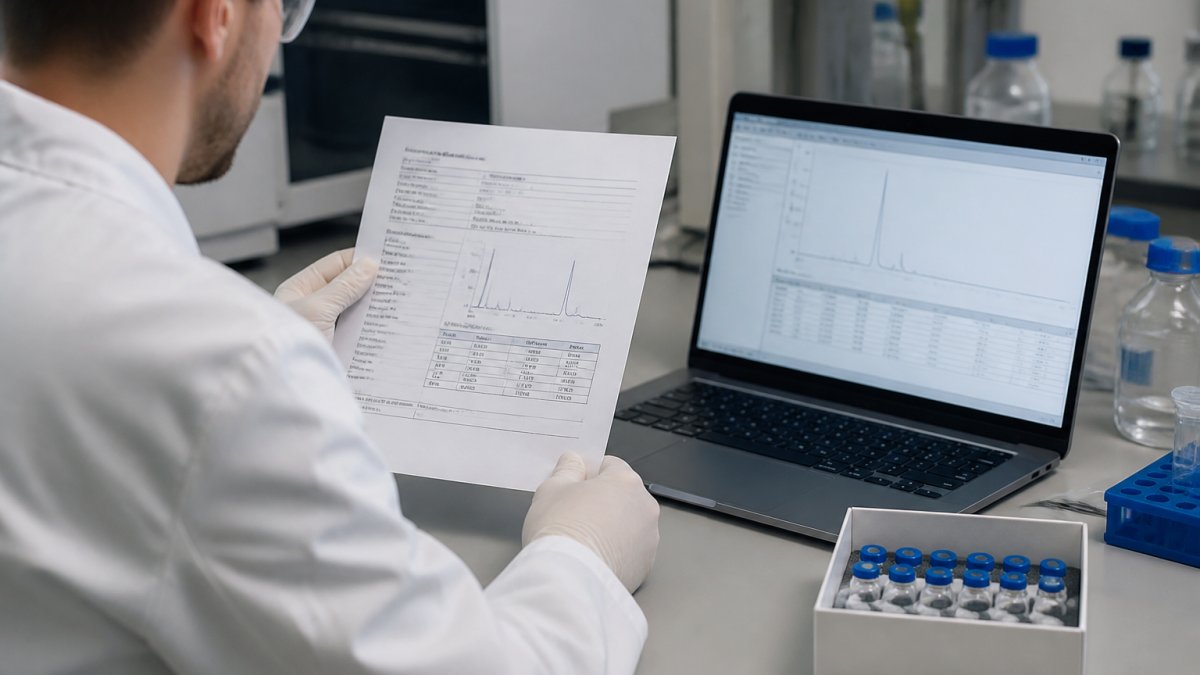
Most fake peptides fall apart here: the paperwork is generic, undated, or reused across unrelated products.
Key Sections Every Legitimate COA Must Include
A real report is not a single purity number on a PDF. It contains several linked sections.
| Section | What It Shows | Why It Matters |
|---|---|---|
| Batch number | Unique ID for the tested lot | Ties report to your vial |
| Test method | HPLC, MS, or both | Confirms how identity was checked |
| Purity result | Percentage from chromatogram | Flags underdosed or impure material |
| Net content | Actual mass per vial | Catches short-filled vials |
| Amino acid sequence | Expected structure | Confirms correct peptide |
| Molecular weight | Measured mass | Matches sequence to compound |
| Lab name and date | Who tested and when | Enables independent verification |
If any are missing, treat the report as incomplete. A purity figure with no batch number proves nothing.
HPLC Purity vs. Net Content: Why Both Numbers Matter
HPLC purity measures how much of the detected material is the target peptide, as a percentage of peak area. Net content measures how much material is actually in the vial.
These are different claims, and fake peptides exploit the gap. A vial can show 98% purity and still be underdosed, because purity says nothing about quantity.
Check both numbers. A report listing purity but not net content hides half the picture.
How to Verify Peptide Purity Through Independent Testing
Verifying peptide purity means confirming the report matches the material, not trusting the seller's copy. The strongest method is contacting the testing lab directly.
Contacting a Lab to Confirm a COA
Most analytical labs keep records of the samples they test. If a seller claims third-party testing, the lab can usually confirm whether that batch number was ever submitted.
Here is a practical workflow:
- Note the lab name, batch number, and test date from the COA
- Find the lab's official contact details, not the seller's link
- Ask whether the batch number appears in their records
If the lab has no record, the report is fabricated; if it confirms the batch, you have independent proof. A second option is submitting a sample yourself, slower, but it removes all doubt for critical work.
Identifying Underdosed Peptides: Signs Your Vial Isn't What It Claims
Underdosed peptides are the most common form of fake product because they are hardest to notice: the vial looks right, the powder dissolves, and nothing seems wrong until results fall short. Catching underdosing requires measurable signals, not appearance.
The Fill Weight Math
A vial labeled 5 mg should contain 5 mg of lyophilized peptide; underdosing means it holds less, sometimes 20% less, sometimes half. Because the powder is mostly air by volume, cake height tells you nothing; the only reliable field check is a calibrated scale. Weigh the sealed vial on a calibrated milligram scale and compare against a known-good vial of the same size and label, a consistent shortfall across multiple vials points to systematic underfilling.
Reading the Chromatogram for Underdosing
HPLC purity and net content are separate measurements, and underdosing hides in the gap. A chromatogram can show a single clean peak at 98% purity while the vial holds only half the labeled mass, purity describes the ratio of target peptide to other material injected, not how much was in the vial.
When you review a report, look for two distinct numbers:
- Purity percentage, the share of the detected peak area belonging to the target peptide
- Net content, the measured mass of peptide per vial, usually reported in mg
A report listing purity but omitting net content is incomplete, the most common gap in counterfeit documentation, because net content exposes underfilling.
Impurity Peaks and Synthesis Quality
Underdosing often travels with poor purification. A rushed batch carries extra peaks, truncated sequences, deletion products, and residual reagents eluting near the main peak.
Watch for these patterns on a chromatogram:
- Multiple large peaks rather than one dominant peak
- A broad or split main peak, which can indicate degraded or partially decomposed material
- High baseline noise, which can mask small impurity peaks
A report showing 95% purity with a messy chromatogram is weaker than 95% with a clean one, the percentage alone does not tell you what the other 5% is.
Physical and Behavioral Signs
Beyond the lab data, a few field observations are worth tracking across batches:
- Weak or inconsistent solubility compared to prior batches of the same peptide
- Cloudy reconstitution when the material should dissolve clear
- Batch numbers that change with every order from the same listing, which can indicate repackaging rather than consistent production
None of these signs is conclusive alone, but together with a net content figure and a clean chromatogram they form a picture. The strongest position is a batch-specific report listing both purity and net content, backed by a readable chromatogram.
Why Underdosing Persists
Underdosing is profitable because it is hard to detect without a scale and a lab report: a seller can stretch a real batch across more vials and rely on buyers who never weigh or test. The defense is the same as for any counterfeit signal, demand batch-specific documentation that includes net content, and verify it independently when the work matters.
Visual Red Flags: Counterfeit Packaging and Labeling
Most guides on spotting fake peptides focus on lab data and digital verification, missing visual identification of counterfeit packaging, the fastest check you can run before a vial reaches a lab. Packaging is the easiest thing to copy, so it carries the least weight in your final decision, but it is the first filter you can apply.
Vial Seals and Crimp Patterns
A legitimate sealed vial uses an aluminum crimp ring compressing a rubber stopper against the glass lip. The crimp should be uniform around the circumference, with even pressure and no gaps between ring and glass.
Look for:
- Uneven crimp pressure, one side tighter than the other, which can indicate hand-crimping rather than a machine seal
- Loose or spinning crimp rings that rotate freely on the vial neck
- Damaged or nicked aluminum with sharp edges or tears
A repackaged vial often shows a crimp that was removed and reapplied, stretched aluminum, discoloration at the fold, or tool marks, strong signals the contents were transferred from another container.
Label Print Quality and Font Consistency
Counterfeit labels are usually reproduced from a scan or photograph, which introduces telltale artifacts.
Check for:
- Blurry or pixelated text, especially on small print like batch codes and concentrations
- Misaligned printing where text drifts off-center or runs into the label edge
- Inconsistent fonts between the product name, the concentration, and the batch code, a real label uses a consistent typeface throughout
A slightly off logo, a font that shifts mid-label, or a batch code in a different typeface are all signals to look closer.
Batch Code and Lot Number Matching
The batch code on the vial label should match the batch number on the Certificate of Analysis exactly, one of the most reliable visual checks, because counterfeiters often reuse a single COA across multiple batches.
Compare:
- The batch code on the vial label against the batch number on the COA
- The lot number on the outer packaging against the vial label
- The date on the label against the test date on the COA, a COA dated before the batch was produced is a clear inconsistency
If the numbers do not match, or the same COA appears across listings with different batch codes, treat the documentation as unreliable.
Tamper-Evident Features
Legitimate export packaging typically includes tamper-evident elements that show whether a container has been opened:
- Shrink bands around the cap or vial neck that must be broken to open
- Sealed outer boxes with a perforated tear strip
- Security tape that leaves a residue pattern if removed
A vial arriving with no tamper-evident seal, or one already broken, has an unknown chain of custody, not proof the contents are fake, but a lost layer of assurance.
What Visual Checks Cannot Tell You
Visual inspection is a filter, not a verdict. A counterfeit vial can pass every visual check, clean crimp, sharp label, matching batch code, and still contain underdosed or substituted material, since fillers like mannitol and lactose dissolve clear and look identical to a real one.
Use visual checks to eliminate obvious problems and decide which vials are worth analytical testing, not to confirm authenticity. That comes from a batch-specific report with a net content figure and a chromatogram you can verify independently.
A Practical Visual Workflow
Run these checks in order before any vial enters your workflow:
- Inspect the crimp for even pressure, no spinning, and no tool marks
- Read the label for print quality, font consistency, and alignment
- Match the batch code on the vial to the batch number on the COA
- Check the tamper seal on the outer packaging and the vial
- Compare against a known-good vial of the same product if you have one
Any single failure is a reason to pause. Multiple failures together are a reason to reject the shipment and request documentation before proceeding.
Payment and Vendor Red Flags That Signal Fake Peptides
Payment method is one of the clearest signals of vendor legitimacy. Legitimate sellers accept traceable payment and provide documentation on request.
Treat these as warning signs:
- Payment only in untraceable methods with no receipt
- Pressure to pay outside the normal checkout
- No physical business address or verifiable contact
A vendor that will not answer basic questions about testing, shipping, or replacements is telling you something.
Online Peptide Sales provides Janoshik-verified batch reports for identified samples, ships in secure export packaging, and offers an optional delivery guarantee with replacement or refund.
Conclusion: Building a Verification Workflow Before You Order
Fake peptides survive because buyers skip verification until something goes wrong. The fix is a repeatable workflow run before every order.
Start with the COA: confirm it lists a batch number, test method, purity, net content, amino acid sequence, and molecular weight. Then contact the lab to confirm the batch was tested.
None of these steps takes long, and together they close off nearly every route a counterfeit seller uses. Buyers who verify consistently stop being targets, that habit, more than any single check, protects a research supply chain.
Frequently Asked Questions
How do I know if my peptides are pure?
Request a batch-specific Certificate of Analysis showing HPLC purity above 95% and Mass Spectrometry confirmation of the molecular weight. The COA should list the amino acid sequence, chromatogram, and impurity profile. Cross-check the batch number on the vial against the report. If the vendor cannot provide a matching COA or the document lacks a chromatogram, treat the product as unverified and do not use it in controlled research.
What are the common red flags of low-quality research peptides?
Watch for COAs that lack batch numbers, HPLC chromatograms, or Mass Spectrometry data. Other signs include payment methods limited to cryptocurrency or wire transfer with no recourse, packaging with misspelled labels or inconsistent fonts, prices far below market rate, and vendors who refuse to answer technical questions about synthesis or testing. Any one of these signals warrants caution; two or more should stop the purchase.
How do third-party analytical reports confirm peptide authenticity?
Third-party reports from labs like Janoshik provide independent verification that the peptide's molecular weight matches the expected value via Mass Spectrometry and that HPLC purity meets the stated percentage. The report should include a chromatogram showing baseline noise and peak separation, plus an impurity profile. Because the lab has no financial stake in the vendor's sales, its data is harder to falsify than in-house testing claims.
Why is batch-specific testing critical for research peptides?
Peptide synthesis varies between batches. A COA from six months ago does not confirm the purity of the vial in your hand. Batch-specific testing ties the analytical data to the exact lot number printed on your vial. Without it, you cannot know whether the product was underdosed, contaminated, or substituted. Always match the batch number on the COA to the batch number on the packaging before using the compound.