 how-to
Is 98% Peptide Purity Good Enough? What COAs Really Mean
Table of Contents
- Is 98% Peptide Purity Good Enough? The Short Answer
- What Peptide Purity Percentage Actually Measures
- How to Read a Peptide Lab Report Line by Line
- Inside a Peptide HPLC Purity Report
- Peptide Identity Testing: The Check Purity Numbers Cannot Replace
- Peptide Certificate of Analysis: A Practical Checklist
- Matching Purity to Your Research: A Decision Framework
- Conclusion
- Frequently Asked Questions
Last Updated: October 15, 2026
Is 98% Peptide Purity Good Enough? The Short Answer
For most research work, 98% peptide purity is acceptable, but the number alone does not tell you whether a compound fits a specific study.
A 98% result means the main peak in a chromatogram covers 98% of the detected signal. The other 2% can include synthesis by-products, degradation products, or leftover solvents. Those traces matter more in some assays than others.
Here is the key problem: the same lot can read 98% in one lab and 94% in another. Method, column, and wavelength all shift the result.
What Peptide Purity Percentage Actually Measures
Peptide purity percentage measures how much of the detected material in a sample is the target peptide, based on one analytical method. It is a relative measurement, not an absolute one. The number reflects what the instrument sees under specific testing conditions.
Three things drive that reading:
- The detection wavelength, often UV absorbance at 214 nm (pubmed.ncbi.nlm.nih.gov)
- The column and gradient used to separate compounds
- How the software draws the baseline between peaks
Change any of these and the area percentage moves. That is why a purity result is only meaningful when the method is stated alongside it.
Area Percentage vs. Mass Purity
Area percentage and mass purity are not the same thing. HPLC reports area percentage: the share of the chromatogram's total peak area. Mass purity measures the actual weight of the target peptide in the sample.
A peptide can show 98% area purity and still contain salts, water, or counter-ions that add mass. So a 10 mg vial may hold less than 10 mg of pure peptide. This gap is one reason fill weight and quantity matter when comparing reports.
How to Read a Peptide Lab Report Line by Line
Reading a peptide lab report starts with the header, not the headline number. The top of the page tells you the sample, the lot, the method, and the date. Skip that context and the percentage means little.
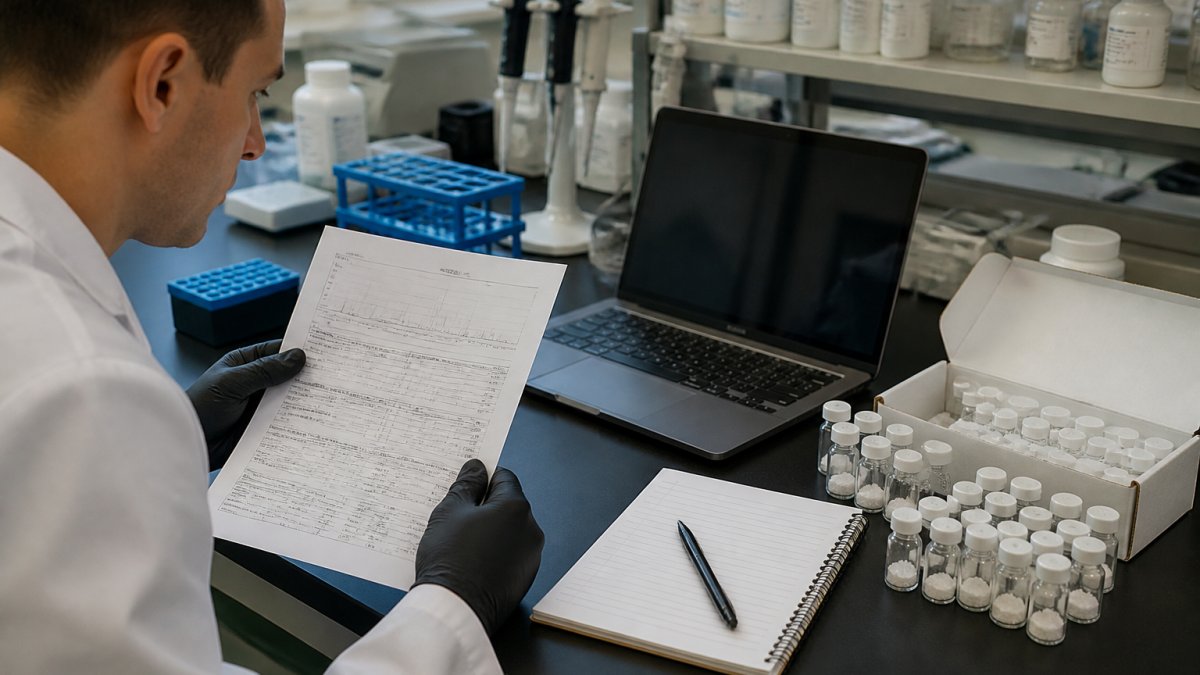
Work through these fields in order:
- Sample and lot number: confirms which batch was tested
- Test method: names the technique, typically HPLC
- Wavelength: shows how the detector read the sample
- Retention time: the peak's position, used to help confirm identity
- Purity result: the area percentage for the main peak
- Impurity peaks: any secondary peaks and their sizes
If a report lists a purity figure but no method or wavelength, treat it as incomplete. A number without conditions cannot be compared to anything.
Inside a Peptide HPLC Purity Report
A peptide HPLC purity report shows a chromatogram, a graph with peaks, plus a table of results. The tallest peak is usually the target peptide. Smaller peaks are impurities, and their total area sets the purity figure.
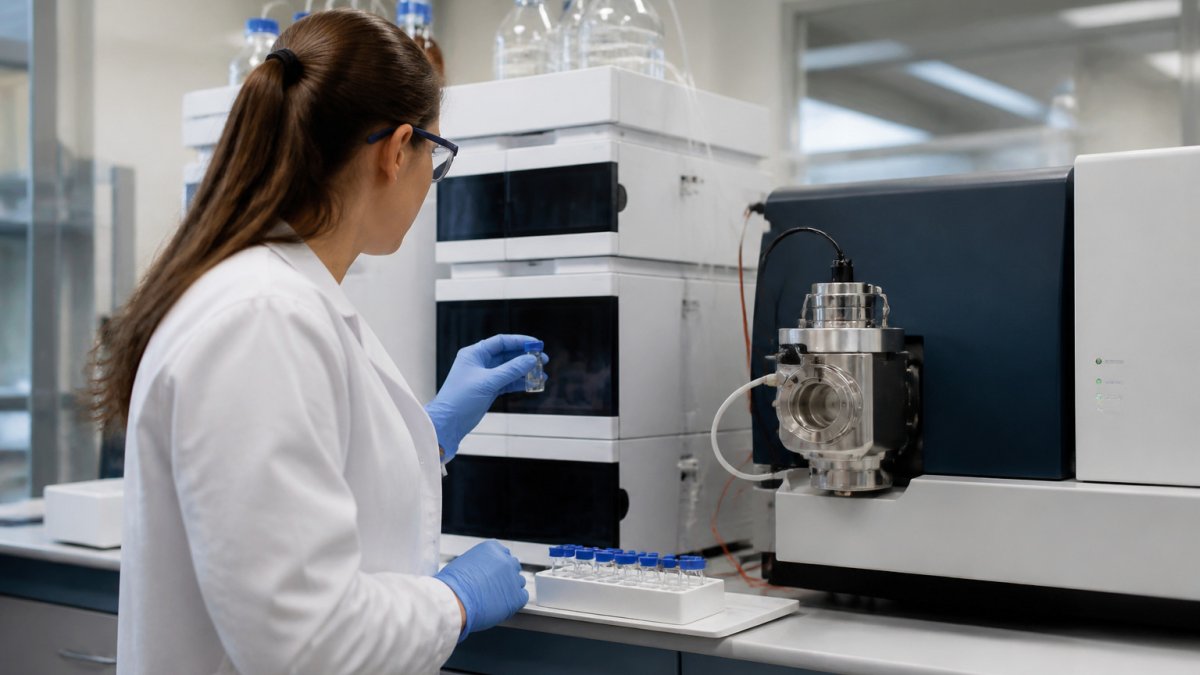
High-performance liquid chromatography separates compounds by how they interact with a column. The target peptide elutes at a set time, and the detector records its signal. Software then calculates each peak's share of the total.
Why Area Percentage Is Not Mass Purity
The number on the report is an area percentage, not a mass percentage. The detector, most often a UV detector reading absorbance at 214 nm, responds to peptide bonds, not to weight. Every compound that absorbs at that wavelength and elutes under the main peak contributes to the same signal.
That creates three limits worth understanding:
- Detector response varies by compound. Two different molecules at equal mass can produce different peak areas, so a 2% area peak is not necessarily 2% by weight.
- Co-elution hides impurities. If an impurity elutes at nearly the same time as the target peptide, the software may merge the two into one peak. The report then shows a cleaner number than the sample actually is.
- Non-absorbing material is invisible. Salts, water, counter-ions, and residual solvents often do not absorb at 214 nm. They add mass to the vial but never appear on the chromatogram.
A common pattern is a sample that reads 98% by area but holds meaningfully less than 98% target peptide by weight once salts and water are counted.
What a Single HPLC Run Cannot Tell You
A single HPLC run cannot confirm the peptide's identity on its own. It shows that one main peak dominates. It does not prove that peak is the compound you ordered.
This is the gap most readers miss. A clean chromatogram proves the sample is mostly one thing. It does not prove that thing is correct, and it does not prove the sample is sterile, free of endotoxin, or suitable for any particular use.
Why Two Labs Can Report Different Numbers for the Same Lot
Two labs can report different numbers for the same lot because their methods differ. A change in column, gradient, or wavelength shifts how peaks separate and how the baseline is drawn. One lab may resolve a small impurity peak; another may merge it into the main peak.
This is why a four percentage point gap between two reports is not proof that one lab is wrong. It often means the two labs tested under different analytical conditions. To compare fairly, compare the method, not just the number.
Peptide Identity Testing: The Check Purity Numbers Cannot Replace
Peptide identity testing confirms that the compound in the vial is the peptide you ordered. Purity testing cannot do this. A sample can be 98% pure and still be the wrong peptide entirely.
Mass spectrometry is the standard tool here. It measures the compound's molecular weight and matches it against the expected value. If the mass fits, the identity is supported.
This is the gap most buyers miss. A clean chromatogram proves the sample is mostly one thing. It does not prove that thing is correct.
| Test | What It Confirms | What It Misses |
|---|---|---|
| HPLC purity | Share of main peak | Correct identity |
| Mass spectrometry | Molecular weight match | Full purity profile |
| Both combined | Purity and identity | Nothing replaces both |
Peptide Certificate of Analysis: A Practical Checklist
A peptide certificate of analysis, often called a COA, is the document that reports test results for a specific batch. Use this checklist to judge whether a COA is complete and trustworthy.
- Sample and lot number clearly stated
- Test method named, with wavelength and column
- Purity result given as area percentage
- Chromatogram included, not just a number
- Identity test shown, such as mass spectrometry
- Testing date present
- Independent lab named, not self-reported
- Report tied to the exact lot you receive
A COA that lists a purity figure with no method, no chromatogram, and no identity check is thin. It may be genuine, but it does not give you enough to verify anything.
Online Peptide Sales provides Janoshik-verified batch reports for identified samples, so the lot you receive links to a named, independent test.
Matching Purity to Your Research: A Decision Framework
Matching purity to your research means asking what the study needs, not chasing the highest number. The query "is 98% good enough" has no single answer because "good enough" depends entirely on what the material is being used for, and, critically, on what the purity figure does and does not establish.
Purity Is Not Safety or Suitability
This is the most important distinction in the entire article. A chromatographic purity figure, whether 95%, 98%, or 99%, does not establish that a compound is safe, sterile, free of endotoxin, or appropriate for human use. It measures one thing: the share of detected signal in the main peak under one set of conditions.
No purity threshold makes a research compound safe or appropriate for clinical use. That determination requires a different category of testing entirely, sterility, endotoxin, identity confirmation, and regulatory review, none of which a purity percentage provides.
A Use-Based Decision Framework
Use this framework to match analytical requirements to intended research use:
- Routine screening or broad assays: 95% or higher is often workable, provided the method is stated and a chromatogram is included.
- Quantitative work or calibration: higher purity reduces interference from impurity peaks, but the method must be documented so results are reproducible.
- Identity-critical work: require mass spectrometry alongside HPLC, a purity figure alone cannot confirm the peptide is the correct compound.
- Sensitive analytical tasks: demand a full method, a clean chromatogram, and orthogonal testing where the assay is sensitive to co-eluting impurities.
The decision rests on three questions: What does the assay measure? How much impurity can it tolerate? And does the report prove identity, not just purity?
If the answer to the last question is no, the purity number is not enough, whatever it reads. A 99% figure with no identity confirmation is weaker evidence than a 96% figure with mass spectrometry behind it.
When to Ask for Orthogonal Testing
Orthogonal testing means confirming a result with a second method that works on a different principle. HPLC separates by interaction with a column; mass spectrometry separates by molecular weight. Because they fail in different ways, using both catches problems a single method would miss.
Ask for orthogonal testing when:
- The assay is sensitive to small impurity differences
- The peptide is expensive or the study is hard to repeat
- Two labs have reported conflicting purity figures
- The identity of the compound matters as much as its purity
Online Peptide Sales provides Janoshik-verified batch reports for identified samples, so the lot you receive links to a named, independent test.
Conclusion
The purity figure is a starting point, not a verdict. A 98% result means little without the method, the chromatogram, and an identity check beside it. Read the report, compare the conditions, and match the number to what the study actually needs. Online Peptide Sales supplies research compounds in 10-vial kits with Janoshik-verified batch reports, secure export packaging, and express international shipping for legitimate laboratory use.
Frequently Asked Questions
Is 98% purity good for peptides?
For most research applications, a reported 98% peptide purity is a solid figure, since it means the main peak accounts for 98% of the UV signal detected in that HPLC run. What it does not tell you is whether the remaining 2% is water, counterions, or something more concerning. Treat the number as one data point, then check the method, the chromatogram, and the identity confirmation before drawing conclusions.
Does 98% peptide purity confirm a peptide's identity?
No. Purity and identity are separate measurements. A purity percentage only describes how much of the detected material elutes as one peak; it says nothing about whether that peak is the correct sequence. Peptide identity testing, usually by mass spectrometry, is what confirms the molecular weight matches the expected compound. A sample can show high purity and still be the wrong peptide entirely.
What should a peptide HPLC purity report include?
A useful peptide HPLC purity report lists the column and mobile phase, the detection wavelength (commonly 214 nm for the peptide backbone), the gradient, the integration method, and the retention time of the main peak. It should also show the actual chromatogram, not just a summary number. Without the method stated, a purity result is hard to compare against any other report.
Can a peptide be highly pure but still have quality issues?
Yes. A high purity number rules out nothing about sterility, endotoxin content, residual solvents, or correct storage history. It also does not detect a peptide that has degraded into a form that co-elutes with the main peak. If your work is sensitive to those factors, look for orthogonal testing and documented handling rather than relying on the purity percentage alone.
How should I interpret a peptide certificate of analysis?
Read a peptide certificate of analysis as a record of what was tested, on which lot, by which method. Check the lot number matches your vial, the test date is recent, the methods are named, and identity confirmation is included alongside purity. If a COA shows only a purity percentage with no method or chromatogram, ask for the full report before treating the figure as meaningful.