 how-to
How to Aliquot Peptides for Long Term Storage
Table of Contents
- Why Aliquot Peptides for Long Term Storage
- What You'll Need Before You Start
- Step-by-Step: How to Aliquot Peptides
- Peptide Storage Temperature: -80°C vs -20°C
- How to Choose the Right Peptide Aliquot Size
- Peptide Vial Labeling and Sample Tracking
- Preventing Peptide Freeze Thaw Cycles
- Common Mistakes to Avoid When You Aliquot Peptides
- Frequently Asked Questions
Last Updated: October 8, 2026
Why Aliquot Peptides for Long Term Storage
Learning how to aliquot peptides for long term storage protects both your sample and your results. An aliquot is a single-use portion of a peptide solution, sealed and frozen so it can be thawed once, used once, and never refrozen.
Online Peptide Sales supplies research compounds in 10-vial kits with Janoshik-verified batch reports, and the storage questions come up with every order. The short answer: split your peptide into small portions before you freeze anything.
The Cost of Repeated Freeze-Thaw Cycles
Every thaw exposes a peptide to moisture, oxygen, and temperature swings. Each refreeze adds another round of stress. Over time, that cycle breaks down the peptide chain, and the damage shows up as drift in your assay readings.
The fix is simple. One vial in, one aliquot out, one use per tube. No leftovers, no second thaw.
What You'll Need Before You Start
Gather your supplies before opening any vial. Working one-handed mid-procedure is how contamination happens.
- Lyophilized peptide vials from your kit
- Reconstitution solvent (sterile water, bacteriostatic water, or buffer such as PBS)
- Low-binding microcentrifuge tubes for each aliquot
Work at a clean bench, ideally under a laminar flow hood. Wipe the surface, wear gloves, and keep every tube capped until the moment you fill it. The CDC guidance on safe laboratory practices covers the basics of aseptic technique if you want a refresher.
Step-by-Step: How to Aliquot Peptides
The full process takes about 30 to 45 minutes for a standard 10-vial kit. Work steadily, label as you go, and note the workflow below is written for a single researcher.
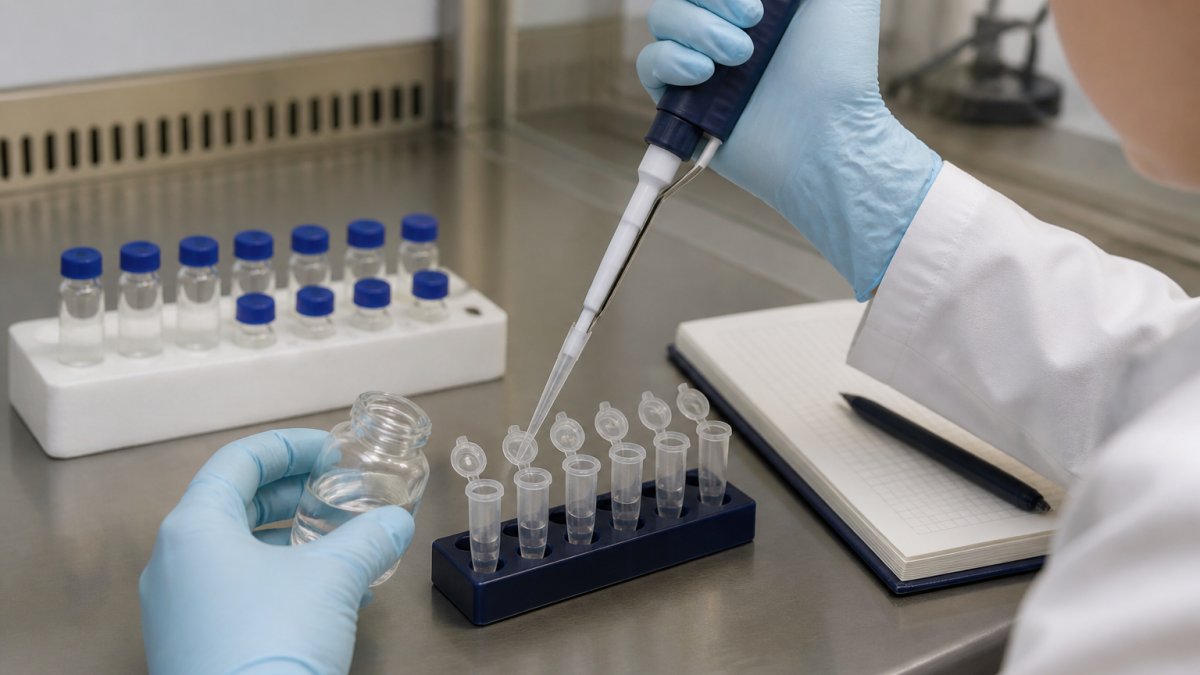
Step 1: Reconstitute the Lyophilized Peptide
A lyophilized peptide is a powder form of the compound, dried under vacuum so it stays stable in transit. To bring it back into solution, add your chosen solvent down the inside wall of the vial rather than straight onto the powder.
Let the vial sit until the powder fully dissolves; if particles remain, swirl again rather than warming the vial, since heat speeds degradation. Note the final volume in your log, because every later dilution depends on it.
A few practical anchors for this step:
- Solvent choice: Sterile water for immediate use, bacteriostatic water when a reconstituted stock will be held at 2-8°C for days, and a buffered solution such as PBS when the peptide is sensitive to pH swings.
- Volume: Add solvent in one steady stream rather than several small squirts; repeated wetting and drying at the powder surface is harder on the peptide.
- Mixing: Swirl or roll the vial between your palms. Avoid vortexing, which introduces air and shear.
Step 2: Divide Into Single-Use Aliquots
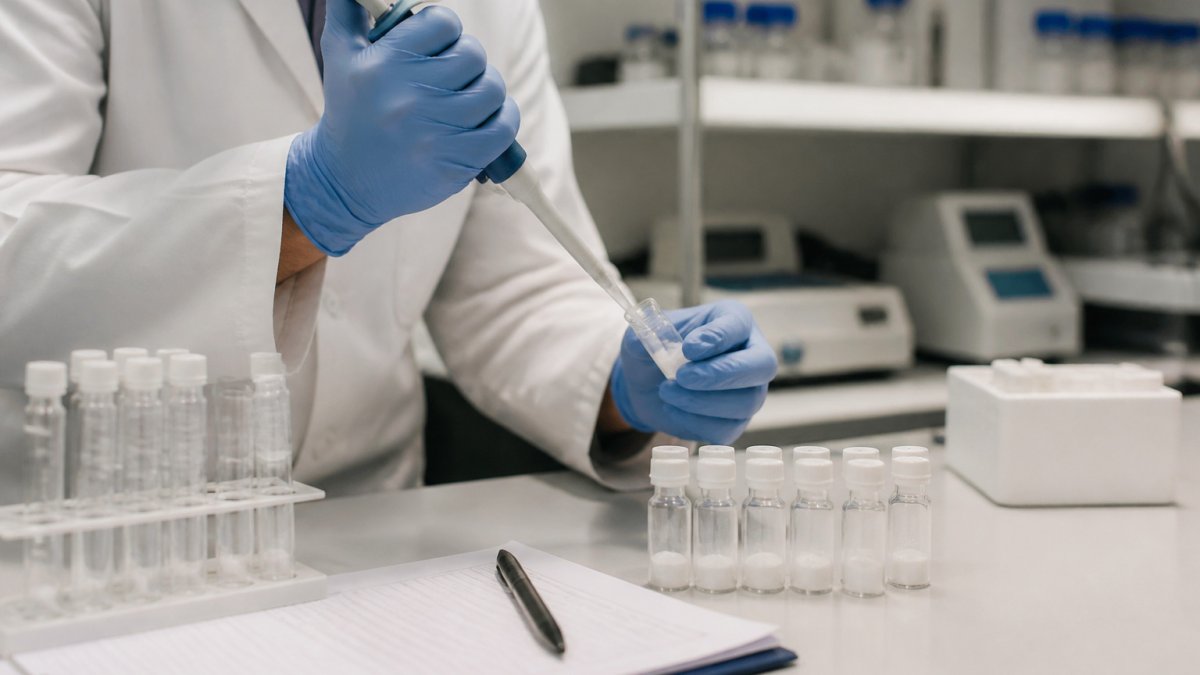
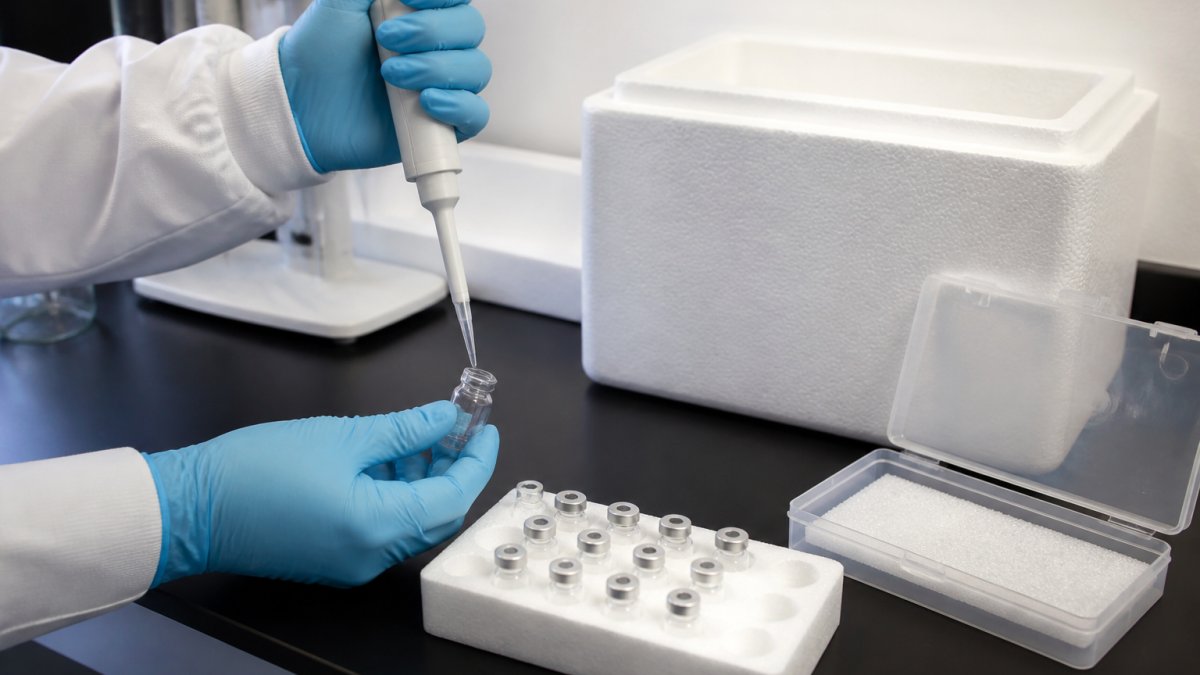
Draw the reconstituted peptide solution into your micropipette and dispense one portion per tube, capping each immediately. Keep the stock vial on ice while you work.
Aim for single-use aliquots sized to your typical experiment. If a run needs 50 microliters, fill tubes to 50 microliters, not 200; leftover volume invites a second thaw.
A repeatable dispensing sequence looks like this:
- Set the micropipette to your target volume and check it against a balance or practice tube before you touch the stock.
- Label the first tube and place it in a rack on ice.
- Draw from the stock vial, dispense into the tube, and cap it before moving to the next.
- Change tips between tubes if you work with more than one peptide, and change tips if a tip touches anything other than the inside of the target tube.
- Work from the stock vial in one pass rather than returning to it repeatedly; each re-entry is another chance for contamination.
Step 3: Freeze and Store
Label every tube before it goes in the freezer, then move the rack to cold storage and log the date, concentration, and solvent used. Once frozen, an aliquot stays sealed until you need it: thaw on ice, use the full tube, and discard the rest.
For a clean freeze, place tubes upright in a rack at the back of the freezer rather than the door, where temperature swings are largest.
Sterile Technique and Contamination Prevention
This is where reproducibility is won or lost. Aseptic handling is not complicated, but it is unforgiving of shortcuts.
- Work in a clean, draft-free space. A laminar flow hood is ideal; if you do not have one, a wiped bench away from open doors and vents is the next best option.
- Wipe the bench and the outside of every vial with a suitable laboratory disinfectant before you start, and let surfaces dry.
- Wear gloves and change them if you touch a phone, a door handle, or your face.
Peptide-Specific Compatibility and Stability
Generic aliquoting advice has a real limit: stability depends on the specific sequence, formulation, solvent, and concentration. A short, robust peptide may tolerate conditions that would degrade a longer or more sensitive one.
Before you aliquot a new compound, check the product-specific data that came with it. Online Peptide Sales ships Janoshik-verified batch reports with each kit, and those reports are the right place to confirm identity and batch details before you commit a whole vial to a storage plan.
A practical habit is a small pilot: aliquot a few tubes, store them under your intended conditions, and test one at intervals. That gives you evidence for your own peptide rather than borrowed assumptions.
Peptide Storage Temperature: -80°C vs -20°C
Peptide storage temperature comes down to how long you need the sample to last.
The trade-off is access. A -80°C freezer holds more stable conditions, but every door opening warms the whole unit. Keep a written inventory on the outside so you can find a tube without digging.
| Storage Goal | Temperature | Typical Use |
|---|---|---|
| Short-term storage | -20°C | Active experiments, weeks to months |
| Long-term storage | -80°C | Archive samples, months to years |
| Working solution | 2-8°C | Same-day or next-day use |
Protect samples from light exposure as well. Amber tubes or a foil wrap over the rack block the UV that slowly breaks peptide bonds.
How to Choose the Right Peptide Aliquot Size
Peptide aliquot size should match one experiment, not one week of work. Check your protocol for the volume a single run consumes, add a small margin for pipette error, then round to a number you can measure cleanly.
- Match the run: fill to the exact volume your assay uses
- Round sensibly: 25, 50, or 100 microliters are easy to track
- Cap the count: more tubes means more surface area and more handling
A Decision Framework for Aliquot Size
1. What does one run actually consume?
Read the protocol for the working volume, not the stock volume.
2. How many runs will you do from this vial?
3. What is the smallest volume you can pipette accurately?
Very small aliquots look efficient but carry more relative error.
4. What is the cost of one wasted tube versus one wasted vial?
Smaller aliquots mean less material lost if a tube is compromised, but more tubes, labels, and freezer space.
Worked Example
Suppose a vial reconstitutes to 1 mL of stock, and your protocol calls for 50 microliters per run.
- 1,000 microliters ÷ 50 microliters per run = 20 runs
- 20 runs = 20 single-use aliquots of 50 microliters each
- If you want a small margin for pipette error, 21 tubes of 50 microliters leaves the last tube slightly short, better to make 20 tubes and accept the exact volume
If your protocol needs a range of concentrations, prepare a small set of working dilutions and aliquot those separately. Use the dilution equation, C1V1 = C2V2, to work out how much stock and buffer each tube needs, and label each dilution level clearly, a "1 mg/mL" tube and a "0.1 mg/mL" tube look identical in a frosty freezer.
When to Deviate From the Rule
A few situations justify breaking the single-use rule:
- Very expensive or scarce material: if a full run uses less than your pipette can measure accurately, a slightly larger aliquot that you split once may be the lesser evil. Document the split so you know the tube was opened twice.
- Stability testing: if you are running a stability study, you may need matched aliquots held under different conditions. Size those to the test, not to a single assay.
- Shared protocols: if more than one researcher draws from the same batch, agree on a standard aliquot size so the inventory stays predictable.
Peptide Vial Labeling and Sample Tracking
Peptide vial labeling is what makes an aliquot useful six months later. A tube with no label is one you cannot trust, and re-testing a sample you already characterized wastes material and time.
Write on cryo-safe labels with a permanent marker, and cover the label with clear tape if tubes sit in a frosty freezer. Include:
- Peptide name and batch number
- Concentration and solvent
- Date frozen
Keep a matching entry in a lab notebook or spreadsheet: tube label matches row, row matches batch report. Online Peptide Sales provides Janoshik-verified batch reports for identified samples, so batch numbers on your tubes line up with the documentation in your records.
Preventing Peptide Freeze Thaw Cycles
Preventing peptide freeze thaw cycles is the whole point of aliquoting. Once a tube is frozen, it should not thaw until the day it is used; every extra cycle adds moisture and stress a peptide cannot undo.
A few habits keep the count at one:
- Pull only the tubes you need for the day
- Thaw on ice, never in a warm water bath
- Use the full tube once it's open
If you thaw a tube and the experiment gets cancelled, mark it as used and set it aside for a same-day run. A short stay at 2-8°C is far kinder than a second freeze.
Common Mistakes to Avoid When You Aliquot Peptides
Most storage failures trace back to a handful of habits. Watch for these before they cost you a batch.
- Refreezing leftovers. The single biggest cause of degradation.
- Aliquots that are too large. Big tubes invite second thaws.
- Unlabeled or smeared tubes. You lose track of what you have.
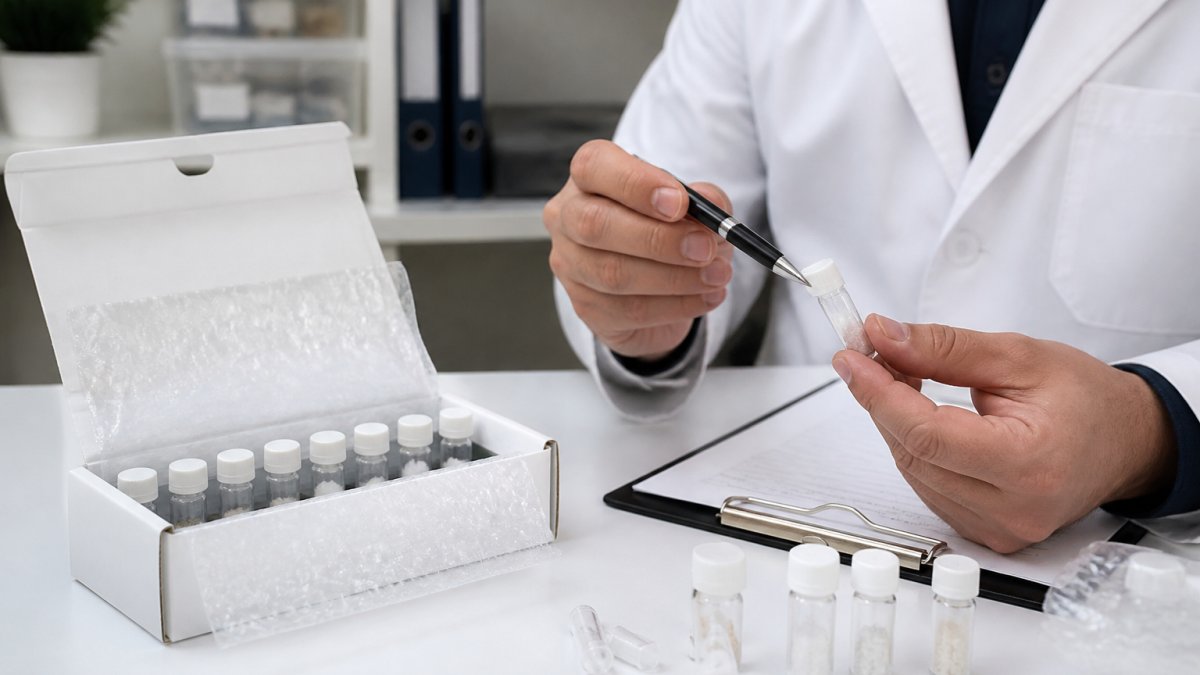
Get these six right and your peptide handling stays clean from the first freeze to the last use. Aliquot once, label well, and let each tube serve a single experiment. That discipline keeps long-term storage reliable, and it is the same standard Online Peptide Sales builds its kits around, with tamper-evident packaging and batch documentation that travels with the sample.
Frequently Asked Questions
How should research peptides be aliquoted before storage?
Reconstitute the lyophilized peptide with an appropriate solvent such as bacteriostatic water or PBS, then divide the solution into single-use portions in sterile microcentrifuge tubes. Calculate the volume using C1V1 = C2V2 so each aliquot contains exactly one experiment's worth. Freeze the tubes immediately at -20°C or -80°C, and record the concentration and date on each label. Working quickly and keeping the stock solution on ice limits degradation during the process.
Should peptide aliquots be stored as a powder or in solution?
Lyophilized peptide powder is the more stable form for long-term storage, so keep vials sealed and dry at -20°C whenever possible. Reconstitute only the amount you plan to aliquot and use within a defined window. Once in solution, peptides are more vulnerable to degradation, which is why single-use aliquots frozen at -80°C are preferred over repeatedly opening one large stock vial.
Why should repeated freeze-thaw cycles be avoided?
Each freeze-thaw cycle exposes the peptide to ice crystal formation and transient concentration shifts that can cause aggregation, precipitation, or loss of activity. The damage compounds with every cycle, so a stock vial thawed ten times may no longer perform the way it did on day one. Dividing the stock into single-use aliquots means each tube is thawed once and discarded, preserving stability across the full storage duration.
How long can a peptide remain stable in storage?
Stability depends on the specific peptide, its concentration, the solvent, and the storage temperature, so no single number applies to every compound. Lyophilized powders stored at -20°C or -80°C generally hold up far longer than reconstituted solutions. For any given peptide, check the supplier's documentation and, where available, a Janoshik-verified batch report for handling guidance. Treat stated storage windows as guidance rather than a guarantee.