 how-to
Shelf Life of Reconstituted Peptides: Storage Guide
Table of Contents
- What Is the Shelf Life of Reconstituted Peptides?
- How Long Do Reconstituted Peptides Last in the Fridge?
- Reconstituted Peptide Storage Guidelines
- How to Tell If Peptides Have Gone Bad
- Peptide Vial Labeling and Date Tracking
- Chemical Stability vs. Sterility: What Actually Matters
- When Storage Conditions Are Uncertain: Safe Handling After Mixing
- Conclusion
- Frequently Asked Questions
Last Updated: October 5, 2026
What Is the Shelf Life of Reconstituted Peptides?
The shelf life of reconstituted peptides depends on the peptide, the diluent, and how the vial is stored.
This guide from Online Peptide Sales covers what actually drives peptide stability.
Reconstituted peptides are freeze-dried peptide powders that have been mixed with a liquid, usually bacteriostatic water, to form an injectable or measurable solution.
That single change matters more than most people realize.
A sealed vial of lyophilized peptide can sit for months or years under the right conditions.
So the honest answer to "how long does it last" is: it depends.
How Long Do Reconstituted Peptides Last in the Fridge?
There is no single refrigerator number that applies to every reconstituted peptide. A commonly quoted working range is about two to eight weeks at 2 to 8 °C, but that figure is a rule of thumb, not a validated beyond-use date.
Cold storage slows degradation. It does not stop it, and it does not reset the clock that started when the powder dissolved.
Why the Label Comes First
A beyond-use date is a product-specific determination. It reflects the exact peptide, its concentration, its pH, the diluent it was mixed with, the container, and the storage conditions the manufacturer or formulator validated. Change any one of those variables and the date can shift.
That is why two vials that look identical can have different real-world windows:
- A peptide supplied with a stated beyond-use date should be tracked to that date, not to a generic range
- A peptide supplied without one leaves you relying on general stability patterns and conservative judgment
- A certificate of analysis describes identity, purity, and batch characteristics, it is not automatically a beyond-use date for the reconstituted solution
When labeling and general guidance disagree, follow the labeling.
What Actually Drives the Timeframe
Several factors move the window in predictable directions:
- Peptide structure: short, simple chains tend to hold up longer than long or complex ones, and peptides with fragile bonds can lose potency within days to weeks
- Concentration and pH: these affect the rate of chemical reactions in solution
- Diluent: a preserved diluent supports repeated access; a preservative-free diluent does not
- Temperature stability: every excursion above refrigeration adds up
- Handling: each puncture of the stopper adds contamination risk independent of chemical stability
These are directional patterns, not guarantees. Two vials of the same peptide can behave differently based on how each was handled.
Bacteriostatic Water Versus Sterile Water
Bacteriostatic water contains a small amount of benzyl alcohol, which slows bacterial growth in a multidose vial. That preservative does not stop chemical degradation, but it lowers contamination risk each time the vial is accessed.
Sterile water has no preservative. A vial mixed with sterile water is best treated as single-use, because contamination risk climbs quickly after the stopper is punctured.
So the diluent affects two separate questions at once: how long the peptide stays chemically stable, and how long the solution stays safe to handle.
Chemical Stability Is Not Sterility
A solution can be chemically intact and still be contaminated, or sterile and still have lost most of its potency. Neither problem is visible on its own, and neither is captured by a single "shelf life" number.
That is the honest answer to how long a reconstituted peptide lasts: it depends on the product, the diluent, and the handling, and the only defensible timeframe is the one tied to your specific product and storage record.
Reconstituted Peptide Storage Guidelines
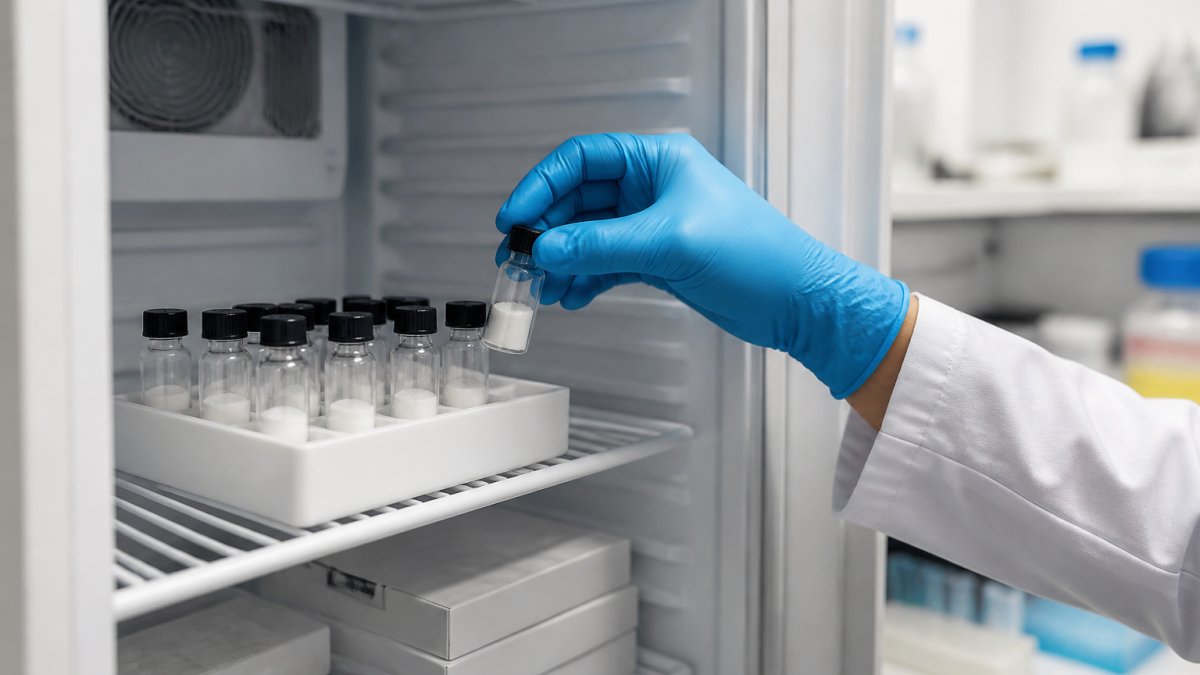
Proper storage means cold, dark, and stable. Refrigerate reconstituted peptides at 2 to 8 °C, keep them out of light, and avoid temperature swings. Handle every vial with aseptic technique to protect sterility.
Temperature Ranges and Light Protection
Temperature is the biggest lever you control.
- Refrigerator (2 to 8 °C): standard for reconstituted peptides
- Room temperature: short-term only, and only during handling
- Freezer (−20 °C): used for some peptides, but check the label first
Light exposure breaks down certain peptides. Moisture and oxygen do damage too. Keep vials capped, upright, and inside their original packaging or a dark box.
A temperature excursion, even a brief one, can shorten shelf life. Leaving a vial on a bench for hours is not the same as a quick draw.
Freezing and Thawing Considerations
Freezing can extend storage for some peptides, but it comes with risks.
Ice crystal formation can damage the peptide structure. Repeated freeze-thaw cycles are worse, because each cycle stresses the molecule again. If a peptide must be frozen, aliquot it first so each portion is thawed only once.
How to Tell If Peptides Have Gone Bad
Visible changes are the clearest warning signs. Cloudiness, discoloration, or floating particles in a reconstituted peptide solution mean the vial should be discarded. If in doubt, throw it out.
Watch for these signs:
- Cloudiness that was not there when mixed
- Discoloration or a color shift
- Particulates or floating specks in the solution
- A gel-like texture or clumping
- A strong or unusual odor
Some degradation happens without any visible sign. A clear solution can still have lost potency. That is why date tracking matters so much.
Peptide Vial Labeling and Date Tracking
Good labeling turns guesswork into a clear record. Mark each vial with the reconstitution date, the diluent used, and the concentration. Track a beyond-use date so nothing sits past its window.
A simple system beats a complex one. Write directly on the vial label or use a small sticker. Include:
- Reconstitution date
- Diluent type (bacteriostatic or sterile water)
- Concentration after mixing
- Beyond-use date based on the label or your storage plan
Keep a log for the whole kit. When a batch report or expiration date matters later, the record is already there.
This is where a supplier's documentation helps. Online Peptide Sales provides Janoshik-verified batch reports for identified samples, so the batch behind a vial can be traced back to a report.
Chemical Stability vs. Sterility: What Actually Matters
Chemical stability and sterility are two separate properties, and both decide whether a reconstituted peptide is fit to use. Chemical stability is whether the peptide molecule is still intact and at its expected potency. Sterility is whether the solution is free of microbial contamination. A vial can pass one and fail the other, and neither failure is reliably visible.
| Factor | What It Means | What Affects It | How It Is Assessed |
|---|---|---|---|
| Chemical stability | Peptide molecule stays intact | Temperature, light, pH, time, concentration | Analytical testing; product labeling |
| Sterility | Solution stays free of microbes | Aseptic handling, preservative, vial type, number of punctures | Microbiological testing; validated beyond-use dating |
A vial can look perfectly clear and still be contaminated. It can also be sterile and still have lost most of its potency. Neither problem announces itself.
The Evidence Hierarchy Behind Any Timeframe
Not all stability claims carry the same weight. When you see a timeframe attached to a reconstituted peptide, it helps to know where it came from:
- Product-specific labeling or validated beyond-use dating, the strongest source, because it applies to that exact formulation, diluent, and container
- Published stability data for a specific peptide, useful, but only as good as how closely the tested conditions match yours
- General rules of thumb, the weakest source, and the one most often repeated online without qualification
Extrapolating between peptides is risky. A stability finding for one compound does not transfer to another with a different sequence, concentration, or formulation. When only general guidance is available, treat it as a starting point and stay conservative.
Regulated Medicines Versus Research-Use Products
It also matters what kind of product you are handling. Regulated, approved medicines come with labeling that specifies storage conditions and beyond-use dating, and that labeling reflects review by a regulatory agency.
Research-use-only products are not approved medicines. Their stability and safety for human use may not be established, and they typically do not carry a validated beyond-use date for a reconstituted solution.
Applying Both Concepts to a Real Decision
A defensible use decision weighs both properties at once:
- If the peptide is within its labeled or documented window and was handled aseptically, chemical and sterility risk are both managed
- If the window is unknown but handling was clean, chemical degradation is the main concern
- If handling was questionable, repeated punctures, unclear technique, unknown diluent, sterility risk dominates regardless of how the solution looks
When either property cannot be reasonably confirmed, the conservative choice is to discard the vial. That is the practical meaning of "what actually matters": not one number, but two independent questions answered together.
When Storage Conditions Are Uncertain: Safe Handling After Mixing
When storage conditions are unknown, treat the vial as compromised. If a peptide was left out, exposed to heat or light, or stored without a date, the safe choice is to discard it rather than guess.
Uncertainty shows up in common ways:
- The vial sat at room temperature for an unknown time
- The fridge lost power or ran warm
- No reconstitution date was recorded
- The diluent used is unknown
In any of these cases, there is no reliable way to confirm the peptide is still good. Discard it.
Safe handling after mixing also matters for the vials you keep. Use aseptic technique, swab the stopper, and never reuse a needle. Store vials upright to keep the solution away from the stopper.
Conclusion
The shelf life of reconstituted peptides is not one fixed number. It depends on the peptide type, the diluent, the storage temperature, and how carefully the vial is handled.
Track dates, protect vials from light and heat, and discard anything with unclear storage history. Those habits matter more than any single timeframe.
Online Peptide Sales supplies research compounds in 10-vial kits with Janoshik-verified batch reports for identified samples, secure export packaging, and express international shipping. For researchers who need traceable materials and clear documentation, that combination supports better storage and handling decisions from the moment a kit arrives.
Frequently Asked Questions
Can you use reconstituted peptides after 30 days?
It depends on the peptide type, diluent, and storage conditions. Peptides reconstituted with bacteriostatic water and kept refrigerated at 2 to 8 °C often remain usable for several weeks, but some degrade faster. Check the manufacturer's product labeling for a beyond-use date. If no date is provided, inspect the solution for cloudiness, discoloration, or particulates before use. When in doubt, discard it rather than risk compromised results.
What happens if you use an expired peptide?
Expired or degraded peptides may lose potency, meaning your experiment could yield inaccurate data. Degradation can also introduce impurities or aggregates that interfere with assays. In research settings, using a peptide past its beyond-use date undermines reproducibility and wastes reagents. If the expiration date has passed or the solution shows appearance changes like cloudiness or particles, discard the vial and reconstitute a fresh one from your lyophilized stock.
Does refrigeration extend the shelf life of reconstituted peptides?
Yes. Refrigeration at 2 to 8 °C slows chemical degradation and inhibits microbial growth in solutions made with bacteriostatic water. A reconstituted peptide left at room temperature may degrade within days, while the same solution refrigerated can last weeks. Protect the vial from light as well, since light exposure accelerates breakdown of certain amino acid residues. Always follow the product labeling for specific storage conditions.
Does the diluent affect peptide stability after reconstitution?
Yes, the choice of diluent matters. Bacteriostatic water contains benzyl alcohol, which inhibits bacterial growth and allows multi-dose vials to be used over a longer period. Sterile water lacks a preservative, so a peptide reconstituted with it should be used sooner. Some peptides require specific diluents to maintain pH and solubility. Always follow the manufacturer's instructions for the correct diluent and storage timeframe.