 blog
Reliable International Research Peptide Shipping in 2026
Table of Contents
- What Makes Research Peptide Shipping Reliable in 2026
- Research Peptide Supplier Verification Before You Order
- International Shipping, Destination Countries, and Import Rules
- Peptide Batch Testing Reports: What a Certificate of Analysis Should Show
- Processing, Dispatch, and Peptide Shipment Tracking
- Packaging, Temperature Control, and Shipment Integrity
- Research Peptide Storage After Delivery
- Conclusion: Choosing Reliable International Peptide Shipping
- Frequently Asked Questions
Last Updated: October 9, 2026
What Makes Research Peptide Shipping Reliable in 2026
Reliable international research peptide shipping moves research-grade compounds across borders with verified chain of custody, intact packaging, and honest tracking. A shipment that stalls in customs or arrives warm fails the study. This guide covers supplier verification, batch reports, customs rules, and post-arrival storage.
A supplier can promise express delivery and still leave a package at a border checkpoint for weeks, or claim third-party testing with a report that has no batch number linking it to your vials. Customs limbo and unverifiable quality claims waste more research budgets than slow transit.
The framework has four parts: verify the supplier, verify the batch, understand the border, and protect the shipment after it lands.
Research Peptide Supplier Verification Before You Order
Supplier verification confirms that quality claims trace back to real, batch-specific testing before money changes hands.
Ask where compounds are synthesized and how they reach the fulfillment facility. Online Peptide Sales sources compounds directly from manufacturers in China and provides Janoshik-verified batch reports for identified samples, linking the vial to the test result.
A common mistake is treating a website's general quality statement as verification. Generic "third-party tested" claims mean nothing without a batch number.
Janoshik Reports and Batch Traceability
Janoshik reports are third-party analytical results from Janoshik Analytical, an independent testing laboratory, documenting the identity and purity of a submitted sample. Batch traceability connects that report to the specific vials in your order. Without a batch number on both the report and the packaging, the report proves only that some sample passed testing at some point.
Here is what to confirm when reviewing a report:
- The batch or lot identifier matches the label on your kit
- The testing date is recent relative to your order
- The reported purity percentage is stated explicitly
- The compound identity matches what you ordered
- The report is legible and unaltered
If a vendor cannot supply a batch-matched report for the compound you want, treat the purity claim as unverified.
International Shipping, Destination Countries, and Import Rules
International shipping of research compounds depends on the destination country's import rules, the carrier's handling, and the accompanying documentation. Country-specific guidance matters more than a blanket "worldwide shipping" promise.
Customs clearance is where most international shipments succeed or fail. In the United States, shipments are reviewed by U.S. Customs and Border Protection (CBP), which enforces the Harmonized Tariff Schedule (HTS) and the Food and Drug Administration's import rules. Complete documentation and an accurate declaration move a package through; vague or missing paperwork gets it held.
A Practical Import-Readiness Framework
Work through four checks before placing an order:
- Compound classification. Identify the HTS code for your compound. CBP uses it to determine admissibility and duty treatment; misclassification is a common reason shipments are held.
- Permitted use and documentation. Research-use-only compounds typically require a commercial invoice, a packing list, and a declaration that the material is for laboratory research, not human or veterinary use. Some classes need additional documentation, such as an FDA prior notice.
- Destination restrictions. Confirm whether your state or territory imposes restrictions beyond federal rules, since a small number of jurisdictions restrict specific compound categories.
- Duties and fees. Even when a shipment clears, CBP may assess duties based on the HTS classification, and carriers often add a brokerage or disbursement fee. These costs land on the recipient unless the vendor states otherwise.
Documentation That Moves a Package Through Customs
A shipment that clears quickly usually has a commercial invoice naming the compound accurately, a declared value matching the invoice, a country-of-origin statement, and a research-use-only declaration.
CBP guidance on importing goods and HTS classification
Vendors that prepare this documentation reduce the risk of a package stalling at the border; those that leave clearance to the buyer shift that risk onto the researcher. Ask whether the vendor includes a commercial invoice and research-use declaration with every international shipment.
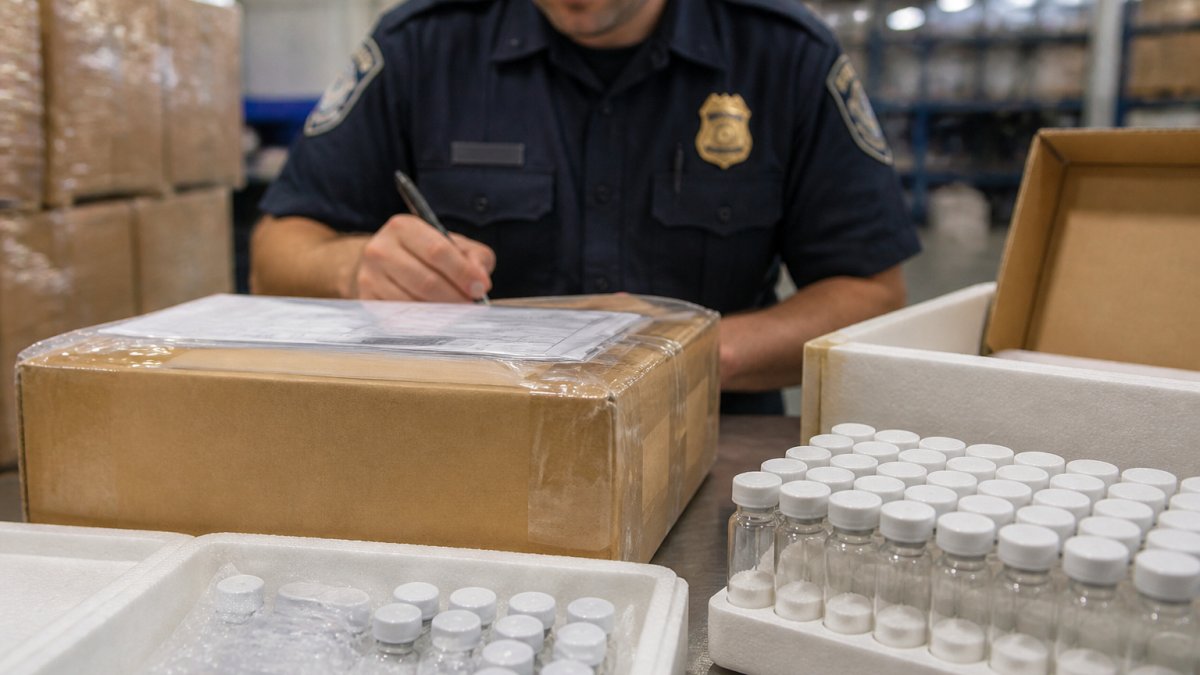
What Happens When Customs Holds or Seizes a Shipment
A customs hold is not a seizure.
If a shipment is held, the carrier or broker notifies the recipient and requests the missing documentation; respond promptly, since CBP gives a limited window before the shipment is returned or seized.
A reliable vendor's policy should answer three questions before you order:
- Who communicates with customs? The vendor, the carrier, or the buyer?
- What documentation does the vendor provide if a hold occurs? Batch reports, invoices, and declarations should be available on request.
- What is the reshipment or refund policy if a package is seized? Some vendors offer a one-time reshipment; others offer nothing. Get this in writing before ordering.
Online Peptide Sales provides Janoshik-verified batch reports and export documentation with international orders, and offers an optional delivery guarantee covering replacement or refund if a shipment is lost or seized in transit.
Peptide Batch Testing Reports: What a Certificate of Analysis Should Show
A certificate of analysis reports the measured identity, purity, and sometimes mass of a submitted sample.
A useful certificate includes the compound name, batch identifier, analytical method, measured purity percentage, testing date, and the laboratory that performed the work. A report missing any of these cannot support a purity claim.
What most buyers miss is the difference between a spot-checked report and a per-batch report. A vendor that tests one batch and applies the result to all future batches is not offering batch-specific verification.
Processing, Dispatch, and Peptide Shipment Tracking
Order processing and dispatch timelines determine when a package actually leaves the facility, which is often different from when tracking first updates.
Peptide shipment tracking begins with a tracking number issued at dispatch.
Delays happen for predictable reasons: carrier backlogs, customs holds, and weather. What separates a reliable vendor is how they handle a delayed shipment. Ask in advance what happens if a package is lost or seized.
| Stage | What Happens | What to Confirm |
|---|---|---|
| Order processing | Order reviewed and packed | Cutoff time for same-day dispatch |
| Dispatch | Package handed to carrier | Tracking number issued |
| In transit | Carrier moves package | First tracking scan appears |
| Customs clearance | Package reviewed at border | Documentation is complete |
| Delivery | Package arrives | Packaging and contents intact |
Packaging, Temperature Control, and Shipment Integrity
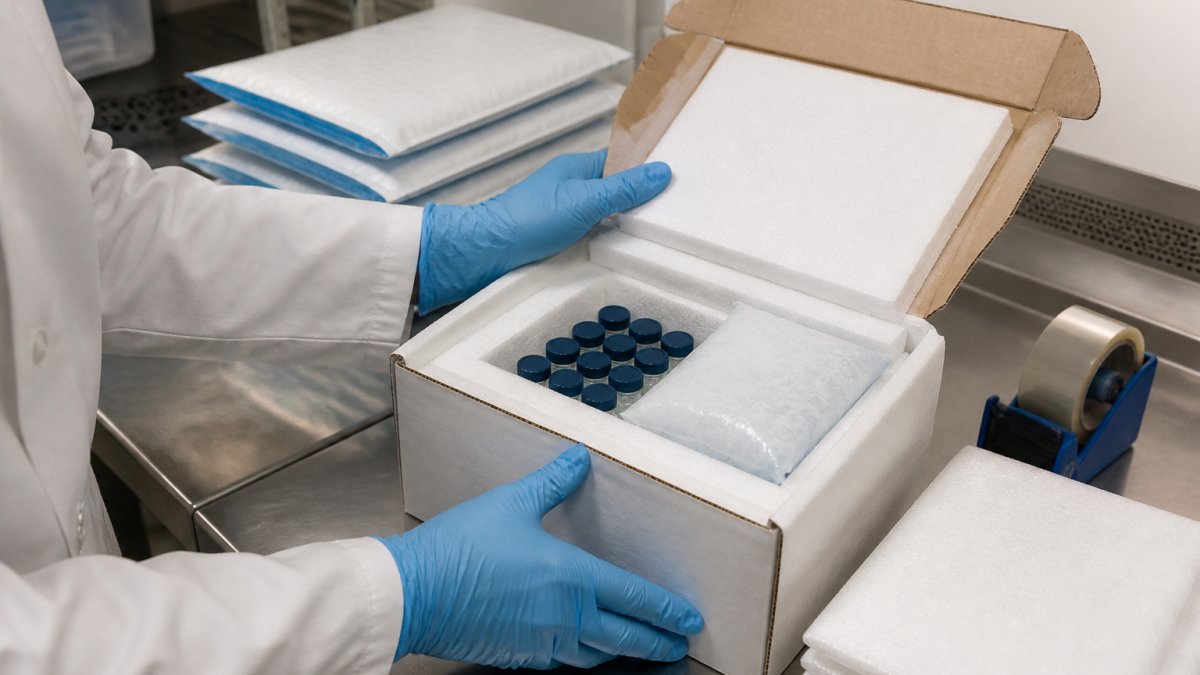
Packaging and temperature control protect the compound during transit and are the most overlooked part of peptide shipping. Research compounds can be sensitive to heat and physical shock, so the box matters as much as delivery speed.
What Good Export Packaging Looks Like
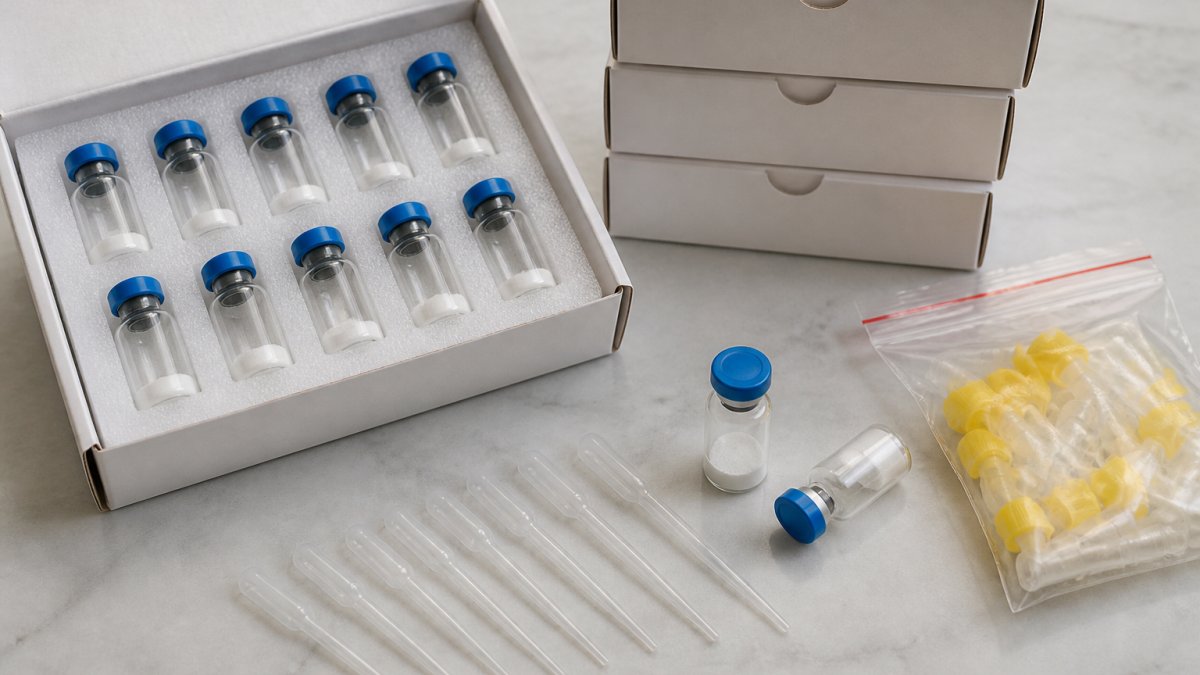
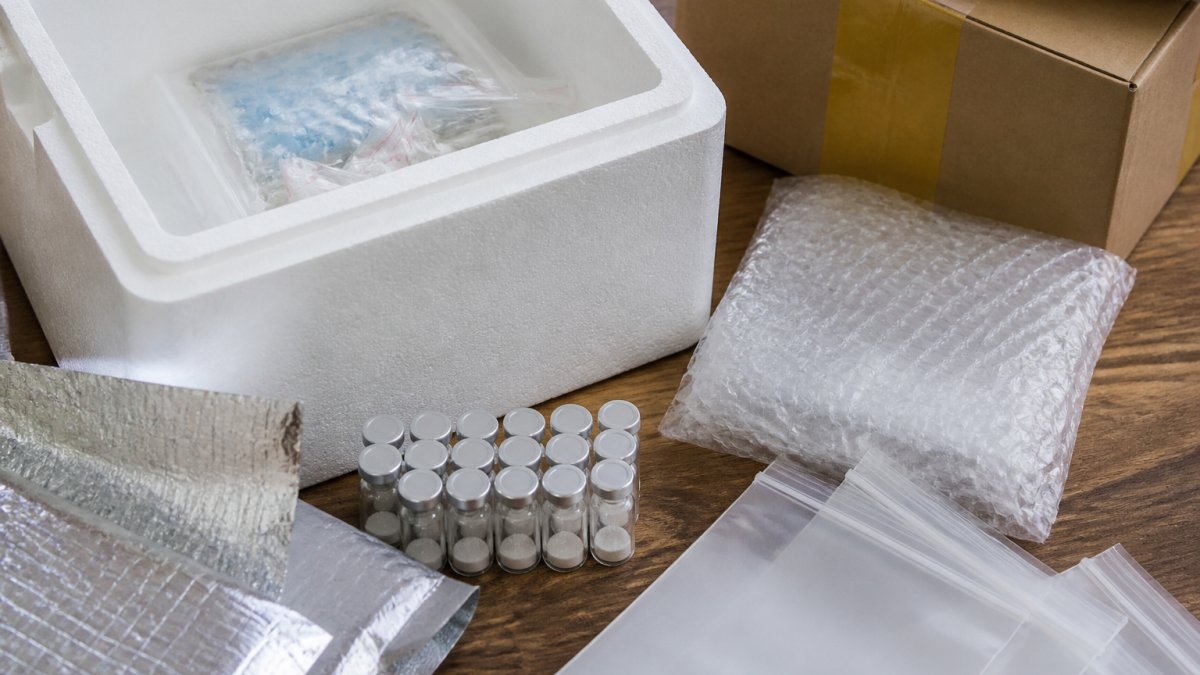
Tamper-evident packaging protects contents from physical damage and shows whether the package was opened in transit. Secure export packaging combines:
- Primary containment. Vials sealed with crimped caps or stoppers, individually wrapped to prevent glass-on-glass contact.
- Secondary cushioning. Foam inserts, bubble wrap, or molded trays that hold vials in place so they cannot shift during transit.
- Temperature layer. A cold pack, gel pack, or insulated liner sized to the expected transit time.
- Outer packaging. A rigid box with a tamper-evident seal and a label that does not advertise the contents.
When a package arrives with a broken seal, crushed exterior, or visible moisture, document it before opening. Photograph the box from multiple angles, note the tracking number, and contact the vendor before discarding any packaging. Most reshipment and refund policies require this documentation.
Temperature Control and Transit-Time Limits
Temperature-sensitive compounds may require a cold pack or insulated lining depending on the compound and transit time. The key variable is how long the package stays within a safe range, not the starting temperature.
Match the cold-pack rating to the expected transit time plus a buffer for customs delays.
If a package arrives warm, do not assume the compound is ruined.
Shipment Integrity Checklist
Use this checklist when a package arrives:
| Check | What to Look For | Action if Failed |
|---|---|---|
| Outer seal | Tamper-evident seal intact | Photograph and contact vendor |
| Box condition | No crushing, moisture, or punctures | Photograph and contact vendor |
| Cold pack | Still cool or partially frozen | Note arrival temperature and time |
| Vial condition | No cracks, leaks, or loose caps | Do not use; request replacement |
| Batch label | Matches your order and batch report | Contact vendor for correction |
| Documentation | Certificate of analysis included | Request batch-matched report |
What to Do When a Shipment Arrives Damaged or Delayed
A damaged or delayed shipment is not automatically a lost cause, but the response window matters. Contact the vendor within 24 to 48 hours of delivery, provide photographs and the tracking number, and state clearly what was wrong.
For delayed shipments, check tracking before assuming the package is lost. A package showing "in transit" for several days may be moving through a carrier hub or awaiting customs review.
Online Peptide Sales ships in tamper-evident export packaging with temperature-appropriate materials and provides batch-matched Janoshik reports with each order.
Research Peptide Storage After Delivery
Storage after delivery determines whether a compound that arrived in good condition stays that way. Inspect the package on arrival, confirm the batch number matches your order, and move the vials to appropriate storage conditions promptly.
General storage practices for research compounds include:
- Store according to the vendor's or manufacturer's stated conditions
- Keep vials sealed until use
- Protect from direct light and heat where the compound is light- or heat-sensitive
- Label and separate batches to preserve traceability
- Record the arrival date alongside the batch report
A common mistake is discarding batch documentation once the package is unpacked. Keep the certificate of analysis with the batch it belongs to, because traceability is only useful if it survives delivery.
Conclusion: Choosing Reliable International Peptide Shipping
The gap between a dependable supplier and a disappointing one comes down to documentation, packaging, and how each handles a problem after dispatch. Verify the batch before ordering, confirm your country's import rules, and check what happens if a shipment is delayed or lost. Online Peptide Sales supports that process with Janoshik-verified batch reports, tamper-evident export packaging, and an optional delivery guarantee.
Frequently Asked Questions
Can research peptides be shipped internationally?
Yes, research-use-only peptides can be shipped internationally, but legality and clearance depend on the destination country's import rules. Before ordering, confirm whether the compound is restricted locally, what documentation customs expects, and whether the vendor provides tracking and reshipment terms. Online Peptide Sales ships in secure export packaging with express carrier options, and orders carry research-use-only status, so buyers remain responsible for confirming local import eligibility.
How can you assess whether research peptide shipping is reliable?
Look for same-day processing, a real tracking number, named shipping carriers, and a written policy covering delayed, lost, or seized shipments. Reliable peptide shipping also means tamper-evident packaging and batch-specific testing records tied to the order. Ask what happens if customs holds the parcel and whether a delivery guarantee, replacement, or refund applies, then compare that answer against the total landed cost rather than the sticker price alone.
How should research peptides be stored after delivery?
Inspect the shipment first, then move vials to storage that matches the batch documentation. Lyophilized peptides typically stay stable at room temperature for short periods but are best kept cold, dark, and dry, while reconstituted material needs refrigeration or freezing as directed. Log the arrival date, batch number, and storage conditions so your research peptide storage after delivery stays traceable for the study record.
What should researchers check before ordering peptides for international delivery?
Confirm four things: destination-country import restrictions, whether the vendor handles customs documentation, the delivery estimate and tracking method, and the reshipment or refund policy for seized or delayed parcels. Also verify batch testing reports are available for the specific lot you receive. Getting these answers in writing before payment prevents the border delays and failed deliveries that most often derail international research peptide orders.