 how-to
Sourcing High Purity Research Peptides: A 2026 Guide
Table of Contents
- Why Sourcing High Purity Research Peptides Starts With Verification
- Peptide Supplier Reliability Checklist for Research Buyers
- What a Peptide Batch Report Should Include
- How to Verify a Certificate of Analysis Independently
- Research Peptide Storage Guidelines After Delivery
- Research Peptide Shipping and Packaging Standards
- Sourcing High Purity Peptides: Cost, Risk, and Research-Use Boundaries
- Conclusion
- Frequently Asked Questions
Last Updated: October 6, 2026
Why Sourcing High Purity Research Peptides Starts With Verification
Sourcing high purity research peptides begins with verification, not price. A purity claim means nothing until an independent laboratory confirms it on a specific batch.
Verification confirms a peptide's identity, purity, and concentration against an independent analytical report tied to a specific batch number.
Verification is a chain, not a document: synthesis, purification, analytical testing, packaging, your bench. Break any link and the certificate becomes decoration.
Peptide Supplier Reliability Checklist for Research Buyers
Supplier reliability comes down to documentation you can audit, not assurances you can't. A reliable supplier answers three questions without hesitation: which batch, which laboratory, and which method.
Documentation and Identity Checks
Work through this list before placing a first order:
- Certificate of Analysis supplied per batch, not per product line
- Batch or lot number printed on the vial and matched to the report
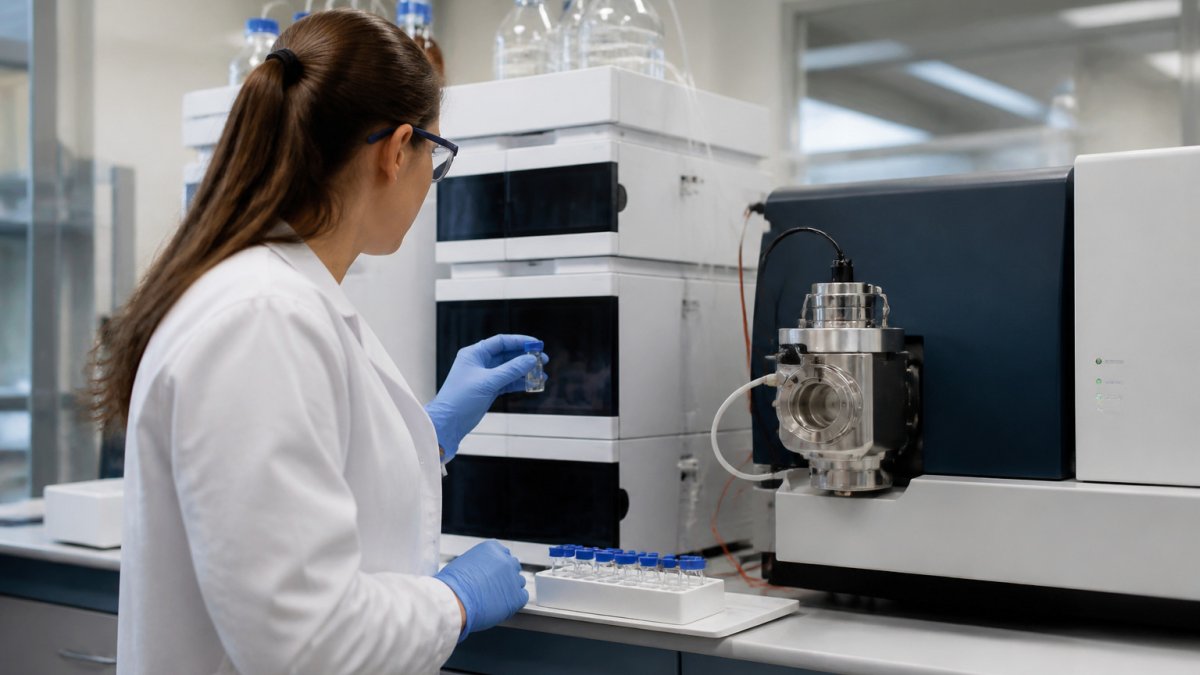
- Analytical method named (for example, HPLC for purity and mass spectrometry for identity)
- Chromatogram and mass spectrum included, not just a summary figure
- Testing laboratory named and independently contactable
If a supplier cannot produce the first four items, stop there. Everything downstream depends on them.
Red Flags That Signal an Unreliable Supplier
Certain patterns predict problems: vague answers about where material is manufactured, reports dated years before current inventory, refusal to name the testing laboratory, prices far below every other quote without explanation, and pressure to order before documentation is shared. None is proof of misconduct alone, but together they describe a supplier optimizing for speed of sale rather than reproducibility.
What a Peptide Batch Report Should Include
A peptide batch report should let a qualified reader reconstruct what was tested, how, and against what acceptance criteria. If any of those three is missing, the report is incomplete.

Reading Purity, Identity, and Concentration Data
Purity, identity, and concentration are three separate measurements that suppliers often blur into one number.
Purity describes what percentage of detected material is the target peptide, typically measured by HPLC as peak area. Identity confirms the material is the correct molecule, established by mass spectrometry against the expected molecular weight. Concentration accuracy describes how much peptide is present per vial versus the label claim.
| Report Element | What It Establishes | What It Does Not |
|---|---|---|
| HPLC chromatogram | Purity percentage and impurity profile | Correct molecular identity |
| Mass spectrometry | Molecular weight match to sequence | Quantity per vial |
| Quantitative assay | Concentration against label claim | Purity of the peak |
| Batch number | Traceability to a production lot | Anything about other batches |
How to Verify a Certificate of Analysis Independently
Independent verification means confirming the report's origin and internal consistency without relying on the supplier's word. Three steps cover most cases.
First, contact the named testing laboratory directly and confirm the report reference exists in their records.
Third, look for method detail. A report naming the instrument, column, and detection method is harder to fabricate than one stating a single percentage.
For context on how analytical laboratories document method validation and quality control, the FDA guidance on bioanalytical method validation outlines the standards that reputable testing facilities work to.
Research Peptide Storage Guidelines After Delivery
Research peptide storage guidelines exist because a verified batch can degrade after it arrives. Verification confirms a moment in time, not a permanent state: a certificate accurate on the day of testing describes material that will drift if temperature, moisture, or light exposure is uncontrolled.
Temperature, Moisture, and Light Controls
Most lyophilized research peptides are stable when kept dry, cold, and protected from light. The ranges below reflect common laboratory practice, not a universal specification, always defer to the storage instructions supplied with the specific batch.
| Condition | Typical Target | Why It Matters |
|---|---|---|
| Long-term lyophilized storage | -20°C or colder | Slows hydrolysis and oxidation reactions that accumulate over months |
| Short-term working aliquots | 2-8°C | Reduces freeze-thaw cycling on material in active use |
| Reconstituted material | 2-8°C, use promptly | Solution-phase peptides are generally less stable than powder |
| Humidity | Low, with desiccant | Residual moisture drives hydrolysis and can cause cake collapse |
| Light | Amber vials or dark storage | Aromatic residues are sensitive to photodegradation |
Three habits protect material integrity:
- Aliquot before freezing so vials are opened once, not repeatedly; every opening exposes the powder to ambient moisture.
- Keep desiccant with lyophilized powder and reseal vials promptly, a vial left open briefly can absorb enough moisture to affect stability.
- Log storage temperature so any excursion can be traced to a date range; an unrecorded freezer failure turns a verified batch into an unknown one.
Sequence-Specific Stability Concerns
Sequence matters too. Peptides containing methionine, cysteine, or tryptophan are more prone to oxidation. Methionine oxidizes to methionine sulfoxide; cysteine can form or scramble disulfide bridges; tryptophan is sensitive to light and oxidative degradation. If a batch contains these residues, tighter handling controls, shorter bench exposure, stricter light protection, more frequent aliquot checks, are worth the extra effort.
Reconstitution and Freeze-Thaw Discipline
Reconstitution introduces the largest single stability risk in most workflows. A few rules reduce it:
- Use the solvent specified in the batch documentation; the wrong solvent can leave material undissolved or cause aggregation.
- Add solvent down the vial wall rather than onto the powder cake to avoid mechanical disruption and aerosol formation.
- Swirl gently; do not vortex, which can shear larger molecules and introduce air that promotes oxidation.
- Divide reconstituted material into single-use aliquots before freezing; each freeze-thaw cycle can cost measurable purity, and the loss compounds.
Post-Delivery Inspection
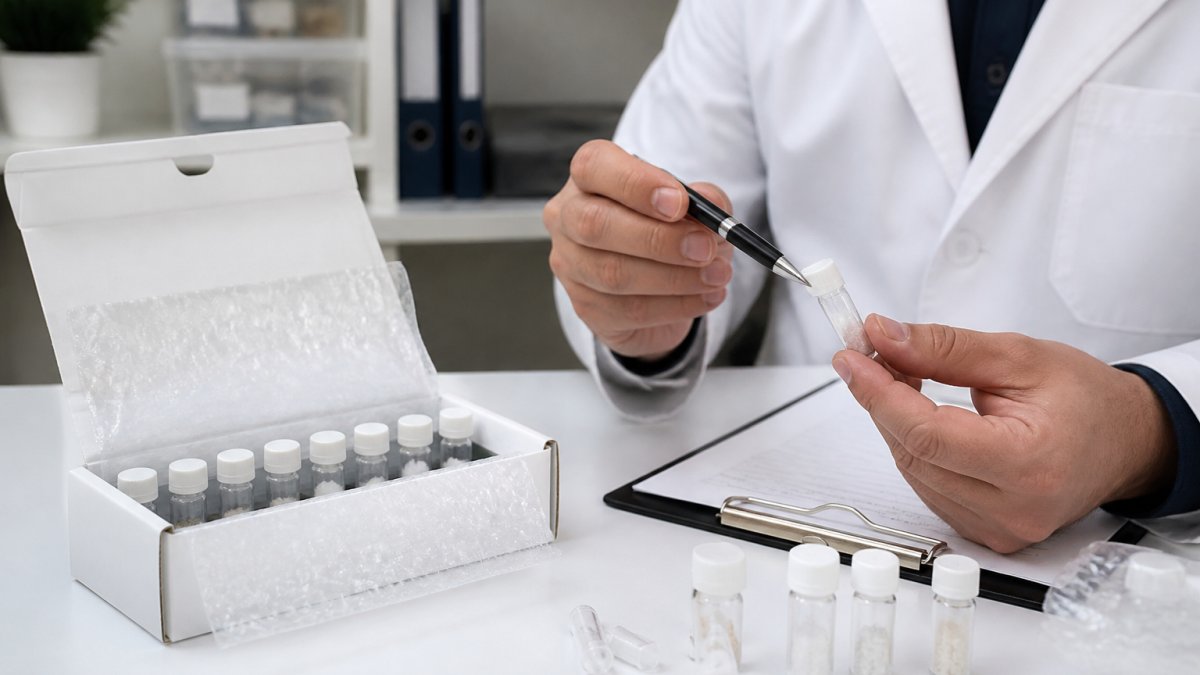
Before any material goes into storage, inspect it. Lyophilized powder should appear as a uniform cake or plug, not a melted or collapsed mass. Discoloration, clumping, or visible particulates warrant documenting the condition and contacting the supplier before use. Record the arrival temperature, packaging condition, and batch numbers on the vials, that record becomes the starting point for any later stability question.
Research Peptide Shipping and Packaging Standards
Shipping and packaging determine whether the material that leaves a facility is the material that reaches your bench.
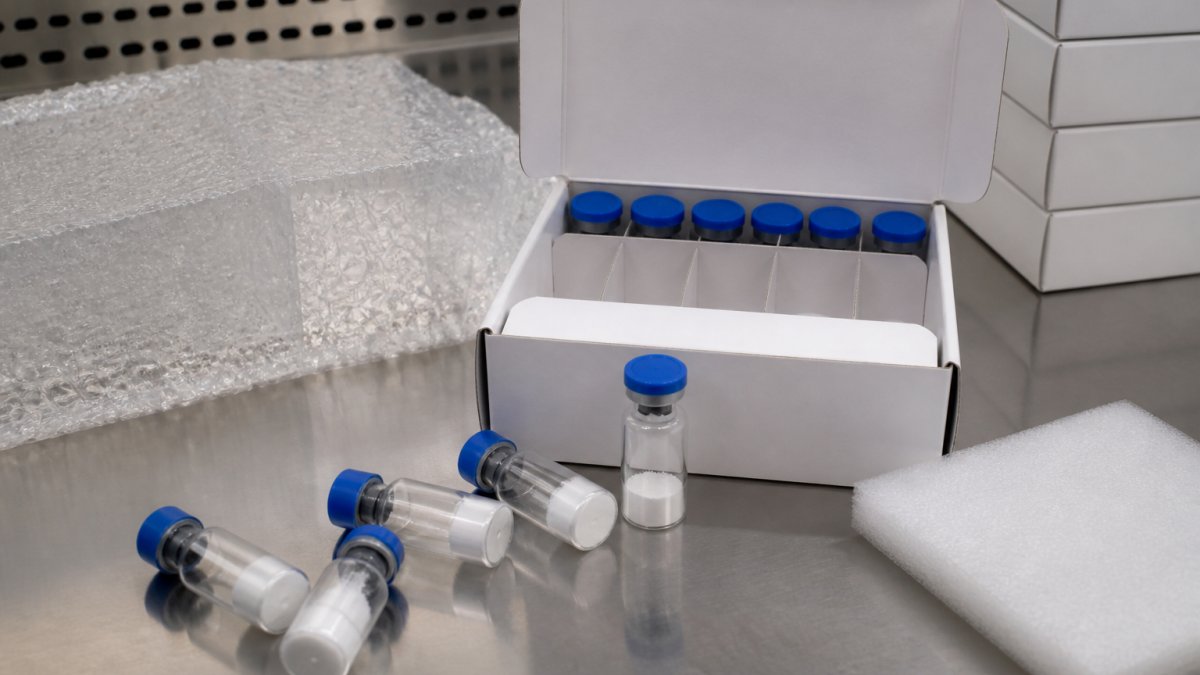
Tamper-evident outer packaging should show no signs of prior opening. Insulated packaging with phase-change coolant should still be cold at delivery.
Documentation should travel with the shipment: batch numbers, storage instructions, and handling notes. For cross-border shipments, customs paperwork must be complete and consistent with the declared contents.
Sourcing High Purity Peptides: Cost, Risk, and Research-Use Boundaries
Cost in this category is a function of verification, packaging, and risk transfer, not just the peptide itself. Two suppliers can quote the same specification and offer very different value, because the quote rarely captures the full cost of a failed batch, a broken cold chain, or a missing report.
A Total-Cost Framework for Procurement
Unit price is the smallest line in most procurement decisions. A more useful framework compares quotes across five dimensions:
| Cost Dimension | What to Compare | Why It Changes the Real Price |
|---|---|---|
| Per-batch testing | Whether every batch is tested or only spot-checked | Untested batches shift failure cost to the buyer |
| Documentation | Full chromatogram and mass spectrum vs. summary figure | Missing method detail makes independent verification impossible |
| Packaging and cold chain | Insulated, phase-change coolant, tamper evidence | A broken cold chain can void the verification data |
| Shipping and customs | Carrier, transit time, paperwork completeness | Delays and holds expose material to temperature swings |
| Failure policy | Written replacement or refund terms | Without a policy, a non-conforming batch is a total loss |
A quote that omits testing, documentation, or a failure policy is not cheaper, it is less complete, and the missing cost reappears later as rework, replacement, or unusable material.
How Risk Transfer Actually Works
Risk works the same way. A supplier that tests every batch absorbs the cost of finding a failure; a supplier that spot-checks passes that risk to the buyer, who discovers the problem only after the material is in hand.
A second risk layer is batch-to-batch consistency. A single good report says nothing about the next shipment. The practical test is whether the supplier can produce a report for the specific batch being shipped, not a representative one from an earlier lot.
Research-Use Boundaries and Institutional Alignment
Research-use boundaries are equally important. Research compounds are sold for laboratory investigation, not human or veterinary use. Reputable suppliers state this clearly and decline orders that suggest otherwise; documentation, labeling, and handling instructions should reinforce that boundary.
For investigators working under institutional oversight, procurement should align with the institution's research conduct standards. The NIH Office of Research Integrity publishes resources on research conduct that help investigators align procurement with institutional requirements.
Online Peptide Sales supplies research compounds in 10-vial kits sourced directly from manufacturers, with Janoshik-verified batch reports available for identified samples, secure export packaging, and express international shipping through major carriers. An optional delivery guarantee covers replacement or refund on qualifying orders.
Conclusion
The supplier that wins a research buyer's business is rarely the one with the lowest quote. It is the one that can produce a batch-specific report, name the laboratory, survive an independent verification check, and deliver the material cold and intact. Build the qualification workflow into procurement rather than applying it after a problem appears. Verification is a process, and it starts before the first order, not after it.
Frequently Asked Questions
How can researchers evaluate a peptide supplier's reliability?
Start with documentation. A reliable supplier provides a batch-specific Certificate of Analysis from an independent laboratory, not a generic report reused across orders. Check that the report lists the amino acid sequence, purity percentage, identity confirmation, and concentration. Ask whether reports cover every batch or only spot checks. Confirm the supplier's replacement policy, shipping method, and packaging standards before ordering. Online Peptide Sales offers Janoshik-verified batch reports for identified samples, which lets buyers match a specific report to a specific kit.
What should a research peptide batch report include?
A complete peptide batch report includes the batch or lot number, the amino acid sequence, molecular weight, purity percentage from chromatographic analysis, identity confirmation by mass spectrometry, and concentration accuracy. It should also name the analytical method used and the testing laboratory. Reports missing a batch number cannot be matched to a physical sample, which makes them useless for verification. Review the report before use and compare the batch number on the report to the label on the vial.
How should research peptides be stored after delivery?
Most lyophilized research peptides remain stable when stored at -20°C, protected from light and moisture. Once reconstituted, store at 2-8°C and use within the period stated in your protocol. Avoid repeated freeze-thaw cycles, which degrade structural stability. Keep vials sealed with parafilm until use, and let them reach room temperature before opening to prevent condensation. Follow the research peptide storage guidelines supplied with your kit and note storage conditions in your lab records.
What does research use only mean for peptides?
A research use only label means the compound is sold for laboratory investigation and is not approved for human or veterinary use, diagnosis, or treatment. Researchers must handle these materials under institutional safety rules and applicable federal and state law. Sourcing high purity research peptides for a legitimate study means keeping documentation, storage, and disposal records that show the material stayed inside a controlled research setting. Buyers should confirm their institution permits the compound before ordering.