 how-to
7 Steps to Reconstitute Research Peptides Safely
Last Updated: October 24, 2026
Quick Summary
To reconstitute research peptides, dissolve the lyophilized powder by slowly injecting a measured volume of sterile diluent into the sealed vial, then allow 5-10 minutes for complete dissolution without agitation. Reconstituting research peptides safely requires sterile supplies, proper diluent selection matched to your compound, and aseptic technique throughout to maintain sterility and accuracy.
- Gather sterile syringes, needles, alcohol swabs, and the correct diluent before opening your peptide vial to minimize contamination risk.
- Check your certificate of analysis to confirm peptide mass and purity, then use a reconstitution calculator to determine the exact diluent volume needed.
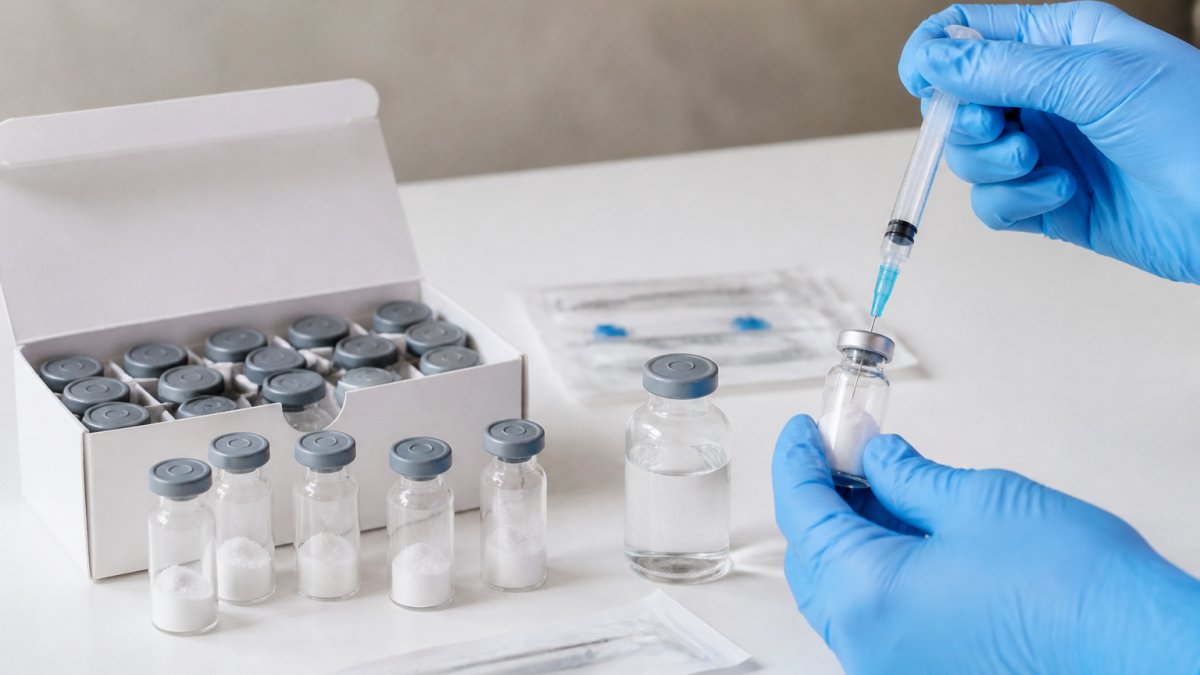
- Sanitize the rubber stopper with an alcohol swab for 10-15 seconds, inject diluent slowly at a slight angle, and let the vial sit undisturbed for 5-10 minutes.
- Store reconstituted peptides according to the manufacturer's documented stability data, typically at 2-8°C in bacteriostatic water or -20°C or below when frozen.
- Label every reconstituted vial with compound name, lot number, diluent used, final concentration, reconstitution date, storage temperature, and beyond-use date.
Table of Contents
- What Peptide Reconstitution Means for Research
- Supplies and Equipment You Need Before Starting
- Bacteriostatic Water for Peptide Reconstitution vs. Sterile Water
- Using a Peptide Reconstitution Calculator to Determine Diluent Volume
- Step-by-Step Reconstitution Procedure
- Storage of Reconstituted Peptides and Handling Best Practices
- Troubleshooting Common Issues During and After Reconstitution
- Ordering Verified Research Peptides from Online Peptide Sales
- Frequently Asked Questions
What Peptide Reconstitution Means for Research
Peptide reconstitution is the process of dissolving lyophilized peptide powder into a liquid solvent to create a usable research solution.
The powder has been freeze-dried to remove water while preserving the compound's structure. Once reconstituted, the peptide becomes a liquid solution ready for experimental use.
Improper technique can compromise your research: contamination, incorrect concentration, or rough handling can affect results. The goal is complete dissolution while maintaining sterility and accuracy.
Most researchers working with research-grade compounds from Online Peptide Sales follow a standardized reconstitution process. The company provides Janoshik-verified batch reports for identified samples, giving you confidence in the starting material.
Supplies and Equipment You Need Before Starting
Successful reconstitution requires specific supplies and a clean workspace. Gather everything before opening your vial to minimize contamination risk.
Essential supplies:
- Sterile syringe (1 mL or larger, depending on diluent volume)
- Sterile needle (18-25 gauge)
- Alcohol swabs or 70% isopropyl alcohol
- Bacteriostatic water or sterile water for injection
- Sterile gauze pads
- Clean, flat work surface
- Gloves (non-latex or latex, depending on your lab protocol)
Optional but recommended:
- Sterile filter needle for drawing solution from the vial
- Absorbent bench paper to protect your workspace
- Sharps container for needle disposal
Before you start, check the COA document that accompanies your peptide kit. The certificate of analysis gives the exact peptide content and purity you need for accurate concentration calculations. Then wipe down your work surface with alcohol, clear clutter, and ensure adequate lighting.
Bacteriostatic Water for Peptide Reconstitution vs. Sterile Water
Choosing between bacteriostatic water for peptide reconstitution and sterile water is a compound-specific decision.
What each diluent actually contains:
- Bacteriostatic water is sterile water containing 0.9% benzyl alcohol as a bacteriostatic preservative. The benzyl alcohol suppresses bacterial proliferation, which is why multi-dose vials of diluent can be accessed repeatedly over time.
- Sterile water for injection contains no preservative, no buffer, and no additive. It is the cleanest possible diluent and is intended for single-use preparation.
Why the choice is compound-specific:
Solubility and stability vary widely across peptides. Some dissolve readily in either diluent; others show poor solubility in preservative-containing water, precipitate at certain pH ranges, or are sensitive to benzyl alcohol.
How to decide for your protocol:
- Check the product documentation first. The handling instructions and COA for your compound should specify the recommended diluent, target concentration range, and solubility notes. If documentation is silent, seek clarification rather than guess.
- Match diluent to access pattern. Multiple aliquots drawn over an extended period suit bacteriostatic water's preservative; single-session use suits sterile water, which adds nothing your assay does not need.
- Match diluent to compound sensitivity. If documentation flags preservative sensitivity or specifies a diluent, follow it. When compatibility is uncertain, sterile water is the more conservative starting point, but confirm with the supplier's documentation.
- Do not mix diluent types within a single vial. Adding a different diluent later changes the solution's composition unpredictably.
Practical trade-offs at a glance:
| Consideration | Bacteriostatic water | Sterile water for injection |
|---|---|---|
| Preservative | 0.9% benzyl alcohol | None |
| Multi-dose access | Supported | Not recommended |
| Additive-free | No | Yes |
| Best fit | Repeated aliquots over time | Single-session use; preservative-sensitive compounds |
| Key check | Compound compatibility with benzyl alcohol | Compound solubility without preservative |
Both diluents are appropriate for in-vitro research when matched to the compound and protocol. Let the validated documentation for your specific peptide and lot drive the decision, not habit or what worked for a different compound.
Review our detailed reconstitution and storage guide for compound-specific handling examples and documentation checkpoints.
Using a Peptide Reconstitution Calculator to Determine Diluent Volume
A peptide reconstitution calculator removes guesswork from determining how much diluent to add. The basic formula: divide peptide mass (in milligrams) by your desired concentration to find the required volume. For example, 10 mg of peptide at a target of 1 mg/mL needs 10 mL of diluent.
Many online calculators automate this math and account for different units. You input:
- Peptide mass (from your COA)
- Desired concentration (your target strength)
- Preferred unit of measurement
The calculator returns the exact diluent volume needed. Precision matters: too little solvent creates an overly concentrated solution, while too much dilutes the peptide below your target strength.
Review our detailed reconstitution and storage guide for step-by-step examples using real peptide quantities.
Step-by-Step Reconstitution Procedure
Follow these steps in order to reconstitute research peptides safely and maintain sterility throughout the process.
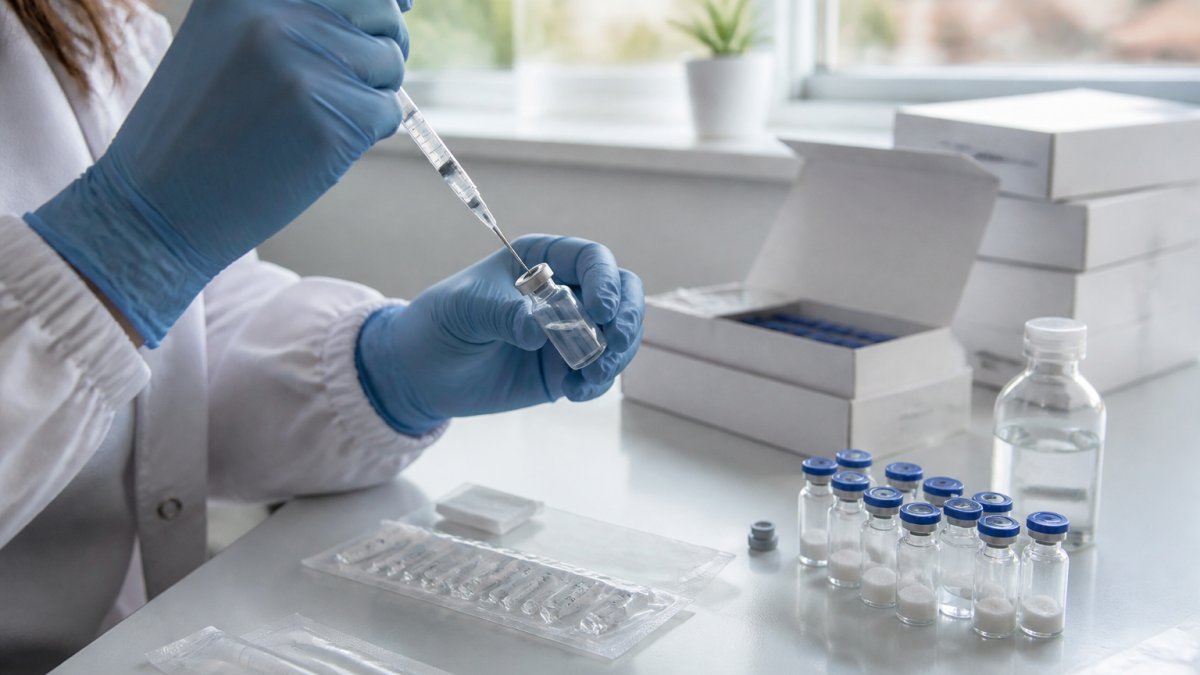
Step 1: Prepare your workspace Wash your hands and put on gloves.
Step 2: Inspect the peptide vial Examine the sealed vial for any visible damage, cracks, or discoloration.
Step 4: Draw the diluent into your syringe Using a sterile syringe and needle, draw the calculated volume of diluent.
Step 6: Allow the peptide to dissolve Remove the syringe and needle. Let the vial sit undisturbed for 5-10 minutes.
Step 7: Mix gently if needed If the peptide hasn't fully dissolved after 10 minutes, gently roll the vial between your palms, never shake vigorously. Rolling distributes the powder without creating foam. The solution should appear clear; persistent cloudiness or particles after 15 minutes may indicate incomplete dissolution or contamination.
Storage of Reconstituted Peptides and Handling Best Practices
Once reconstituted, a peptide solution is chemically and physically less stable than the lyophilized powder it came from. Storage guidance is not a single set of numbers but principles applied against the compound's documented stability data.
Why reconstituted peptides degrade:
- Hydrolysis, water participates in peptide bond cleavage over time; the rate depends on pH, temperature, and the specific sequence.
- Oxidation, exposure to oxygen and light can oxidize susceptible residues, altering the compound.
- Aggregation, peptides can self-associate into insoluble clusters, especially at high concentration or after agitation.
- Microbial growth, a preservative-free solution offers no protection against bacterial or fungal proliferation.
- Freeze-thaw stress, repeated freezing and thawing can denature or aggregate peptides.
Each of these mechanisms is compound-dependent, which is why the manufacturer's stability data, not a universal rule, should set your storage parameters.
Setting storage conditions:
- Start with the product documentation. The handling instructions and COA for your compound and lot are the primary source for storage temperature, light limits, and any stated stability window. Work within any range given.
- Refrigerated storage (commonly 2-8°C) is typical for solutions in bacteriostatic water accessed repeatedly over a short-to-moderate period. Confirm against your compound's documentation.
- Frozen storage (commonly -20°C or below) suits longer holds or compounds whose documentation specifies it. Freezing does not make a solution indefinitely stable.
- Protect from light. Amber vials, foil wrap, or a dark cabinet reduce photodegradation of light-sensitive peptides.
- Minimize headspace and air exposure. Keep vials sealed and upright; air contributes oxygen and moisture.
Labeling that supports traceability:
Every reconstituted vial should carry, at minimum:
- Compound name and lot number
- Diluent used and final concentration
- Date and time of reconstitution
- Storage temperature
- Beyond-use date derived from the compound's documentation
- Initials of the preparer
Handling best practices:
- Use aseptic technique every time the vial is accessed; swab the stopper and let it dry before each draw.
- Keep the stopper clean and covered between uses.
- Avoid repeated freeze-thaw cycles, aliquot before freezing if the protocol allows.
- Never return unused solution to the vial.
- Inspect before each use; discard if cloudiness, particles, or discoloration appear.
Aliquoting to extend usable life:
If a solution will be accessed many times, consider aliquoting your solution into single-use portions under sterile conditions before freezing.
Disposal and contamination response:
- Place used needles and syringes in a sharps container immediately after use; follow your institution's sharps disposal policy.
- Treat single-use supplies as single-use, do not reuse needles, syringes, or swabs.
- If you suspect contamination (cloudiness, particles, unexpected color, or a compromised stopper), stop using the vial, retain it for documentation, and follow your laboratory's incident procedure. Do not attempt to "rescue" a suspect solution by filtering or re-diluting it.
Learn best practices for storing reconstituted peptides to align your storage plan with compound-specific documentation and maintain research integrity.
Troubleshooting Common Issues During and After Reconstitution
Problems during or after reconstitution can usually be identified and addressed quickly.
The peptide won't dissolve completely: Cloudiness or graininess after 15 minutes suggests incomplete dissolution.
Foam or bubbles form during injection: Rapid injection creates bubbles. Slow down and inject the diluent gradually.
The solution appears discolored: Discoloration can indicate contamination or a reaction between the peptide and diluent. Compare the color to your expectations based on the peptide type.
You're uncertain about the concentration: Double-check your calculator math. Verify the peptide mass from your COA and confirm your target concentration. Recalculate the required diluent volume.
Ordering Verified Research Peptides from Online Peptide Sales
Starting with high-quality, verified peptides ensures your reconstitution process succeeds. Online Peptide Sales provides research compounds in 10-vial kits with Janoshik-verified batch reports available for identified samples.
What to verify before ordering:
- The peptide purity and identity match your research requirements
- Janoshik verification is available for your chosen compound
- The kit format (10 vials) fits your experimental needs
- Shipping timeline meets your project deadline
Review quality standards for research peptide kits before placing your order. Understanding what to check ensures you receive compounds suitable for your work.
Online Peptide Sales handles secure export packaging and express international shipping, serving researchers at academic institutions, biotechnology firms, and independent laboratories conducting legitimate scientific investigations. Starting with verified material and transparent batch documentation reduces the risk of contamination, incorrect concentration, or unexpected reactions during the procedure.
Frequently Asked Questions
What is the safest way to reconstitute lyophilized peptides?
The safest approach to reconstitute research peptides involves preparing a sterile workspace, sanitizing the vial stopper with an alcohol swab, adding diluent slowly along the vial wall rather than directly onto the powder, and allowing the peptide to dissolve through gentle rolling or swirling, never vigorous shaking. Use aseptic technique throughout and verify the final solution is clear before storage. Always confirm the diluent type and volume using a peptide reconstitution calculator based on your compound's specifications.
How do you calculate the correct volume of bacteriostatic water for reconstitution?
Use a peptide reconstitution calculator or the formula: diluent volume (mL) = peptide mass (mg) ÷ desired concentration (mg/mL). For example, to create a 10 mg/mL solution from 100 mg of lyophilized peptide, you would add 10 mL of bacteriostatic water. Always account for the volume the peptide powder itself occupies. Online Peptide Sales provides detailed batch information and guidance to help you determine the correct calculations for your research protocol.
Why should I use Janoshik-verified batch reports for research compounds?
Janoshik-verified batch reports provide third-party analysis confirming the purity, identity, and composition of your research peptides. This verification protects the integrity of your laboratory work by ensuring the compound matches specifications before you invest time and resources in reconstitution and experimentation. Online Peptide Sales offers Janoshik-verified reports for identified samples, giving you documented proof of product quality and consistency across batches.
What are the common mistakes to avoid when reconstituting research peptides?
Common errors include vigorous shaking or vortexing (which can denature the peptide), adding diluent too quickly, using non-sterile equipment or workspace, failing to sanitize the vial stopper, and improper storage after reconstitution. Additionally, miscalculating diluent volume or using incompatible solvents compromises the final product. Always prepare a clean workspace, use aseptic technique, add diluent slowly, and verify the solution appearance before use.